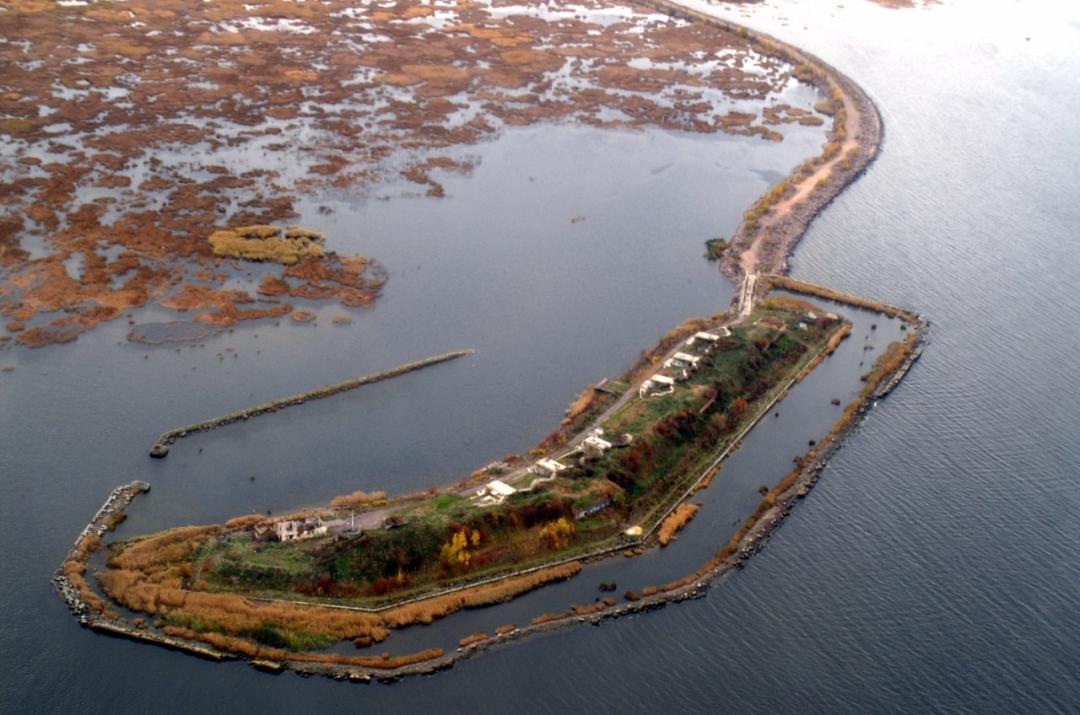
Fort "Krasnaya Gorka" (Alekseevsky)

X8FH+65 Fort Krasnaya Gorka, Leningrad Region, Russia

Fort "Krasnaya Gorka" (Alekseevsky) (renamed "Krasnoflotsky" in 1919) is one of the two powerful coastal forts of the Kronstadt position of the Peter the Great Naval Fortress. It was built between 1909 and 1914 to protect against a possible attack by the fleet of the German Empire. It was part of a strong mine-artillery position that reliably defended the approaches to Kronstadt and Saint Petersburg from the approach of large enemy ships. It was named after the village of Krasnaya Gorka, near which it was located (now the settlement Fort Krasnaya Gorka in the Lomonosov district of the Leningrad region).


Fort "Krasnaya Gorka" (Alekseevsky) (renamed "Krasnoflotsky" in 1919) is one of the two powerful coastal forts of the Kronstadt position of the Peter the Great Naval Fortress. It was built between 1909 and 1914 to protect against a possible attack by the fleet of the German Empire. It was part of a strong mine-artillery position that reliably defended the approaches to Kronstadt and Saint Petersburg from the approach of large enemy ships. It was named after the village of Krasnaya Gorka, near which it was located (now the settlement Fort Krasnaya Gorka in the Lomonosov district of the Leningrad region).


The project was based on the design of the "Russian fort" by K. I. Velichko. The gun positions are connected to each other by underground passages and surrounded by subterranean structures. The vaults of the concrete structures reached a thickness of 183 cm and were equipped with anti-spall coverings made of corrugated iron and I-beams. Ammunition delivery was carried out by railway. The rear of the fort was protected by a powerful belt of field and permanent fortifications, a minefield, wire obstacles, and a moat. Great attention was paid to camouflage during construction—the gun positions were covered by a belt of iron "bushes" painted to match the color of the vegetation.

Construction, under the direction of Major General Apollon Alekseevich Shishkin, began in 1909 simultaneously with Fort Ino (Nikolaevsky) and was completed by 1915. It was named after the village of Krasnaya Gorka (now the settlement Fort Krasnaya Gorka), near which it was located.

The fort became operational at the beginning of 1914. By the start of World War I, the fort's garrison was staffed according to wartime standards (2,000 artillerymen, 2,000 infantrymen, and more than 500 servicemen of other branches). The fort did not participate in combat operations during the world war.

By January 1917, the fort's garrison had grown to 5,500 people. In 1918, due to the proximity of the German army, the fort was mined. The explosion was canceled, but the charges were not removed. On August 19, during a severe thunderstorm, several charges detonated. The powder magazines of three Canet guns and four 254-mm guns exploded. The artillery crew perished, the guns were severely damaged, and one 254-mm gun was destroyed.

During the Civil War, the fort was part of the defensive fortifications of "Red" Petrograd. By this time, the fort had 25 guns ranging in caliber from 76 to 305 mm. During hostilities, it opened fire on the enemy: on November 20, 1918, on the battery "Pummola" captured by the Finns, which had previously been part of the fort Ino's fortification system, and on June 29, 1919, on an enemy transport ship.

On June 13, 1919, during the Northern Corps offensive on Petrograd led by General A. P. Rodzyanko, the fort's garrison raised an anti-Bolshevik uprising, joined by the forts "Gray Horse" and "Obruchev." On June 16, the uprising was suppressed by fire and a landing force from Baltic Fleet ships (more than 600 12" shells were fired at the fort). The insurgents defended themselves by shelling Kronstadt and ships of the Red Baltic Fleet. On June 16, Red Army troops entered the fort abandoned by the insurgents. The White Army could not take advantage of the fort's defection to their side because they learned of the uprising only on the third day—the day it was crushed. The fort's garrison retreated to the Whites.

On October 30, 1919, the fort engaged in an artillery duel with the British monitor "Erebus," which was providing timid and belated fire support by the British Fleet to Yudenich's army offensive.

In 1919, the fort was subjected to strikes by British aviation: from September 29 to November 12, 1919, there were 13 raids (18 airplanes) on the fort's structures, dropping 176 bombs. Minor damage to the fort's internal structures was noted; no hits or damage to the guns were achieved. Two people were killed and 24 wounded in the garrison.

In 1921, the guns of "Krasnaya Gorka" fired on Kronstadt, suppressing the anti-Bolshevik uprising.

During the Winter War in 1939, the guns of "Krasnaya Gorka" fired on Finnish positions located on the opposite shore of the gulf. On February 26, 1940, a Finnish lone bomber "Blenheim" bombed "Krasnaya Gorka."

By late summer 1941, German troops entered the effective firing range of the main caliber artillery of "Krasnaya Gorka," and on August 31, the 12-dm batteries opened fire on enemy troop concentrations near Koporye. In September, the Germans reached the shore of the Gulf of Finland near Strelna, forming the Oranienbaum bridgehead. The fort's artillery range was about 25 kilometers, while the bridgehead's boundaries were approximately 30 km from the fort. The Krasnaya Gorka artillerymen were responsible for securing the fairway—fighting Finnish batteries that could shell Soviet ships and submarines on missions. Thus, two years of continuous combat operations passed. Also, armored trains "Baltiets" and "For the Motherland" ran on the railway tracks around "Krasnaya Gorka."

In the fall of 1943, troop concentrations began on the bridgehead for the complete lifting of the siege of Leningrad. On January 14, 1944, the batteries of "Krasnaya Gorka" opened fire on resistance points in the villages of Gostilitsy and Dyatlitsy. The intense work ended only by January 27, when the encircled Strelna-Peterhof enemy group ceased to exist, and the German-fascist troops were pushed back 65–100 km from Leningrad.

With the threat eliminated in the south, the center of the struggle shifted north—against enemy troops on the Karelian Isthmus. Artillery preparation for breaking through the fortification line on the isthmus lasted from June 9 to 16, 1944. In addition to the batteries, railway transporters TM-1-14 and TM-1-180, brought here from Leningrad, fired on the Finns from the fort's territory. The fort's combat activity ended with these salvos.

The first postwar years were spent restoring the fort's facilities, replacing naval veterans—the 6-dm Canet guns—with modern 130-mm B-13 guns, and installing a radar station at the fort. In 1950, "Krasnaya Gorka" received a new fire control system.

The fort existed as a military unit until the early 1960s, after which it was disarmed, and the guns and equipment were sent for melting. In 1975, a memorial was created at the fort; three guns (100-, 130-mm, and a 6-dm Canet gun) and two railway gun transporters—TM-3-12 and TM-1-180—were installed on the former 6-dm battery. In the early 1990s, the military finally left the fort, and the memorial was looted. The fort itself was also raided by "metal scavengers," who did not even hesitate to dig up the deep underground passages with their armored vaults.

In 2006, the railway transporters and the 6" battery were firmly enclosed by three rows of barbed wire supposedly for demining; everything was dug up, the forest was felled, and now the whole area stands dug up and disrupted. The 6-dm "Canet" was sent to Moscow for melting, the 100-mm gun's whereabouts are unknown.

By 2012, demining of the 6- and 10-dm batteries was completed, and the barbed wire was removed. Now it is possible to walk there. Among the bad news— the mess hall, galley, and club were demolished. The demolition of old barracks has begun.

Sources:

https://ru.wikipedia.org/wiki/Krasnaya_Gorka_(fort)

http://www.nortfort.ru/kgorka/


Follow us on social media

More stories from Kronstadt - a fort fortress

Battery "Prince Menshikov"

XQJ5+Q2 Kronstadt District, Saint Petersburg, Russia

In 1826, a wooden two-tier battery armed with 24 guns was erected at the entrance to the Merchant Harbor. In 1841, it was decided to build a four-tier casemated battery on this site (three enclosed tiers and one open tier). The project was drafted in three weeks by engineer-captain Zarzhetsky. Construction took place from 1843 to 1850. During the construction, the harbor wall and the old battery foundation were reinforced with piles and underwater counterforts. The completed battery was named after Admiral Prince Menshikov, the head of the Naval Ministry.

Alexandrovskaya Battery (Fort Reef)

Kronstadt Highway, 74, Saint Petersburg, Russia, 197761

Fort Reef, the westernmost of the Kronstadt forts, was included in the UNESCO heritage list in the early 1990s and until recently was a closed military facility, which helped it remain relatively well preserved. The fort is not very well studied, and its history still needs to be written. It is known that it first fulfilled its defensive functions more than 300 years ago when Tolbukhin’s soldiers repelled a Swedish landing here. Later, a temporary wooden-earth battery of 11-inch guns was located there, existing until 1890. Most of the existing fortification structures of Reef were built before World War I. Experiments were also conducted here to shell and test the strength of new concrete protective structures for that time, particularly Portland cement.

Northern Battery (Fort) No. 1

2QH4+XV Kronstadt District, Saint Petersburg, Russia

This battery (often also called Northern Fort No. 1) is the largest and most accessible of the entire chain of sea batteries (forts) located north of Kronstadt. Moreover, it is the only one among them completely rebuilt in concrete. It was constructed in 1855–1856 (E. I. Totleben) and rebuilt in 1861–1869 (K. Ya. Zverev). At that time, the island on which the fort was located was connected to Kotlin Island by a dam. This fort underwent its most significant reconstruction in 1899.

Northern Battery (Fort) No. 2

2QHR+9H Kronstadt District, Saint Petersburg, Russia

Built in 1855–1856 (E. I. Totleben), rebuilt in 1862–1867 (K. Ya. Zverev). The fort is still in a relatively preserved condition.

Northern Battery (Fort) No. 3

2RFF+86 Kronstadt District, Saint Petersburg, Russia

Built in 1855–1856 (E. I. Totleben), rebuilt in 1862–1867 (K. Ya. Zverev). During the construction of the Protective Structures Complex, it was incorporated into the body of the dam, and the adjacent territory to the fort was used for sand deposition. When the sand was removed by bulldozers, the fort's structures were damaged. Between 2015 and 2019, the fort was conserved.

Northern Battery (Fort) No. 4 ("Zverev")

2RCX+H5 Kronstadt District, Saint Petersburg, Russia

In 1857, in addition to the five batteries under construction, the construction of two more began, which were named "Battery No. 10" and "Battery No. 11." During the construction process, the numbering of the forts changed, and Battery No. 10 was renamed "Naval Northern Battery No. 4 Fort 'Zverev'."

Northern Battery (Fort) No. 5

2VCF+WH Kronstadt District, Saint Petersburg, Russia

Sample of a stone-earth battery from the mid-19th century. Engineer-General Totleben. Rebuilt by Engineer Major General Zverev in 1864-1868.

Northern Battery (Fort) No. 6

2VHW+2C Kronstadt District, Saint Petersburg, Russia

Northern Fort No. 6 (Naval Northern Battery No. 6) was built during the Crimean War in 1853-1854 by the fortification engineer Totleben and rebuilt in 1864–1869 by Zverev. It has a horseshoe shape with an inner bay. There is a pier with mooring posts. Similar in design to Fort No. 1 South and Northern Forts 1, 2, 3, and 7, the fort had four casemates, each housing two guns. The casemates were located along the front face, which has a slight bend. Like the others, the fort had an earthen rampart and was surrounded by a stone breakwater, forming a harbor on the southern side of the island. The brick casemates, as well as part of the breakwater, have been preserved to this day.

Northern Battery (Fort) No. 7

2WJ9+VJ Kronstadt District, Saint Petersburg, Russia

Northern Battery No. 7 – the closest to the Sestroretsk shore. The structure includes four standard casemated traverses connected by earthen ramparts. During the construction of water protection facilities, the battery was connected to the dam, and a construction equipment parking area was located in its vicinity. In addition, a new pier was built in the harbor, from which a road was cut directly through the earthen rampart. Despite this, the overall degree of preservation here was quite high, and "Number Seven" was for a long time one of the best sites for the possible organization of a coastal defense museum. At present, all metal parts at the Northern Sea Battery No. 7 have been destroyed.

Fort "Pavel 1" or "Risbank"

XPF8+MG Kronstadt District, Saint Petersburg, Russia

Fort "Pavel I" or "Risbank" is a 19th-century architectural monument. It was built to protect Kronstadt from the south and was almost completely destroyed in 1923. This is the story of how one careless sailor caused more damage to the Baltic Fleet than the entire German fleet did throughout the First World War.

Fort "Grand Duke Konstantin"

XPW2+4F Kronstadt District, Saint Petersburg, Russia

Fort "Grand Duke Konstantin" is one of the largest fortification structures in Kronstadt. Built in 1808-1809, rebuilt in 1858-1879 and 1897-1901. On the territory, there are several museums, a hotel, a pier, several bays for yachts, and a yacht-border complex (customs, etc.).

Southern Battery (Fort) No. 1

The 1st Southern Battery is one of the 20 pearls in the necklace of fortifications of the capital of the Russian state. Its construction began in 1856 and took a total of 20 days — from March 2 to 25 according to the old style. Since the forts are located on artificial islands, piles were driven for their creation. The island's mass consists of wooden log structures filled with earth and flooded in a specific order. Daily, 1,600 people were employed in the construction.

Fort "Emperor Alexander I" or Plague Fort

XPQ9+Q3 Kronstadt District, Saint Petersburg, Russia

Plague Fort is one of the long-term structures that are part of the Kronstadt defense system. Its other name is Fort "Emperor Alexander I." The building stands on a small artificial island south of Kotlin Island. Plague Fort was constructed from 1838 to 1845. It was a typical casemated sea fort of that time. It resembles the famous French Fort Boyard, whose construction was completed much later than that of "Alexander I." From 1899 to 1917, it was used as a laboratory for plague research.

Fort "Peter I" or "Citadel"

XPQM+W7 Kronstadt District, Saint Petersburg, Russia

Fort "Peter I" or "Citadel" is a historical and architectural monument of the 18th century. It was created to protect the Merchant Harbor from the south. It is under state protection. It is located near Kronstadt. Peter I, understanding that one Kronshlot was not enough to defend Kronstadt and Saint Petersburg from the Swedes, arrived at Kotlin in May 1705 to place a coastal battery on the island. The construction was overseen by Kruys, and the battery was named Saint John.

Fort "Shants" (also known as Alexandrovskaya Battery, also Alexander and Nikolay Shants)

Kronstadt Highway, 47, Saint Petersburg, Russia, 197761

On the northwest of Kotlin Island, a narrow swampy cape juts forward, commonly called simply "the spit." In 1706, to counter the Swedish fleet, an artillery battery was installed there and surrounded by an earthen rampart. In the mid-19th century, permanent concrete structures were built, the new fort was named Schantz, and powerful artillery was placed in it.

Fort Kronshlot

XPHX+QF Kronstadt District, Saint Petersburg, Russia

On May 7 (18), 1704, Peter I set out from Saint Petersburg to Kotlin Island on several ships. Under his orders, fourteen 6-pounder guns were installed in the embrasures of the fort's tower. Then, Novgorod Metropolitan Iova performed the ceremony of consecrating the new Russian fortress, which was named "Kronshlot" (Crown Castle). This day is now celebrated as the founding day of Kronstadt.

Fort Obruchev ("B" or "Krasnoarmeysky")

3P5C+P6 Kronstadt District, Saint Petersburg, Russia

Fort Obruchev (Fort "B", Fort "Krasnoarmeysky") is one of the northern forts of the Kronstadt fortress, designed by engineer Shishkin. Construction of the fort began in 1896 during the reconstruction of the Kronstadt fortress. The depths here ranged from 2 to 4 meters. Fort "B" was planned to be located 7 km southwest of Fort "A" and 4 km from Kotlin Island.

Fort Porokhovoy or the Gunpowder Cellar of the Naval Department

XRQ7+R9 Kronstadt District, Saint Petersburg, Russia

In Kronstadt, there used to be many powder magazines in ancient times. Both on the island itself, at the forts of the Kronstadt fortress, and on the ships. Throughout Kronstadt’s history, gunpowder explosions happened frequently: due to lightning, careless handling, and as a result of sabotage. Therefore, when they began building the Northern numbered forts, it was decided to construct a powder magazine close to the forts but still far from the city. The entire architecture of the fort fully met the requirements for the safe storage of gunpowder and ammunition: island location, a powerful foundation made of granite blocks, two-meter-thick brick walls, and the most advanced heating and ventilation system of that time. Inside, the “Powder Magazine” is a two-level warehouse, with rooms connected by galleries; on the floor, you can still see the remains of rails along which small wagons were moved—this allowed for the rapid transportation of ammunition within the fort.

Fort Totleben ("A" or Pervomaysky)

3RPX+82 Kronstadt District, Saint Petersburg, Russia

In 1896, a major reconstruction of the Kronstadt fortress began, during which it was decided to build new large artillery forts on artificial reclaimed islands in the Gulf of Finland, northwest of Kotlin Island, between which the Northern fairway passed. One of these was Fort "A," which was constructed according to the design of Captain Shishkin of the Engineering Department on a shoal 10 km from Kotlin Island. The estimated cost of construction amounted to 6,500,000 gold rubles.

Southern Battery (Fort) No. 2 or "Dzichkanets"

XP53+3R Kronstadt District, Saint Petersburg, Russia

Built in 1855–1856 (Totleben, Dering), rebuilt in 1869–1873. By the highest decree on April 7, 1856, this fort was named after the construction leader, many officers were promoted and awarded, and the contractor — first guild merchant Kudryavtsev — was granted the title of Honorary Citizen.

Southern Battery (Fort) No. 3 ("Count Milyutin," "Tower Battery")

XMCW+X6 Kronstadt District, Saint Petersburg, Russia

Fort Count Milyutin was originally named something completely different. The first name was Third Southern, and the second was Tower Battery. The current name was given to the structure by Alexander II himself, who made a personal visit to these places and thus honored the famous Russian general-field marshal Dmitry Alekseevich Milyutin.

Battery (Fort) "Gray Horse"

X6Q8+JX Gora-Valday, Leningrad Oblast, Russia

The "Gray Horse" Battery, from August 29, 1919 — "Advanced" Fort, from 1926 — "Bukharin" Fort, from 1936 to 1953 — "Krasnogvardeysky" Fort, was an anti-landing coastal battery of the Kronstadt position of the Peter the Great Naval Fortress. It was built in 1911 on Gray Horse Cape in the area of the village of Chyornaya Lakhta. The position included two open long-term batteries — on the left flank, a four-gun 120-mm Vickers battery, and on the right, a three-gun 152-mm Canet battery.

Fort Ino (Nikolaevsky)

599F+FW Peschanoe, Leningrad Oblast, Russia

The best military engineers of pre-revolutionary Russia, who created the most powerful fortification in the country on the northern shore of the bay, could not even imagine that its service life would be insignificantly short – about three years. And this very place would become a "supplier" of legends that stir the imagination of descendants.