

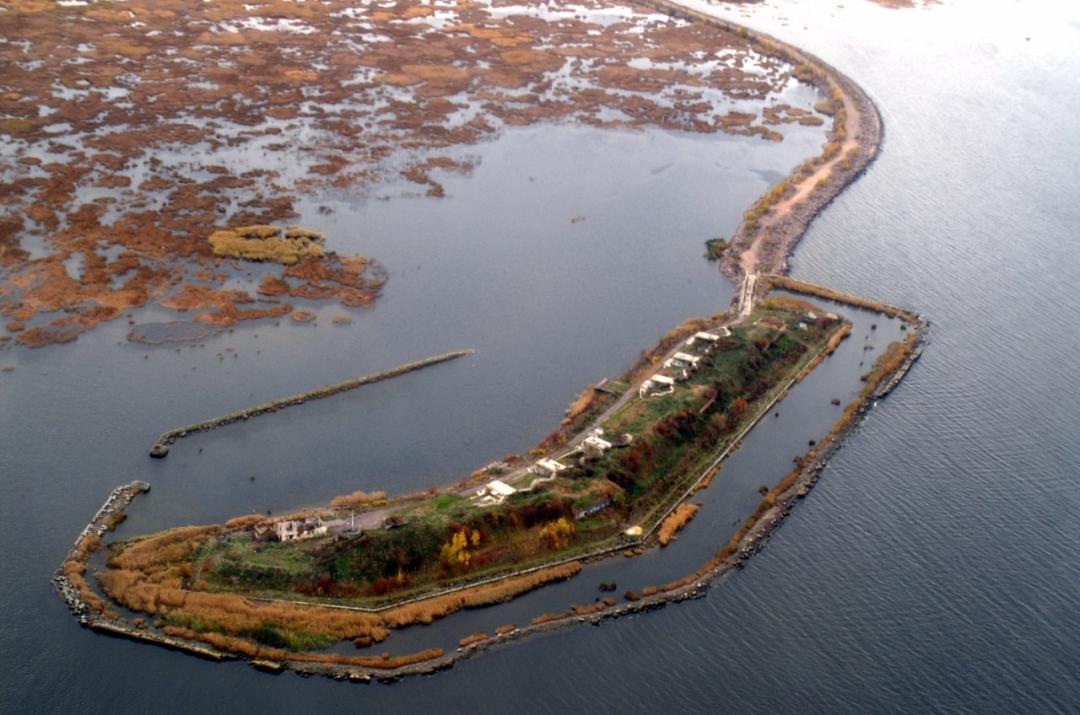
The Northern Fort No. 3 (Northern Battery No. 3) is part of the Kronstadt Forts system – a complex of structures aimed at protecting Kronstadt and the Northern capital from sea attacks. The northern forts include fortifications (batteries) numbered from one to seven, which form a chain of islands along the northern part of the dam, as well as two larger fortress forts, "Obruchev" and "Totleben." Upon completion of these, the northern forts of Kronstadt became the second line of defense for the northern fairway. The numbered northern fortifications were built on a crib foundation with log platforms, on which artillery fortifications were also constructed from logs. (Cribs are log frames filled with soil, forming the base of artificial islands.) In 1863, by order of military engineer Eduard Ivanovich Totleben, all northern fortifications were rebuilt in stone and concrete according to the advanced fortification construction technologies of that time. By the end of the 20th century, the numbered northern forts could no longer withstand enemy long-range artillery, and it became necessary to build new fortifications further from the fortress.
In 1865, new rifled 11-inch guns were specially developed for the northern forts. The guns were ordered and manufactured in Germany at the Krupp factory. Later, between 1862 and 1867, during the modernization of the Kronstadt fortress fortifications, the fort was rebuilt.
The reconstruction work was carried out under the supervision of Zverev. The need for rebuilding the forts arose due to the appearance of new weapons. Initially, like most forts, the 3rd Northern Fort was built using crib technology: wooden log frames filled with cobblestones were driven with piles, then a wooden platform was constructed, on which temporary wooden fortifications were erected.
Later, the wooden structures were replaced with concrete and brick. The 3rd Northern Battery was equipped with 11-inch guns. After the reconstruction in the 1860s, the fort served as a military supplies warehouse.
Access to the fort was by water; the embankment road was built later. The granite embankment, where ships once docked for unloading, has survived to this day. In 1896, the fort was decommissioned and no large-scale construction work was carried out on it afterward. During the Great Patriotic War, the 3rd Northern Fort was part of the Baltic Fleet's air defense system. Machine gun pillboxes from the wartime period have survived to this day – in front of the fort’s facade, protecting against enemy boats and landings. On one of the pillboxes, the inscription "Kronstadt Fortified District" can be read.
The fort’s batteries have two floors: the lower floor housed powder magazines, and the upper floor contained three large casemates for guns and ammunition. The casemates were additionally protected from the rear by a moat.
It is possible to access the fort from the dam side; the fort is currently a coastal structure.
During the construction of the Kronstadt defensive structures, the fort became part of the dam, and sand and building materials were stored nearby. Heavy bulldozers operated in the area, which negatively affected the fort’s condition. Some buildings are damaged and covered with sand.
In 2013, a restaurant called "Landskrona" was opened on the territory of the 3rd Northern Fort, but it is now closed. There are plans for conservation and large-scale restoration of the fort, but so far no work has begun, although the fort has been fenced off.
The sandy beach near the fort is a decent beach and a favorite summer recreation spot for city residents.
Sources:
https://nafort.ru/fort_3N.html




Written by Jermaine
Discuss this with the author and others
No comments yet. Be the first to start the conversation.