

Design and construction of the northern island batteries were carried out taking into account the experience of the Crimean campaign, during which Anglo-French forces captured the city of Sevastopol and destroyed the entire Russian fleet in the Black Sea. At the same time, the Anglo-French squadron under Admiral Napier blocked the sea approaches to Saint Petersburg. Although the Kronstadt forts existing at that time were quite outdated, Napier did not dare to run the squadron under the fire of the forts, limiting himself to a naval blockade. But the danger of such a breakthrough remained, and in the winter of 1855-56, on the practically unprotected Northern fairway, the construction of five batteries on artificial reclaimed islands was started “with the greatest haste.” However, the war soon ended, but the construction of permanent forts continued.
In 1857, in addition to the five batteries under construction, two more were started, named “Battery No. 10” and “Battery No. 11.” During construction, the numbering of the forts changed, and Battery No. 10 was renamed “Naval Northern Battery No. 4 Fort ‘Zverev.’” The fort was named after one of its builders – engineer major general Zverev. Construction was carried out using a technology already developed at that time – in winter, wooden frames called “ryazhi” were built on the ice of the gulf and filled inside with stone. As the ice melted, the ryazhi sank to the bottom, forming an island. The gaps between them were filled with stone and reinforced with piles. Materials for construction were delivered in winter over the ice by sledges, and in summer by barges. One can only marvel at the grandeur of the manual labor of thousands of soldiers and fortress workers, as a man-made island rose above the waves of the Gulf of Finland. History has not preserved the names of the ordinary participants nor the names of the victims, who surely existed in such a grand construction. Workers lived in barracks set up on the ice in winter, and in summer – directly on the ryazhi, surrounded by the sea. Incidentally, the choice of the construction site was not accidental – the future fort was located on the eastern edge of the Northern fairway, so in case of an enemy fleet breakthrough attempt, the main blow would fall on Fort Zverev. The island was built directly on the hull of a frigate sunk three years earlier – the last among other ships deliberately scuttled on the Northern fairway to block enemy ships’ passage.
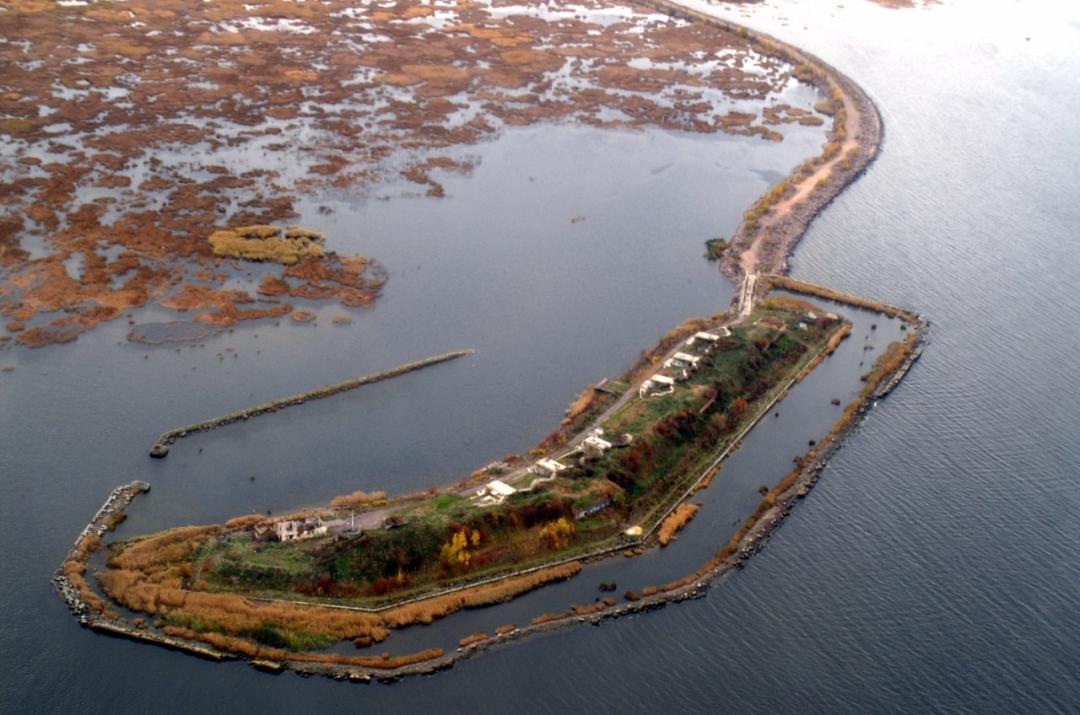
The island grew. Unlike its older numbered counterparts, the fort had a different configuration and a larger surface area of the island. The T-shaped form allowed the guns to be installed so as to fire not only frontally but also flanking, which significantly increased the fort’s combat capability. The design and construction of the new forts were led by a talented fortification engineer, hero of the Sevastopol defense, General-Adjutant Count Totleben. The construction was personally supervised by Emperor Alexander Nikolaevich, who repeatedly visited the forts under construction.
Above the island’s surface rose brick casemates faced with granite. In three frontal casemates connected by a common earthen parapet, six 11-inch guns were placed, forming the fort’s main armament. For flanking fire, six 8-inch rifled and four 10-inch smoothbore guns were located in the side galleries of the gorge section. Also, in accordance with the then theory of naval warfare (which proved itself in 1877 on the Danube, when a single mortar shell sank the Turkish corvette “Lufti Jalil”), two batteries of 6-inch mortars, five guns each, were created for indirect fire, placed openly behind the parapet. For its time, the fort represented a very formidable combat force. Attention was also paid to the quality of architectural finishing, as evidenced by the partially preserved cornices, pedestals, parapets, and cast-iron fences that remain to this day. It is clear that the builders valued not only the functionality of the structure but also cared about its aesthetic aspect. On “Zverev,” asphalt was successfully used for the first time in Russia as a construction material – the floors of the barracks were poured with it as an experiment.
In the gorge section, on the pier, a cast-iron crane from the Berd factory with a lifting capacity of 19.2 tons was installed for loading ammunition and other heavy cargo from approaching ships, incidentally the only one preserved to this day. Like the forts contemporary to “Zverev,” the island was surrounded by a stone ring mole, in which the builders left two passages for ships to enter the harbor formed by this mole. By 1868, the construction of the fort was fully completed. Even now, a century and a half later, one is amazed by the meticulous finishing and facing of the casemates and the grandeur of the almost entirely manual labor performed.
Naval armament developed, and by the late 1870s, the fort, due to its design and especially the casemated artillery arrangement with a very narrow firing sector, no longer met modern requirements. To install heavier guns, the island was enlarged by dumping stone around the perimeter and reinforcing it with piles; the embrasures of the frontal casemates were bricked up, and the entire front facade was covered with earth, thus turning the artillery casemates into ammunition storage for the new guns. The galleries in the gorge section were also deprived of guns and converted into living quarters for the personnel. The artillery armament, consisting of 11-inch Krupp rifled guns, was moved to the parapet. Later, production of such guns was mastered by the Obukhov plant, and most forts were armed with domestically produced guns. Rangefinder pavilions for “Petrushevsky indicator devices” were also built on the parapet. However, by the beginning of the 20th century, the old fort again required rearmament. Its design no longer met the demands of modern warfare. In 1901, the fort’s armament was dismantled, additional buildings were constructed on the territory, rail tracks were laid, and a naval mine depot was organized. The exact armament of the fort at the beginning of World War I is not precisely known. Having never fired a shot at the enemy, the fort survived the upheavals of the world war and the 1917 revolutions. Whether there were any disturbances among the fort’s garrison during the revolutions is unknown. It is known that by early 1918, the fort’s armament consisted of only two 120-mm guns. With such armament, the fort became part of the Karelian sector of the Petrograd defensive group of troops. Also, due to increased combat readiness of the fortress, wire obstacles were installed. At that time, there was indeed a real danger of the forts being stormed by White Guard or White Finnish troops.
On February 28, 1921, the fort’s garrison joined the Kronstadt fortress garrison, which appealed to the working people of Russia, directly accusing the Bolsheviks of betraying the revolution’s cause. In Kronstadt, the most prominent party leaders were arrested, and mass resignations from the party by ordinary members began. This episode entered history as the “Kronstadt Rebellion.” The fort participated with its artillery in repelling several assaults on Kronstadt by government troops, but on March 18, as a result of more thorough preparation of the assault, the fort was taken by units of the 7th Army, apparently without serious resistance. The fort’s commander and the numerical strength of the garrison are unknown, but apparently the garrison was quite small.
Already in 1922, the fort underwent rearmament again, and its firepower consisted of four 120-mm guns. In 1923, the battery commander was appointed party commissar Kabanov – later a general and commander of the heroic garrison of the Hanko Peninsula in 1941. Kabanov shared his first impression of the fort in his memoirs: “...An hour later, on the artificial granite islet in the gulf, barely having looked around, I introduced myself to the battery commander. Barely listening to me, he said: ‘Here you will live. In this casemate. Once there was a smoothbore gun here, loaded from the muzzle. Now this is your cabin.’ First of all, he showed me the fort: its cramped inner courtyards behind a granite arch with copper letters on the stone ‘Battery No. 4, Zverev, 1857,’ which, however, left me indifferent – I was not strong in Russian military history at that time; its squat gloomy barracks; its blind, windowless, elongated combat magazine buildings hidden from prying eyes under an earthen parapet – we went into these magazines, where shells of calibers unknown to me lay in exemplary order. On the parapet stood four beautiful guns on pedestals, protected by thick armor shields. Novikov explained to me that these were 120-mm caliber naval guns with Vickers system breechblocks, exactly like on the new battleships. That was my first visual impression of the naval forts, received that October morning of the twenty-third year...” Service conditions at the forts were quite difficult. According to Kabanov’s recollections, even he – the commander – could not get away to Kronstadt for a few hours for the first time in several months, and the rank and file had no chance – only service, service, service... It is characteristic that almost all memoir authors, sharing their first impression of the fort, call it a “prison,” that is, apparently, the fort made a very oppressive impression on all newcomers.
In the mid-1930s, the fort was additionally rearmed – on its left flank, a battery for four 76-mm universal anti-assault guns was erected; on the right flank, a four-gun anti-aircraft battery was built; three permanent firing points for three machine guns each were constructed, as well as three command posts – for the three batteries, respectively. In one of the casemates, a central post was equipped, connected to the command post of the 120-mm battery by a vertical communication shaft. In winter, the fort’s garrison performed border functions, patrolling the assigned section of the frozen gulf.
With the start of the Soviet-Finnish war, the fort was put on high alert. It is known that the artillery of the forts participated in the artillery preparation of the Soviet troops’ offensive on the Karelian Isthmus, but whether the “Zverev” battery fired is not precisely known.
At the beginning of the Great Patriotic War, part of the fort’s guns were dismantled for sending to the front, and the armament again consisted of the same four 120-mm guns. Soon, the 120-mm guns were replaced by the same number of newer 100-mm guns. The battery was named the 153rd battery of the 15th separate artillery battalion. No data on the garrison’s numerical strength for this period has been found; it is only known that the officer staff consisted of four people – battery commander Senior Lieutenant Malaev, commanders of the fire platoon and control platoon, and the medical instructor Senior Lieutenant Lupanova. For the first time, the fort’s guns fired at a real enemy, fulfilling requests from the land front. Fire was directed not westward, where the fort was oriented to fight the enemy fleet, but in the opposite direction – at German units in Peterhof and Strelna. Correction posts with direct telephone communication with the battery were deployed on both shores of the gulf. During the war, the battery also fired at concentrations of Finnish troops on the Karelian Isthmus and later actively participated in the preparation of the Krasnoselsko-Ropshinsk and Vyborg offensive operations.
In winter, several rows of wire obstacles were installed on the ice in front of the line of forts. To the south of the forts ran the “Ice Road,” connecting Kronstadt with Lisiy Nos. The fort’s garrison also patrolled along the wire obstacles and the assigned section of the “Ice Road.” According to some reports, it was here on January 29, 1943, that a passenger car driving off the road fell through the ice hole; among the five passengers was the commander of the Baltic Fleet squadron, Vice Admiral Drozd, the legendary “Don Ramon” of the Spanish Republican fleet. Only the driver survived. This story remains quite mysterious to this day... The only “floating” admiral of the Baltic Fleet Command, who personally directed combat operations of the Light Forces Detachment from ship bridges, died absurdly in an ice hole due to a driver’s error, who lost the marked route. There was a rumor that the admiral was deliberately eliminated after he, conducting his own investigation of the Baltic Fleet tragedy, which had no equal in power in the Baltic, directly accused Admirals Tributs and Panteleev – that is, the fleet commander and his chief of staff – of treason.
After the end of the Great Patriotic War, the fort remained on combat duty, conducting training and practical firing exercises; the fort’s garrison consisted of 50 people with four officers.
“Zverev” remained in service longer than its counterparts – equipment was removed from other northern numbered forts in the late 1940s to early 1950s, while “Zverev” maintained combat readiness until 1953, when the equipment was mothballed and partially removed, and a small “garrison” of five people remained to guard the fort. When the equipment was completely removed and the fort abandoned to the mercy of random visitors is not exactly known; presumably, this happened in the early 1960s. Possibly, military warehouses were located there for some time.
When were the fort’s premises disfigured by fire with such force that no temporary changes can hide the consequences of this grand fire? One witness names the summer of 1978, when the fort burned repeatedly over several months. According to some claims, by that time the fort was used as a dump for spent fuel and lubricants, as well as decommissioned ammunition. Allegedly, this was how (by burning) all this was disposed of, so according to this version, the fire was controlled. According to another version, bilge water from ships heading to Kronstadt for repairs was drained into the fort’s cellars, after which someone set it on fire. There is also a third version – high-temperature phosphorus-containing mixtures, pyrogels, were tested there.
The first version is quite realistic, especially considering the attitude toward historical monuments in our country, and the attitude of servicemen toward these monuments in particular. However, this version exists only on the basis of rumors and assumptions, and we have no facts confirming or refuting it.
The second version was officially voiced by recognized specialists on Kronstadt forts. In most sources devoted to this issue, this version is presented as the only one. But some facts cast doubt on this scenario – primarily the volume and nature of the destruction. In no ordinary household fire, even a very strong one, does brick melt, hanging like icicles, and flow like molten lava! Ceilings and walls collapse, iron turns to ash, but brick does not turn into glass! This requires a fairly prolonged temperature of at least 1800 degrees Celsius. (The melting temperature of brick, depending on the grade, ranges from 1800 to 2500 degrees.) For comparison – the combustion temperature of pure gasoline is 1100 degrees, not to mention dirty bilge water, which, if it burns at all, will most likely burn at a minimum temperature of 600 degrees, releasing a large amount of waste in the form of smoke, soot, and soot deposits.
Finally, the third version is quite realistic. Could new types of weapons have been tested there? Quite possibly, considering that nearby is Fort No. 6, still on the balance of the Research Institute “Gidropribor,” which was engaged in the development of naval weapons – mines, torpedoes, rockets, depth charges. This institute had a whole fleet of special vessels for weapons testing, and the fort housed workshops and laboratories, presumably for safety reasons, while the institute itself was located in Leningrad. Theoretically, nothing prevented the institute’s staff from conducting these very tests at the neighboring fort. Applying the “temperature” theory used above, one of the few substances capable of producing a temperature of 2300-2700 degrees in a short time was thermite mixture. The temperature indicated is for industrial thermite used in welding works. Possibly, combat substances based on thermite mixtures can produce an even greater destructive effect.

As a result, a significant part of the fort’s premises was destroyed due to an intense volumetric thermal effect, during which the brick walls turned into glass, and streams of this molten lava flowed through corridors and casemates, then solidified into various bizarre formations. In the end, an architectural and fortification monument was practically destroyed; the right-flank and central casemates, as well as the left-flank gallery, were literally burned to ashes. At the cost of incredible efforts and sacrifices, ruining their health and lives during construction, people erected this grand structure in the middle of the sea, and people destroyed it a hundred years later. Or rather, began to destroy it.
The remaining destruction was finally completed by scrap metal collectors in the 1980s, who cut almost all the metal from almost all Kronstadt forts; “Zverev” did not escape this fate either.
The fort has been one of the UNESCO World Heritage cultural sites since 1990.
Sources:
http://boat.ucoz.ru/publ/fort_quot_zverev_quot_prokljatoe_mesto/3-1-0-38
https://culttourism.ru/saint-peterburg/kronshtadt/severnyy_fort_4_zverev.html




Written by Jermaine
Discuss this with the author and others
No comments yet. Be the first to start the conversation.