


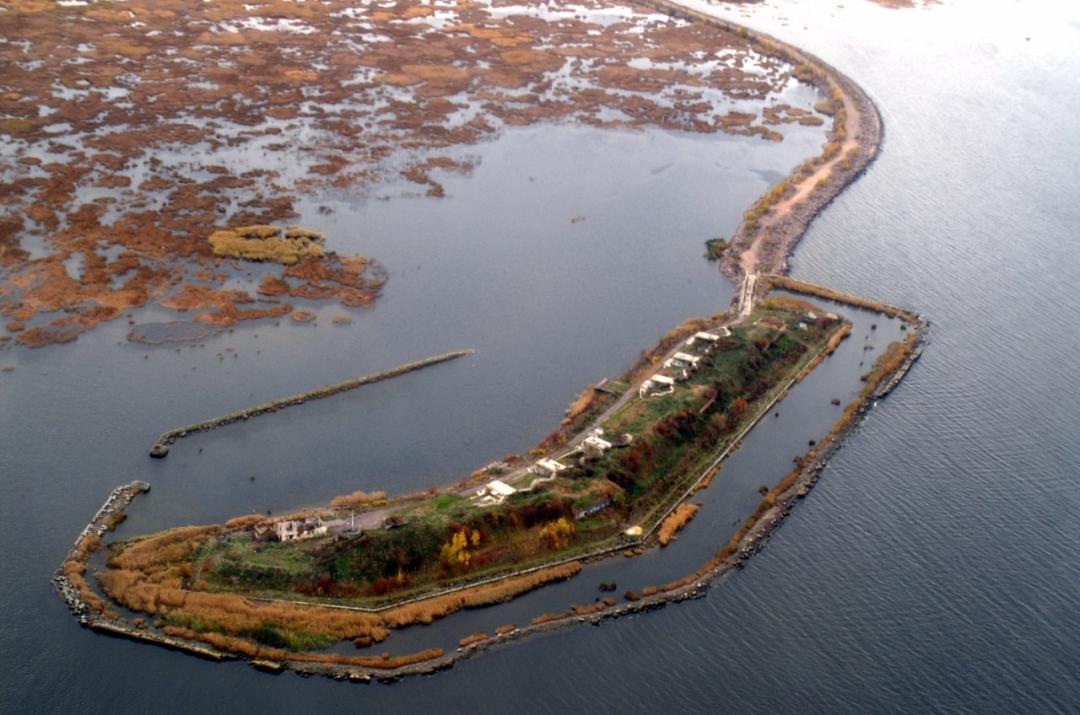
Fort No. 2 (Southern Battery No. 2 — "Dzichkanets"). Built in 1855–1856 (E. I. Totleben, Dering), rebuilt in 1869–1873. By the highest decree on April 7, 1856, this fort was named after the construction leader, many officers were promoted and awarded, and the contractor — a First Guild merchant Kudryavtsev — was granted the title of Honorary Citizen.

The builder of the sea batteries was appointed commander of the Northern Engineering District, Engineer Major General Iosif Gedeonovich Dzichkanets. The enormous contribution of this man was duly recognized, and on April 7, 1856, by the highest decree, the 2nd sea battery was named "Dzichkanets." The entire fort consists of just one building with casemates, three gun rooms inside, and a powder magazine in the form of a separate structure under an earthen rampart.
The construction of this fort, like all the others, is connected with the Crimean War. After the defeat, Russia urgently began strengthening the approaches to the capital, where an enemy squadron tried to break through but was stopped by the fire of the already existing forts Pavel and Alexander. The Gulf of Finland was completely blocked by a barrier made of piles driven into the bottom, thus creating an underwater fence, and behind the piles, artificial islands were placed close to each other, on which artillery guns were installed. They were built in 1855-57, then rebuilt and rearmed later. The fort was especially reinforced during the next wave of unrest in Poland in 1863, when there was fear that European countries might want to intervene and declare war on us, so the capital was additionally fortified again.
Initially, the battery was just an earthen rampart with wooden houses for the personnel, but in 1870 brick casemates appeared, which have survived to this day. The fort was equipped with 8 guns, which was quite a lot for such a small island. However, the guns were smaller than those in 20th-century fortresses, so placing them closely was not difficult. By the 1890s, the fort already had 21 guns.
At the beginning of the 20th century, the 2nd Southern Fort was considered too outdated; naval artillery was already firing much more powerful shells that could destroy such structures. The fort was disarmed and began to be used as a warehouse.
During the war, the fort was part of the Kronstadt air defense system. After the war, there were 3 guns stationed here, and in 1957 the fort was finally disarmed.




Written by Jermaine
Discuss this with the author and others
No comments yet. Be the first to start the conversation.