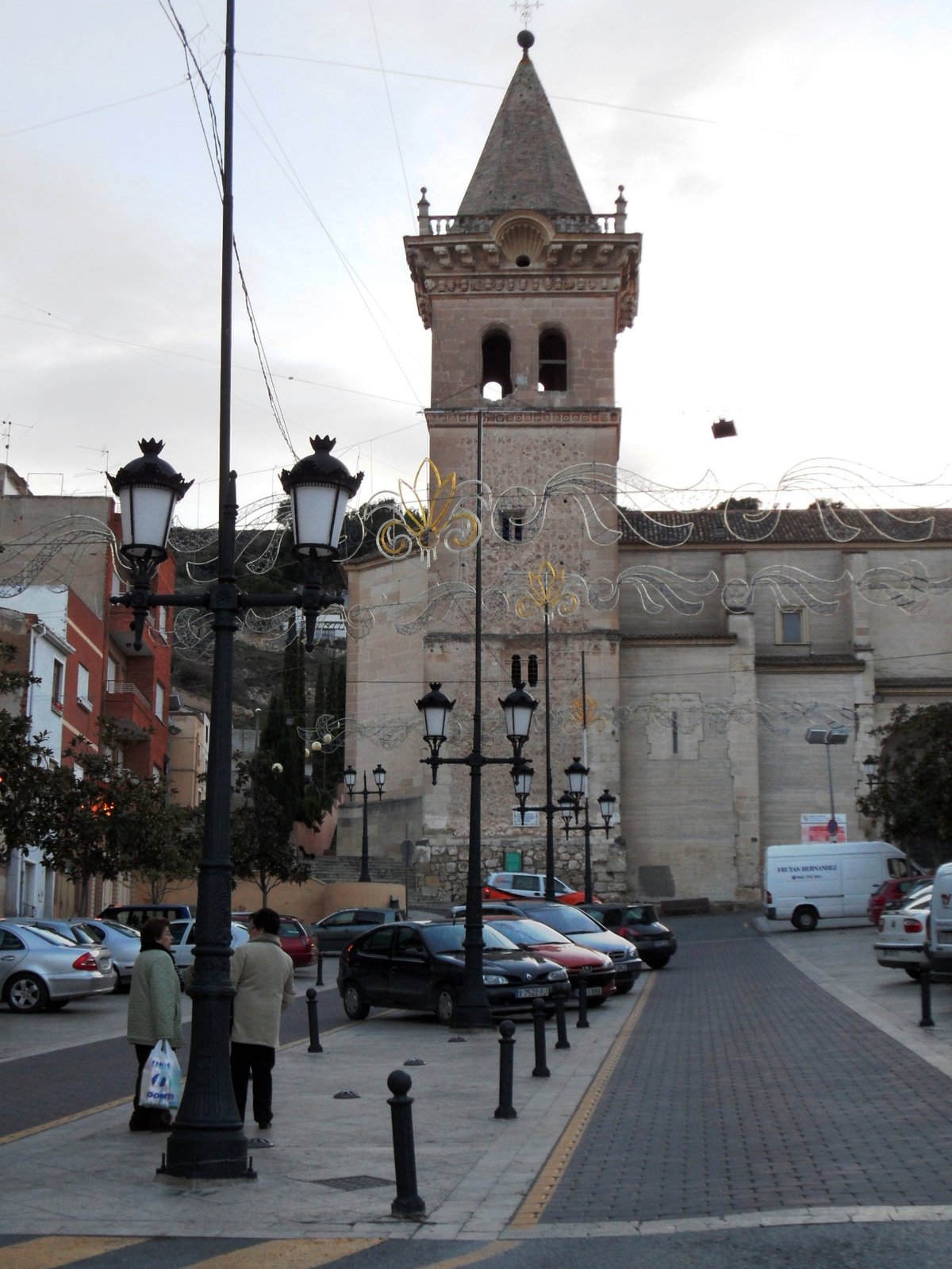

The Iglesia de la Asunción, or more commonly Iglesia Vieja, was a church consecrated in 1540 in the Spanish town of Yecla. It fell into disrepair during the Spanish Civil War, but was rebuilt in the 1980s.
The Gothic and Renaissance building is most notable for a mysterious statue on top of the tower. The statue, which is traditionally said to represent the Virgin Mary, is carved from red stone. However, this is not its most striking feature.
For origins of this statue, we must return to the beginning of the church's construction, in the mid-16th century. Then, the bell that sits atop the tower was a sacred artifact. The bell was forged to ward off the Spanish invaders, who were encroaching upon the southern parts of the Iberian Peninsula. The priests who presided over the construction had it transported from the nearby region of Valencia, and to this day the mechanism that raised the bell is still preserved in the church.
However, the invaders never came. In the years that followed, the church continued to be used by the people of Yecla, as seen in the dueling Gothic and Renaissance architecture. By the late 18th century, the church had become the target of anti-clerical sentiment, echoing the strife between Catholics and Protestants in the rest of Europe. The church was eventually desecrated and abandoned.
It was not until 1936, during the Spanish Civil War, that the church was sacked and burned. The building lay in ruins until the 1980s, when it was restored under the leadership of regional architect Andrés Terol.
And so, the story of the bell and the stone statue atop the tower of Yecla's church remains a fascinating mystery. The only certainty is that the iron ball, for reasons unknown, has retained its place atop the church since the days of Valencian blacksmiths.
Sources: Wikipedia, OpenStreetMap, Wikidata, Wikimedia Commons
Written by Nicolo Ciampini
Discuss this with the author and others
No comments yet. Be the first to start the conversation.