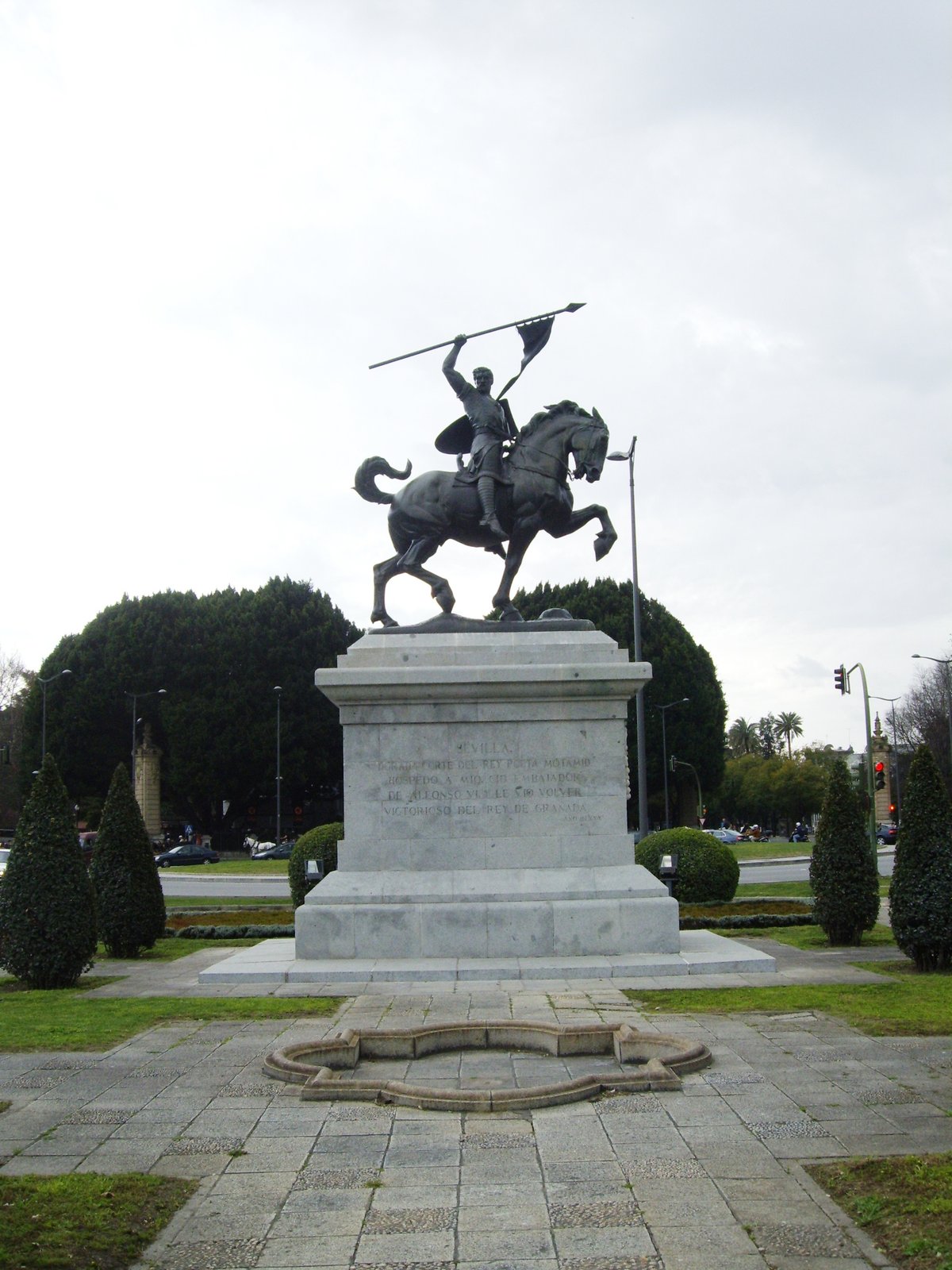

In 1929, the Hispanic Society of America bestowed a gift upon Spain: a statue of the legendary hero, El Cid Campeador, atop his horse, Babieca. Commissioned and funded by the Hispanic Society, the work was the creation of American-born artist Anna Hyatt Huntington. Today, this statue, located next to the Plaza de San Diego in Seville, was unveiled during the Ibero-American Exposition of 1929. The inspiration for this gift originated from the relationship between the Hungtington family and some organizers of the exposition, such as Vicente Traver and the sculptor Mariano Benlliure.
In December 1927, the Seville City Council enlisted Benlliure to determine the statue's location. The statue was perched atop a stone pedestal, designed by the architecture Aníbal González, and inaugurated in the presence of King Alfonso XIII. The statue, a reproduction of a prototype crafted by Huntington in 1927, is now housed in the Brookgreen Gardens in South Carolina.
The statue has been recreated in various locations, including Balboa Park in San Diego, Lincoln Park in San Francisco, and a street in Buenos Aires. In 1964, the Hispanic Society of America commissioned Spanish sculptor Juan de Ávalos to forge a copy of the statue, which now resides in Valencia. The pedestal base commemorates the relationship between the Cid and Seville.
Despite being created more than 90 years ago, the statue found a modern interpretation in 2013 when artist Olek crocheted it, with the assistance of the Seville City Council.
Sources: Wikipedia, OpenStreetMap, Wikidata, Wikimedia Commons
Written by Nicolo Ciampini
Discuss this with the author and others
No comments yet. Be the first to start the conversation.