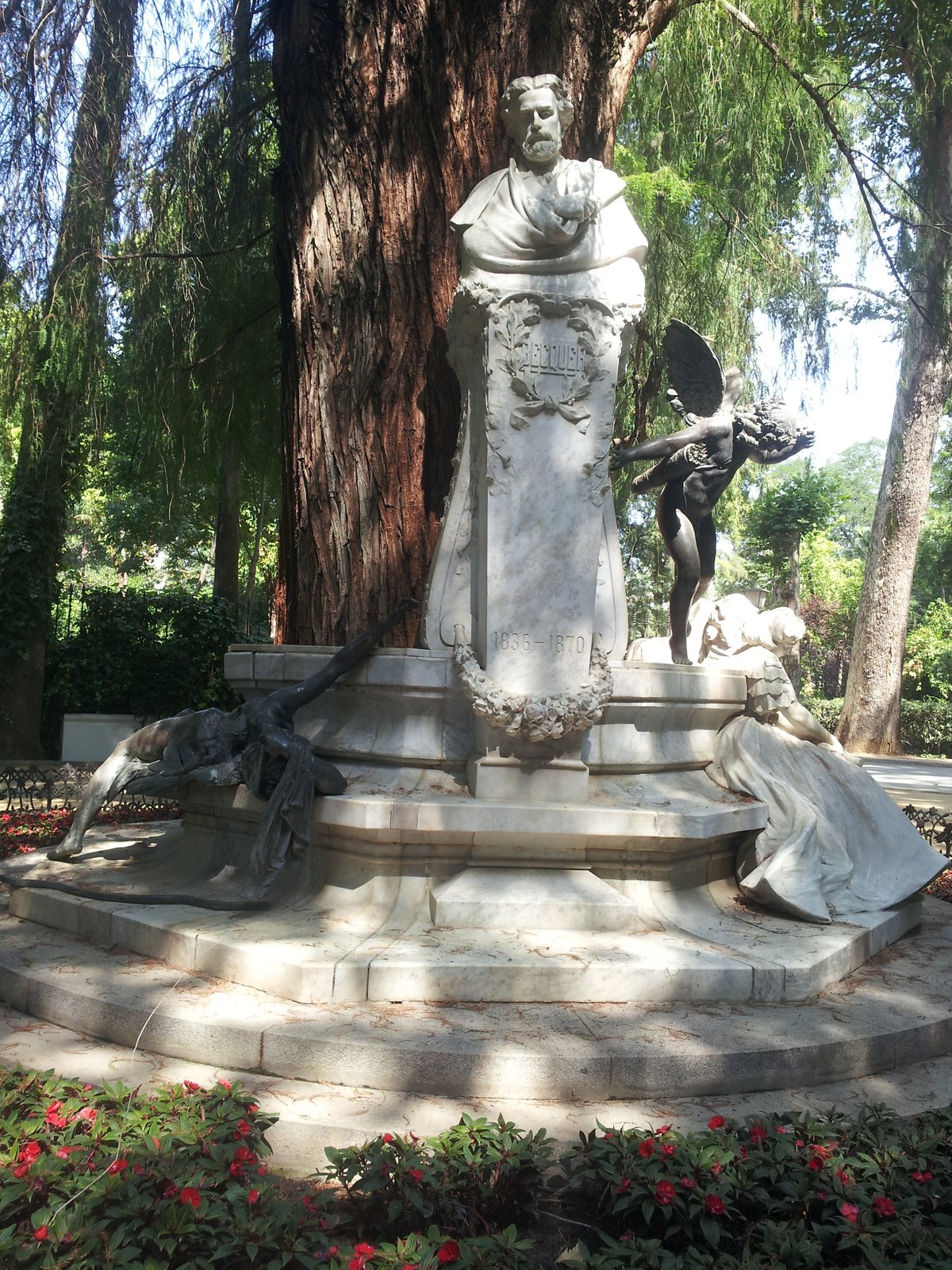

Set around a cypress tree, the Glorieta de Bécquer becomes a stage for a marble and bronze homage to the bard Gustavo Adolfo Bécquer, sculpted by Lorenzo Coullaut-Valera in 1911. The monument features a central marble bust of Bécquer, ensconced on a pedestal emblazoned with his name and dates of birth and demise.
A set of three women seated on a marble bench accompanies the bust, symbolizing love that arrives, present love, and lost love. The first woman, the youngest, shows a flush of anticipation, while the second shows the fullness of love, and the third appears to suffer from melancholy. These figures recall Bécquer's Rima X. Two additional bronze figures represent wounded love, or Eros, and love that wounds, or Cupid.
Historically, the brothers Serafín and Joaquín Álvarez Quintero planned the monument in 1910, financing it with profits from their play La rima eterna. The sculpture was worked on in workshops in Barcelona before being installed in Sevilla. While the monument remains a tribute to the poet, a nearby niche for books was destroyed by vandalism in 2022.
Sources: Wikipedia, OpenStreetMap, Wikidata, Wikimedia Commons
Written by Nicolo Ciampini
Discuss this with the author and others
No comments yet. Be the first to start the conversation.