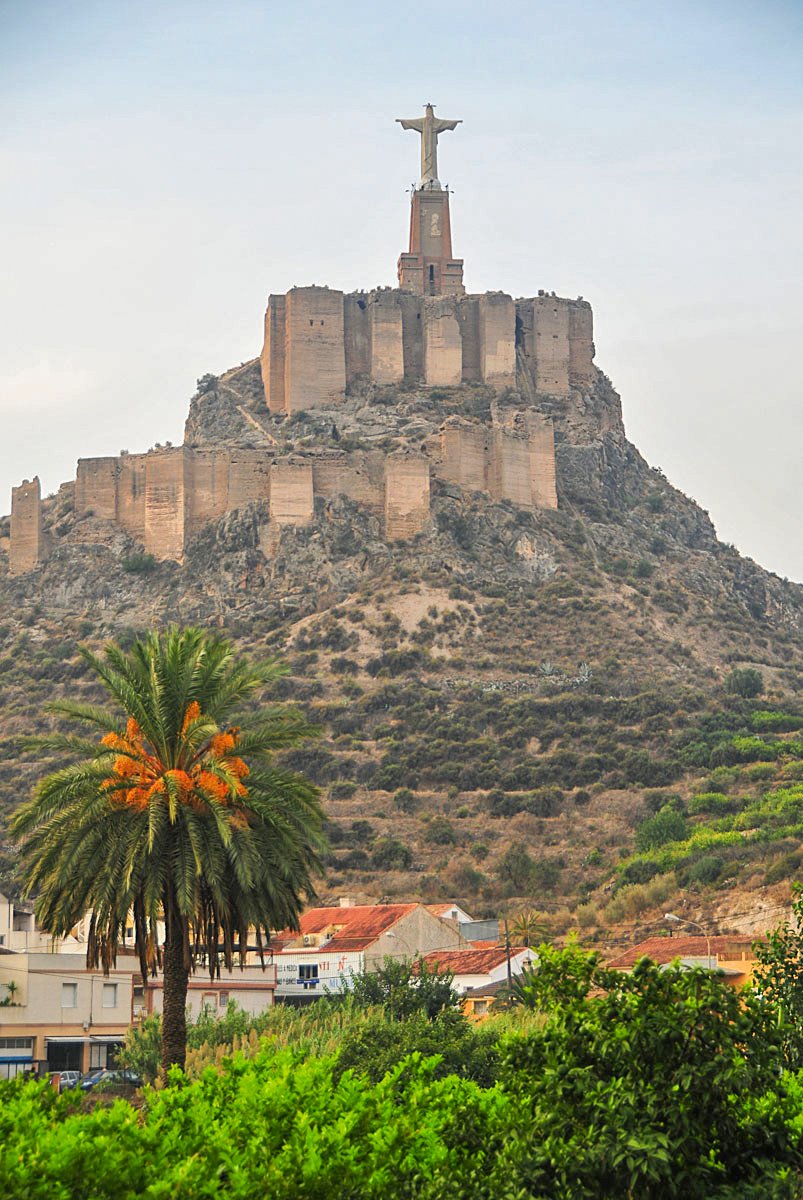

The Castle of Monteagudo is a historic castle located 5 kilometers northeast of Murcia and 18 kilometers southwest of Orihuela, in the Region of Murcia, Spain. It is situated on an impressive rocky promontory that stands 149 meters above the sea level, dominating the entire Huerta de Murcia. Its strategic location makes it a landmark of the prelitoral depression of Murcia. The castle's origins date back to the Islamic period, with the first references to it dating back to 1078-1079.
In the time of Ibn Mardanis, the castle acquired its current structure. Alfonso X the Wise, King of Castile, located his Murcian residence at Castle of Monteagudo. The addition of Orihuela to the Kingdom of Denia made Monteagudo the fortified spearhead of the first Muslim kingdom of Murcia on its northeastern border. During the second period of the Taifa of Murcia, the Mardanisí, during the 12th century, Monteagudo was part of an important architectural complex along with Ibn Mardanis' recreational Alcázar, Qasr Ibn Sad, and the fortification of Larache.
In the 13th century, before the Christian conquest, poet Hazim al-Qartayanni sang of its verticality contrasting with the vast plains of the Vega del Segura in his work Qasida maqsura. The castle of Monteagudo has two concentric walled areas at its top. The upper recinct is rectangular with cubic towerones defending the walls and contributing to structural strength due to the irregular terrain. The upper recinct is divided into two sectors: a plaza de arms and another to the north with multiple rooms and amenities. The main entrance to the upper recinct is marked by a typical arch.
Sources: Wikipedia, OpenStreetMap, Wikidata, Wikimedia Commons
Written by Nicolo Ciampini
Discuss this with the author and others
No comments yet. Be the first to start the conversation.