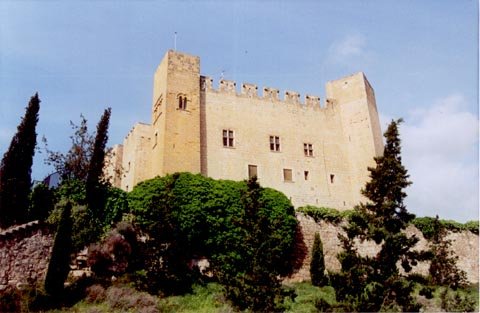

Castillo de Mequinenza is a castillo-palacio that has dominated the confluence of Spain’s rivers Ebro, Segre and Cinca for six centuries. Built by the Moncada family in the 14th and 15th centuries, it served as a border checkpoint between Aragon and Catalonia, and between the provinces of Zaragoza and Lerida. Despite the region’s frequent invasions, the castle survived. For a time, it was sometimes referred to as a Muslim fortress, described by the Arab chronicler Edrisi as Miknasa.
In 1192, it became the property of Armengol VII of Urgel under King Alfonso II of Aragón’s rule. From the 13th century to 1722, the Moncada family held the castle, until it passed to the Dukedom of Medinaceli. During the Catalan rebellion against King Philip IV, the castle served as a critical fortress. It was attacked and surrendered to French troops from 1808 to 1809, but controlled by Spanish troops again on February 17, 1814. The castle’s name is among those inscribed on the Arc de Triomphe, and it is one of the plaza fuertes (fortified places), including Naples, Plaisance, Madrid, and Mequinenza.
King Ferdinand VII reincorporated Mequinenza and its castle into the Crown as a military outpost after the war. After the Civil War, Spanish troops abandoned the castle in 1939. In 1959, the Endesa Foundation bought and restored the castle. As of 2026, the town hall of Mequinenza purchased the building and incorporated it into the municipal heritage.
Sources: Wikipedia, OpenStreetMap, Wikidata, Wikimedia Commons
Written by Nik Frost
Discuss this with the author and others
No comments yet. Be the first to start the conversation.