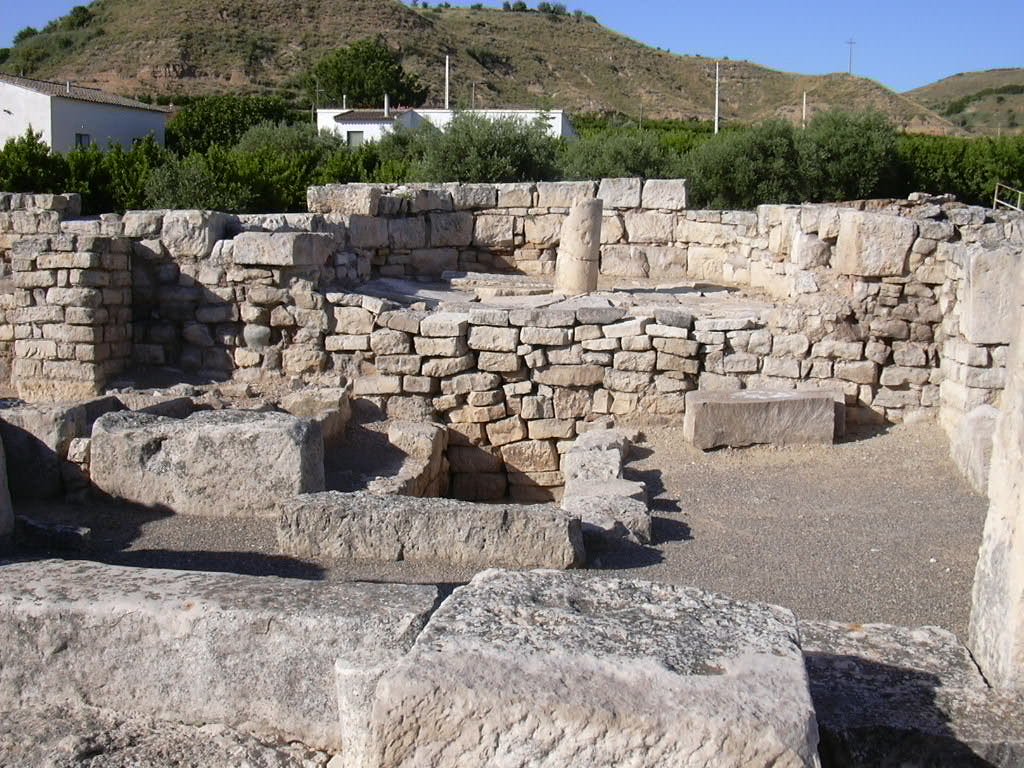

Villa Fortunatus, a Roman rural villa, only its ruins remain. Located on the banks of the river Cinca in Spain's Huesca province, the villa is one of the most important examples of rural Roman architecture in Aragon. The villa's construction can be traced back to the 2nd-4th centuries AD. The western wing (6) is the oldest part of the villa, while the late 3rd and early 4th centuries saw its expansion, connecting the new part with a stairway as it was higher.
The villa has a square peristyle measuring 20.5 x 17 meters (1). The central garden, 350 square meters, has an aquarium (2), decorated with marine frescoes, and a well (3). The owners' quarters were located in the western wing (6), while the public area of the villa, used for receptions and parties, was located in the southern wing (4). The eastern area had the baths and latrines (9). The villa was decorated with mosaics, some of which date back to the 4th century AD.
A mosaic with the name FORTV - NATVS gives the villa its name. The interpretation of the text FORTV - NATVS is a topic of ongoing debate. The mosaic FORTV - NATVS is a large fragment of the upper third of a frieze found in a 5.85 x 4.70-meter open room on the southern peristyle (4). The agricultural calendar found in the south gallery is mainly preserved in the Museum of Zaragoza. The mosaic of the exedra represents a jar with ondulating branches, pots, and bunches of grapes.
In the 6th century, a paleocristian basilica (A) was built on the western wing of the villa. The basilica follows a three-nave plan and ends with a semicircular interior and square exterior apse (B). At the basilica's feet, there is a baptistery (C) with a basin surrounded by four columns. An altar votive Roman altar is found beside the baptistery. The villa is located near the Iberian site of Santa Quiteria, excavated by José Salarrullana at the end of the 19th century.
J. Serra directed excavations on the villa from 1926 to 1939. The villa was further studied by the University of Barcelona in the late 1980s. In 2009, the Diputación General de Aragón spent 1.2 million euros on covering the site to protect the remains. M. Ángeles Magallón Botaya and others wrote 'La romanización' in the book 'Fraga en la antigüedad' in 1992.
Sources: Wikipedia, OpenStreetMap, Wikidata, Wikimedia Commons
Written by Nik Frost
Discuss this with the author and others
No comments yet. Be the first to start the conversation.