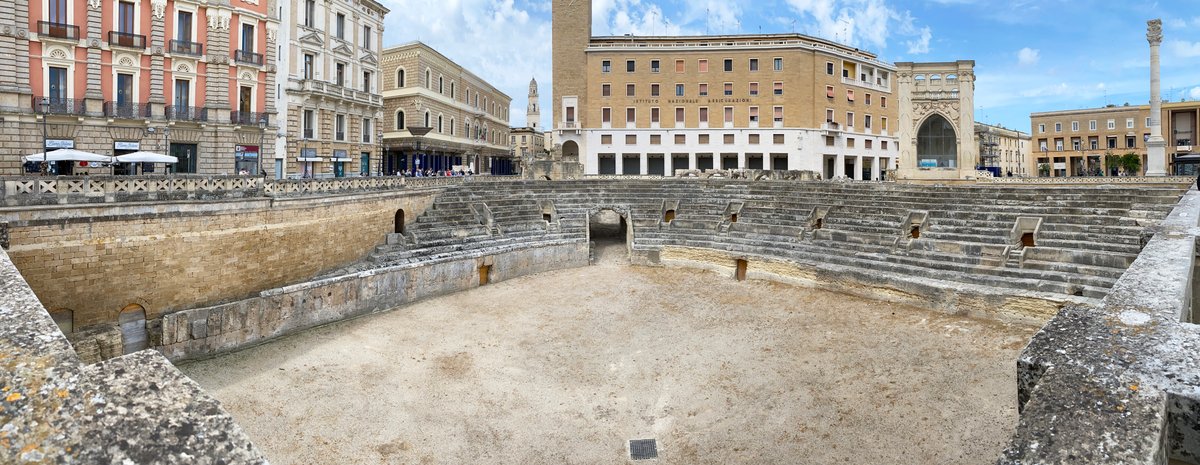

Hidden beneath the surface of Piazza Sant'Oronzo, in Lecce, Italy, lies a national monument, a remnant of a construction project helmed by Augustus during a tumultuous period. This project, along with a neighboring theatre, serves as a testament to Lupiae's prominence from the 1st to 2nd century AD. The amphitheatre was unearthed during the construction of Italy's Bank's Palace in the early 1900s. Archeologist Cosimo De Giorgi led the excavation efforts from 1900 to 1940.
Today, only a third of the full structure is visible, with several buildings and the church of Santa Maria della Grazia standing on the remainder of the square. The amphitheatre, built partly into the rock and partly above arches in opusquadrata, can accommodate around 25,000 spectators. The original arena was significantly higher than the current one, with dimensions of 102 x 83 meters externally, and an arena of 53 x 34 meters. The amphitheatre, divided from the audience area by a high wall adorned with marble reliefs depicting scenes of human and animal combat, also includes two circular corridors surrounding the arena, one underneath the seating and another, external, portico.
The division wall between the arena and the audience area also had several communication passages leading to the central corridor and a narrower corridor behind the arena for service purposes. Today, the amphitheatre serves as a venue for performances by both ancient and modern authors, standing alongside similar monuments from the Colosseum to the Arena of Verona, spanning centuries of the Roman Empire.
Sources: Wikipedia, OpenStreetMap, Wikidata, Wikimedia Commons
Written by Nicolo Ciampini
Discuss this with the author and others
No comments yet. Be the first to start the conversation.