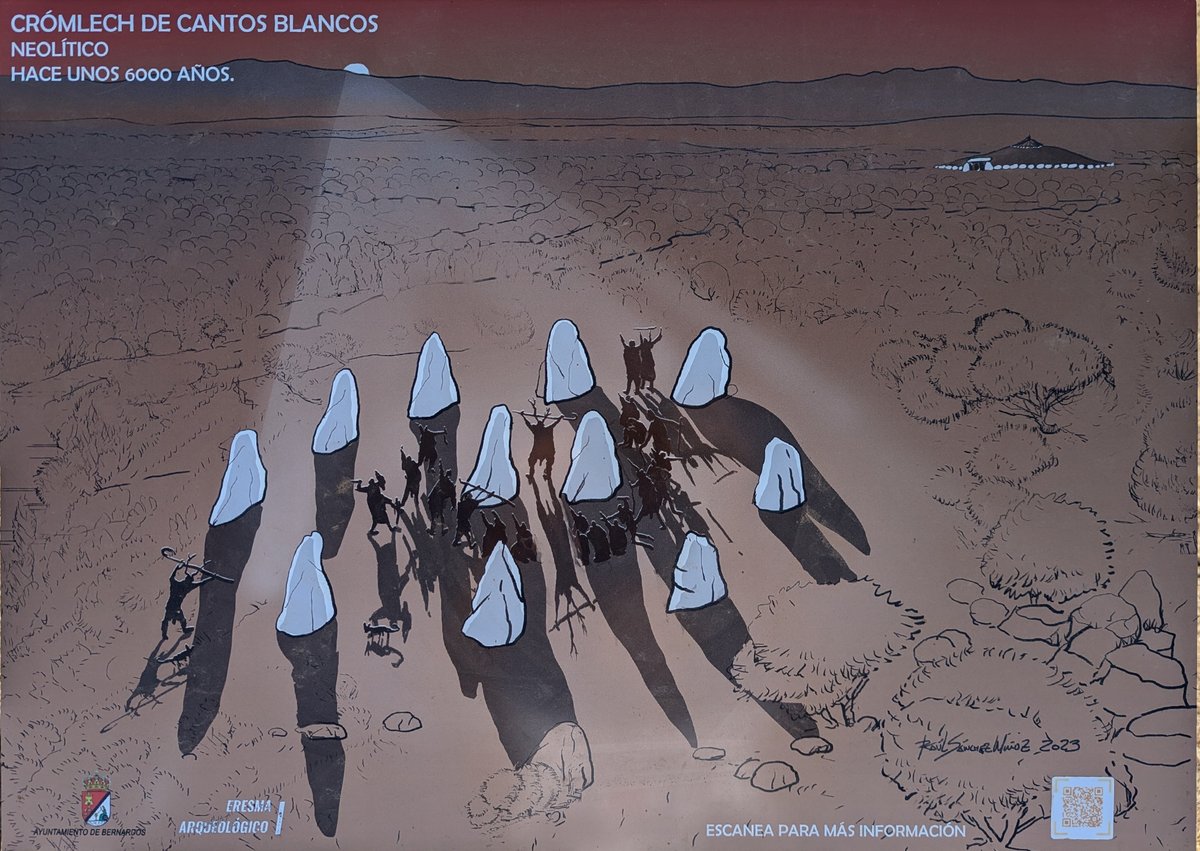

The Crómlech de Cantos Blancos is an archaeological site in Bernardos, Segovia, Castilla y León, Spain. It was discovered in October 2020 by the Eresma Arqueológico Project Team. This is the first crómlech found in Castilla y León. Cantos Blancos consists of a planned arrangement of quartz menhirs forming alignments and enclosures with shapes such as quadrangular, rectangular, circular, and oval. It was built by neolithic societies around the fifth millennium before Christ.
It is located on the shoulder of the Eresma Valley and at the confluence with the Arroyo de Santa Inés, in Bernardos. When it was erected, it was part of a first-order megalithic site. At the foot of some menhirs, a set of identical archaeological materials to those found at the nearby dolmen of Santa Inés have been recovered: handmade ceramic fragments, as well as other objects carved in pizarra. The placement of Cantos Blancos at the shoulder of the Eresma Valley - the autopista de la prehistoria - and at the confluence with another water source - the arroyo of Santa Inés - does not seem accidental.
Some menhirs at Cantos Blancos are oriented towards Peñalara, the most distinctive peak of the Sierra de Guadarrama. Cantos Blancos results from a series of different construction phases carried out over time by the neolithic communities that lived in the area. During the post-Neolithic period, known as the Chalcolithic, there are indications that some monuments of this type, such as the crómlech of Los Almendros in Évora, were deliberately destroyed by knocking over the menhirs.
The interpretation is that with the Bronze Age come important technological, social, and ideological changes, but they clash with the original meaning of the crómlech. In the case of Cantos Blancos, it is observed that the majority of the menhires have fallen onto one of their sides.
Sources: Wikipedia, OpenStreetMap, Wikidata, Wikimedia Commons
Written by Nik Frost
Discuss this with the author and others
No comments yet. Be the first to start the conversation.