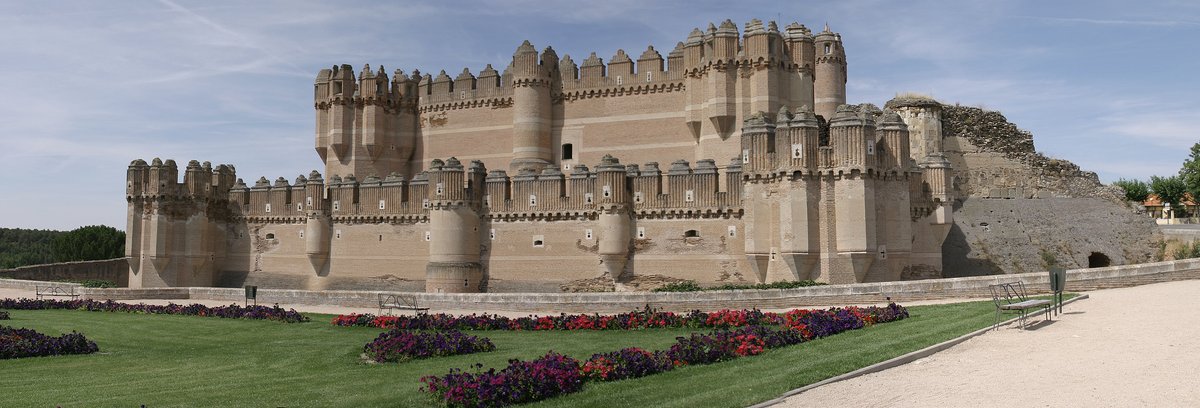

The Castle of Coca, located on the outskirts of the town of Coca, central Spain, is a masterpiece of architecture that dates back to the 15th century. Originally built in the 15th century, it stands as a testament to the Moorish influence on Spanish design. The castle showcases a unique fusion of Islamic and Christian elements, a result of Moorish architecture interweaving with the Gothic style. The castle was not built on a hilltop like many others, instead it stands as stated.
It is protected as a Spanish National Monument, and while it may have undergone some changes over time, its original architecture remains. The castle was constructed by a Moorish architect and engineer, a common practice during the medieval times where Moorish specialists were often commissioned for large building projects. The castle was built using bricks that were hardened to withstand enemy onslaught. The brickwork on the castle walls is smooth and even, and features a distinctive pattern called the Mudéjar style, which is characterised by intricate geometric patterns and the blending of Islamic and Christian influences.
The castle is noted for its three-tiered defense system, which includes a central keep, known as the Tower of Homage, and an outer curtain wall, although much of this has not survived to this day. The town of Coca, where the castle is situated, has a long history dating back to the second century BC, and was once the birthplace of the Roman Emperor Theodosius I. The family that owned the castle, the House of Alba de Tormes, owned it until the mid-20th century when the Ministry of Agriculture received it. The castle stands today as a proud reminder of Spain's rich history.
Sources: Wikipedia, OpenStreetMap, Wikidata, Wikimedia Commons
Written by Nicolo Ciampini
Discuss this with the author and others
No comments yet. Be the first to start the conversation.