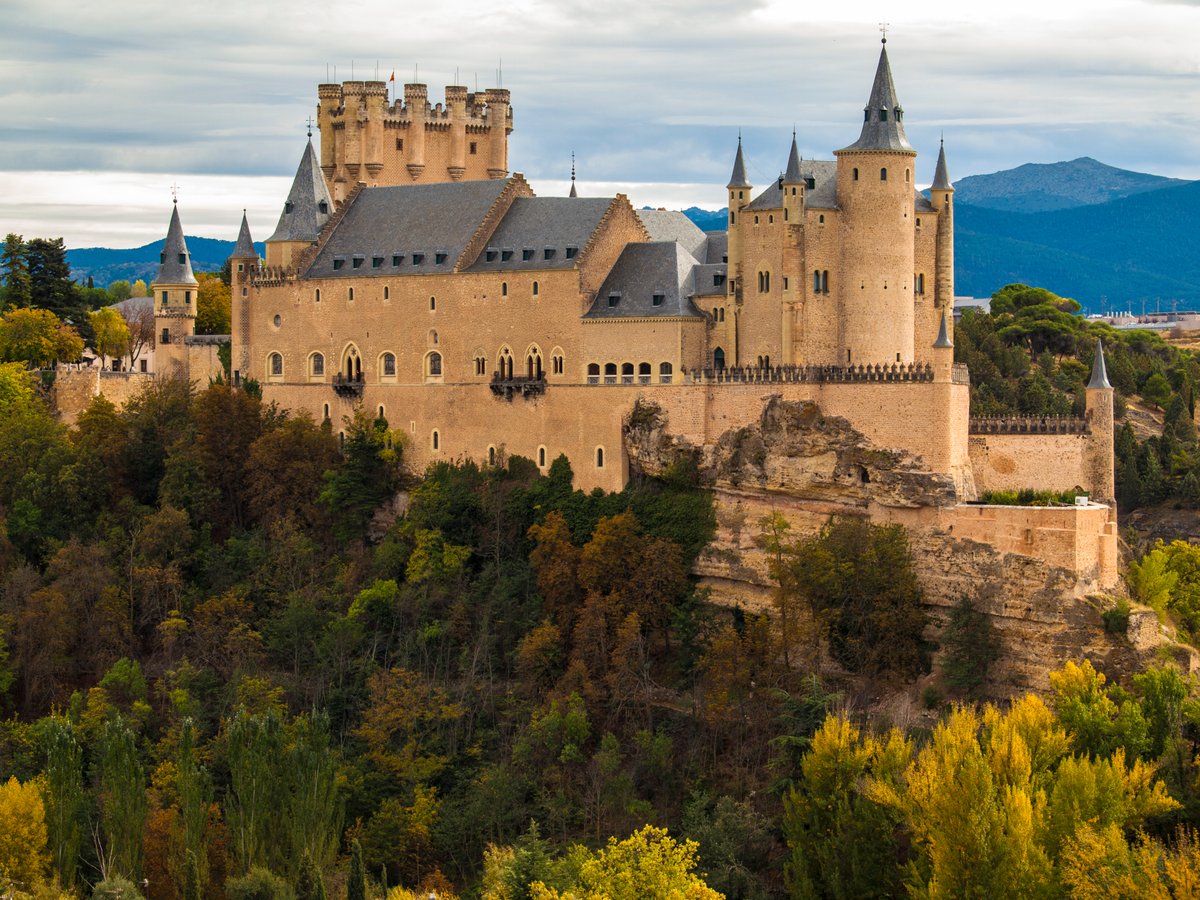

The Alcázar of Segovia is a medieval fortress located on a rocky crag at the western end of Segovia's Old City, above the confluence of the Eresma and Clamores rivers. Dating back to at least the 12th century, it served as both a royal palace and a fortress for the Castilian monarchs. In the Homage tower, the treasure of the Crown of Castile was stored, providing the funds to finance Christopher Columbus's first voyage. In 1437, the books of the royal administration were moved here, establishing one of the first royal archives of Castile.
The site originated as a Roman castrum, but the current structure was built by the Berber Almoravid dynasty. Because the Almoravid dynasty was short-lived, very little of their physical work survived in Spain, and their architectural style is scarcely talked about in scholarship. Starting in the 13th century, the Alcázar became a favorite royal residence, leading to significant construction by the House of Trastámara.
In 1258, during the reign of King Alfonso X, an intense thunderstorm caused a fire that destroyed several rooms, leading to centuries-long reconstruction. The fortress has served many roles over time, including a state prison, a Royal Artillery College, and a military academy. It also housed the royal armory, which served as the basis for the one now exhibited in the Royal Armoury of Madrid.
Today, the Alcázar is a UNESCO World Heritage Site, functioning as a museum and a military archive. It remains one of the most renowned medieval castles globally and one of the most visited landmarks in Spain.
Sources: Wikipedia, OpenStreetMap, Wikidata, Wikimedia Commons
Written by Nicolo Ciampini
Discuss this with the author and others
No comments yet. Be the first to start the conversation.