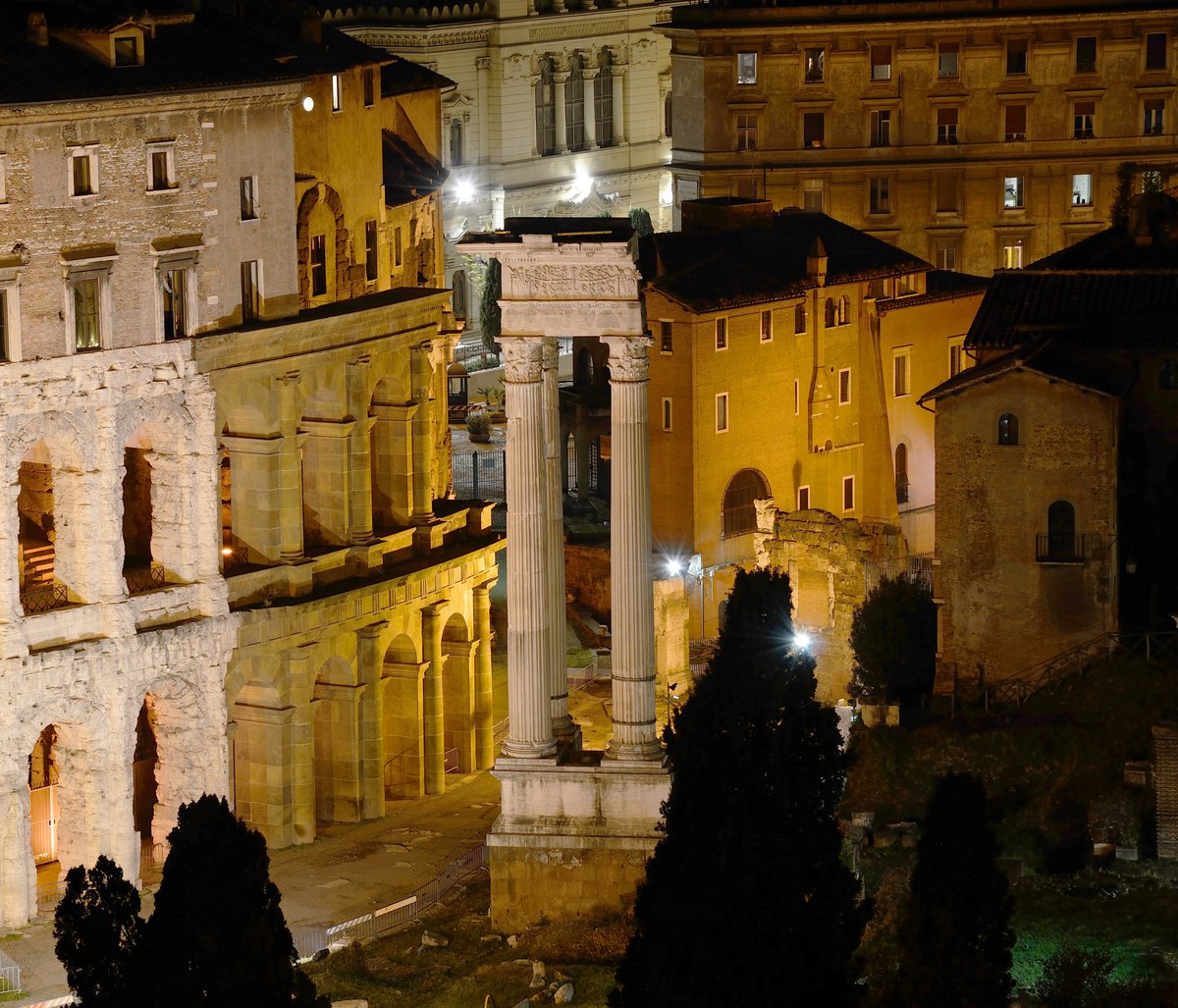

The Temple of Apollo Sosianus, known as the Apollinar and the temple of Apollo Medicus, is a Roman temple dedicated to Apollo, found outside the pomerium in Campus Martius, beside the Theatre of Marcellus and the Porticus Octaviae in Rome, Italy. Apollo was a foreign god, so the temple had to stay beyond the pomerium, making it a common site for extra-pomerial senate meetings. The temple was originally constructed by the consul Gaius Iulius Mento in 431 BC, then restored in 353 BC and possibly in 179 BC.
In the 1940s, the fallen columns were elevated on the podium, yet not in their original locations. The temple's distinctive feature is the hexastyle elevation, with Carrara marble columns lining the front and long sides of the pronaos, while the rear columns are plastered bricks. The temple was later rebuilt by Gaius Sosius and was dedicated in the name of the emperor, Augustus. The temple's main pediment was adorned with sculptures taken from a classical Greek temple.
Sources: Wikipedia, OpenStreetMap, Wikidata, Wikimedia Commons
Written by Nicolo Ciampini
Discuss this with the author and others
No comments yet. Be the first to start the conversation.