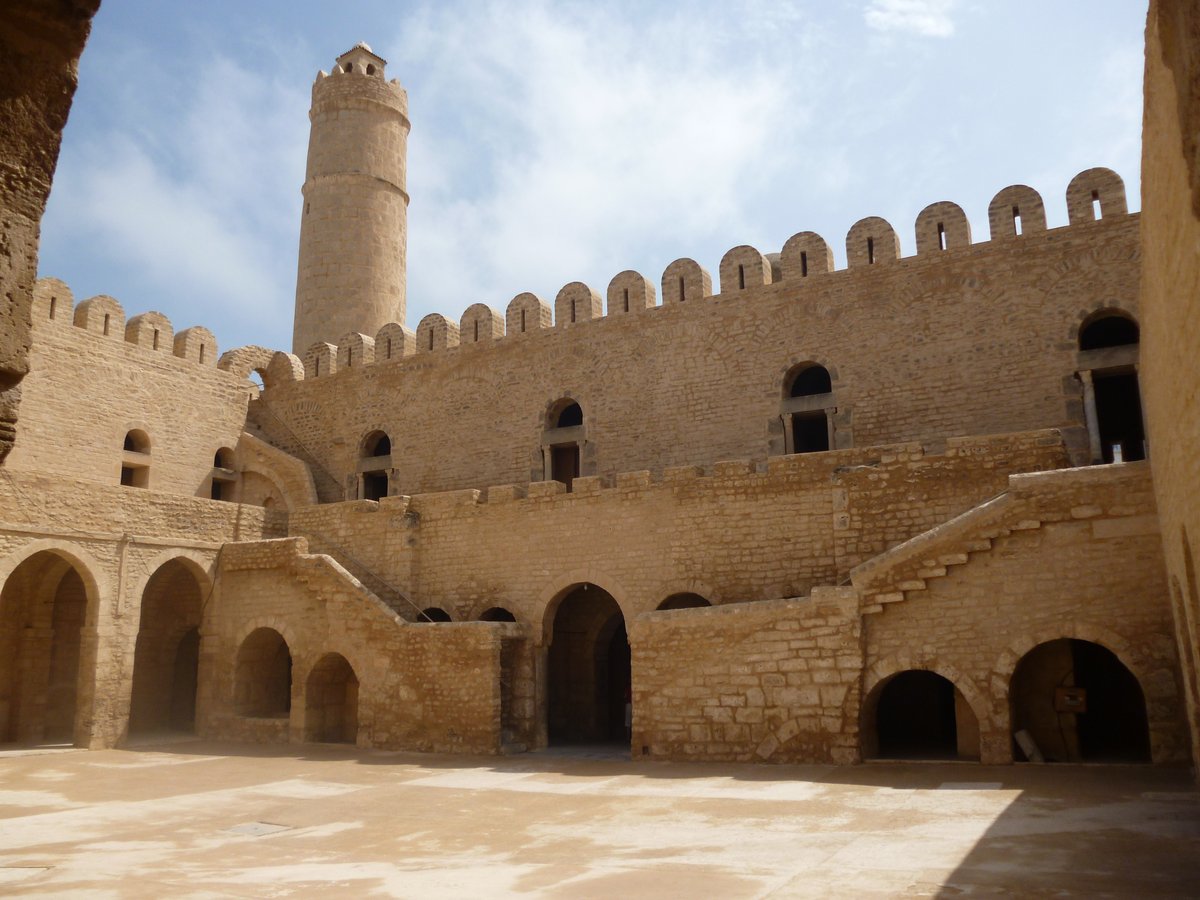

In the city of Sousse, Tunisia, stands the Ribat of Sousse. This stone fort was most likely founded during the 8th century and reconstructed or completed in its current form during the early 9th century under the Aghlabid dynasty. While many ribats were built along the coastline during this period to send rapid signals, the Ribat of Sousse is by far the best-preserved. It was built over the remains of more ancient fortifications from Classical antiquity.
During the restoration of the fort, two floors, a basement, and battlements were added, along with thirty rooms for guards. A mosque was also established on the terrace, considered the first mosque built in the city. The ribat includes a water basin first built by Ibrahim ibn al-Aghlab and expanded later by Ziyadat Allah. In 1988, the ribat was inscribed, along with the Medina of Sousse, as a UNESCO World Heritage Site. The building measures around 38 meters long and 11 meters high. Round towers reinforce its corners and the middle of its four sides, except for the southeastern corner, where a square tower serves as the base for a tall cylindrical tower on top of it, and the middle south side, where a projecting rectangular salient serves as the entrance gate.
The entrance to the courtyard is framed by reused ancient columns. Above the doorway of the cylindrical tower, an inscription on a marble plaque records the name of the Aghlabid emir Ziyadat Allah I and the year 821. This is the oldest surviving Islamic-era monumental inscription in Tunisia. The southeastern corner features a square tower topped by a tall cylindrical tower, which was most likely intended as a lighthouse.
Sources: Wikipedia, OpenStreetMap, Wikidata, Wikimedia Commons
Written by Mutabor
Discuss this with the author and others
No comments yet. Be the first to start the conversation.