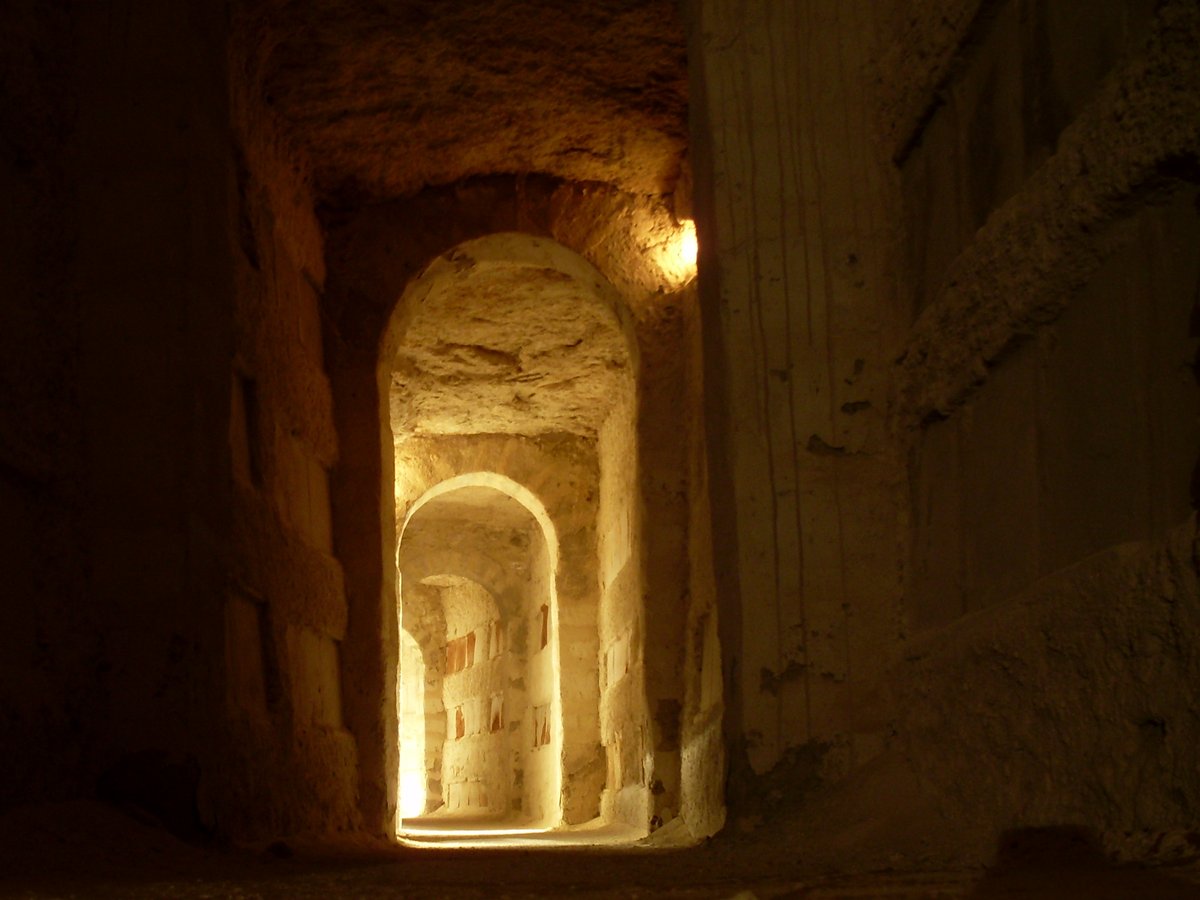

Located to the west of the medina of Sousse in Tunisia, the Catacombs of Sousse are an underground necropolis. Discovered in 1888 by Colonel Vincent, these tunnels were developed in the basement around the end of the 1st century by Christians to bury their dead during a period of persecution. The site consists of 240 galleries extending over five kilometers.
Among the four known catacombs, three are completely explored: the catacombs of Bon Pasteur, Hermes, and Severus. These sites were used as clandestine cemeteries, places of worship, and refuges for early followers of Christianity until the end of the 4th century. While they were well-preserved upon discovery, they degrade rapidly once the earth is removed due to runoff water. They are notably more modest than the catacombs of Rome, bearing witness to the poverty of the Christians of that time.
The catacombs of Bon Pasteur are open to visitors. They feature graves carved into the walls and superimposed on several floors, which were sealed with tiles or marble slabs sometimes engraved with the names of the deceased. Bodies were buried in shrouds and sometimes soaked in lime. At regular intervals, niches are found that once held oil lamps. When new galleries were opened, earth was moved into abandoned galleries, which helped preserve the site. Some inscriptions and funerary objects are now kept at the archaeological museum of Sousse. Works of an artistic character, including epitaphs, marble engravings of sacred symbols such as fish and doves, and a plain marble sarcophagus of a child, are also exhibited there.
Sources: Wikipedia, OpenStreetMap, Wikidata, Wikimedia Commons
Written by Mutabor
Discuss this with the author and others
No comments yet. Be the first to start the conversation.