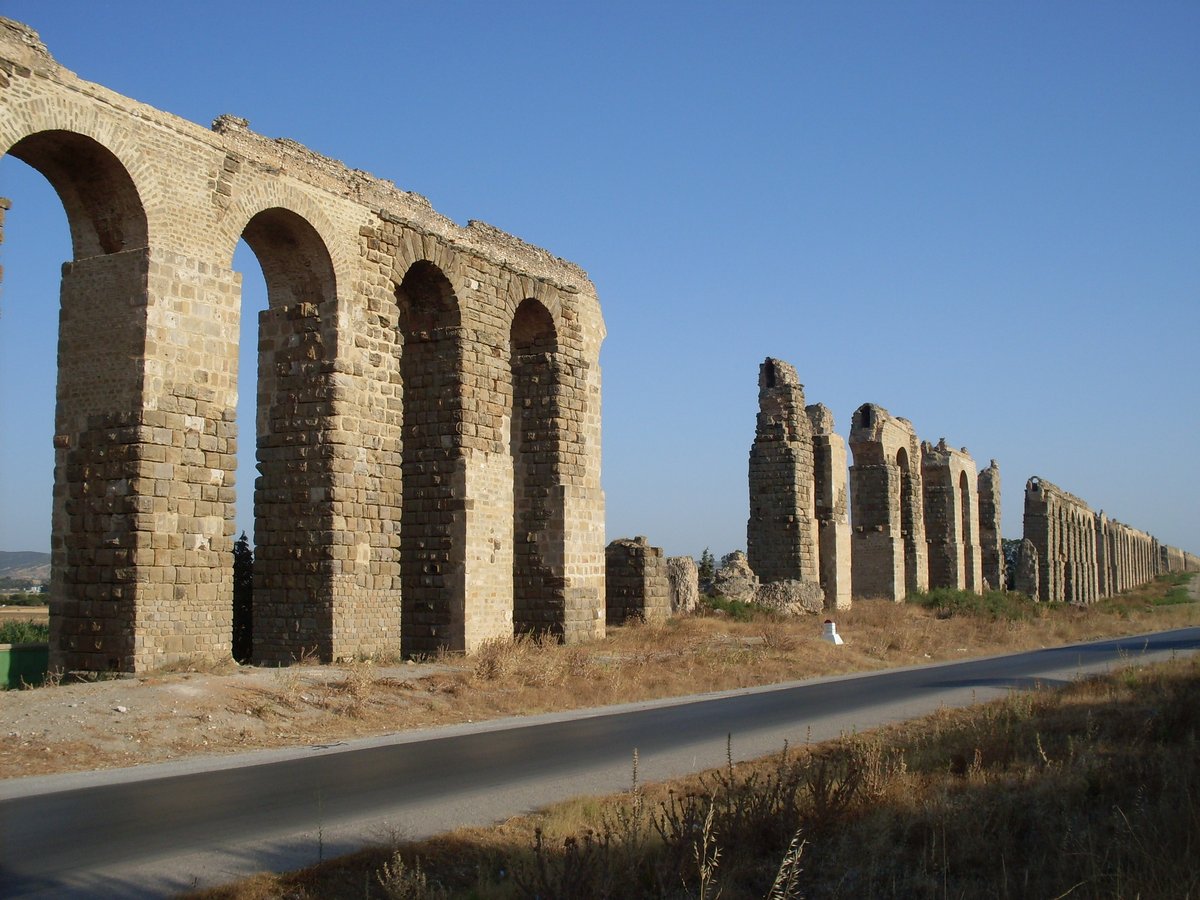

The Zaghouan Aqueduct, also known as the Aqueduct of Carthage, is an ancient Roman masterpiece that supplied the city of Carthage with water. From its source in Zaghouan, it flows a total of 132 km, making it among the longest aqueducts in the Roman Empire. The construction date is not entirely clear, but it may have been inspired by a visit from Emperor Hadrian in 128 to end a five-year drought, or by the opening of the Baths of Antonius in 162, which required a steady supply of water that rainwater alone could not provide.
The aqueduct draws on several sources, most importantly a spring near the town of Zaghouan in the Djebel Zaghouan mountains. In Roman times, a sacred fountain was built over this spring. To feed the aqueduct, water was gathered in a basin under an artificial terrace, which served to clean the water by allowing impurities to settle on the bottom. A second source was added during Severan times in the region of Djouggar. The channel was engineered to drop only 264 m over its 90 km journey to Carthage, averaging a decline of 0.3%.
To maintain a steady fall by gravity, the channel followed the contours of hills and was laid on or just under the surface where possible. In three places where it could not remain at ground level, engineers erected imposing arcades. These include a 125-meter-long bridge in the plain of Oudna reaching 33 meters high, an arcade in the plain of Miliane reaching 20 meters, and a 10 km section in the plain of La Soukra reaching 20 meters. The channel, built with Roman cement and sandstone bossage, was closed by a vault with ventilation openings and circular depressions to purify the water.
Since the water supply was essential, the aqueduct was destroyed during the Vandal siege of 439, the Eastern Roman reconquest, and the conquest of Carthage by the Arabs in 698, but it was restored each time. From the sixteenth century, the aqueduct deteriorated and was used as a stone quarry. In 1859, a French engineer received the task of restoring the water channel in order to supply Tunis with water. While much of the ground-level channel was reused, modern pressure pipes were installed where the pillars were destroyed. Since 1862, it has remained in use, supplying water to the region today.
Sources: Wikipedia, OpenStreetMap, Wikidata, Wikimedia Commons
Written by Mutabor
Discuss this with the author and others
No comments yet. Be the first to start the conversation.