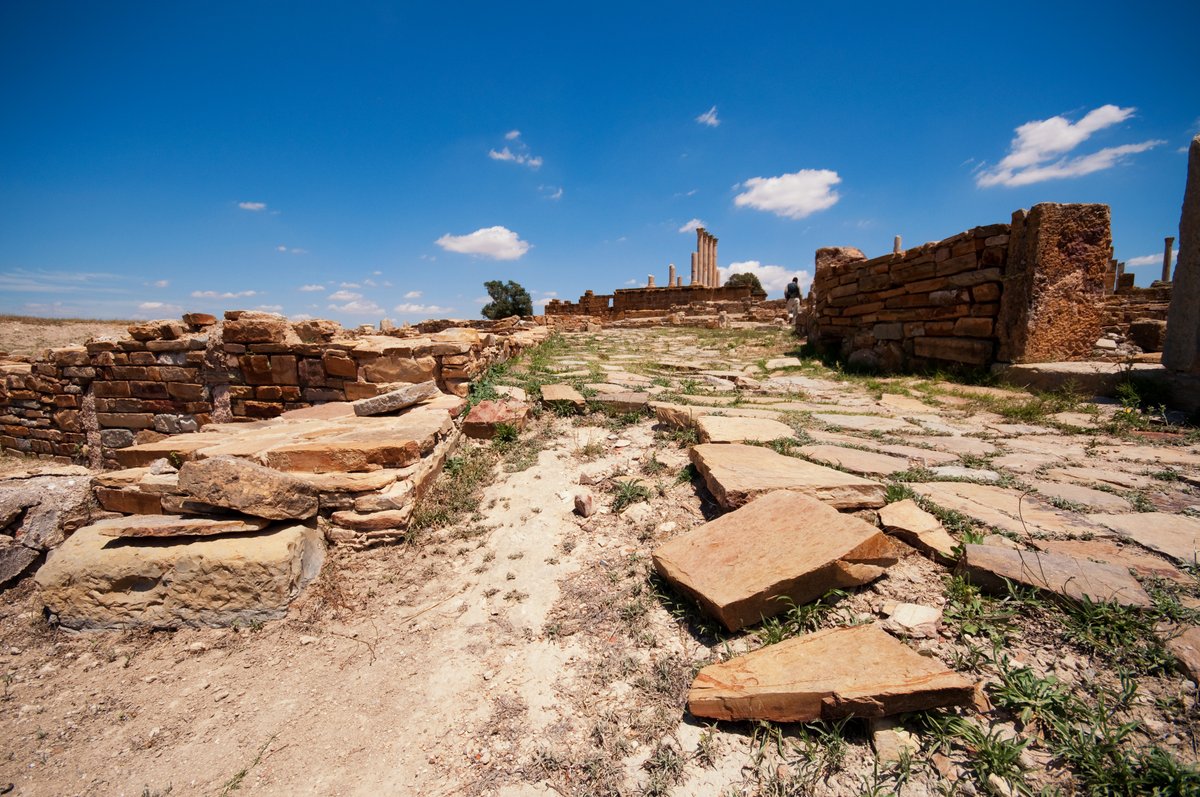

In the middle of the countryside in northern Tunisia, lies the archaeological site of Thuburbo Majus. Originally a Punic town, it was founded as a Roman veteran colony by Augustus in 27 BC to provide land for his soldiers. Located on a major thoroughfare connecting Carthage to the Sahara, it became an important establishment for trade and agriculture, notably growing grain, olives, and fruit.
Most of the town was built between 150 and 200 and restored in the 4th century after the Crisis of the Third Century. It received a Capitolium in 168 and served as a productive agricultural center. In the early third century, the town was the birthplace of the Christian martyr Perpetua. While some parts of the old Roman road remain in ruins, the town is situated in an area with no other towns in close proximity.
Excavations in 1916 revealed a tetrastyle temple decorated with statues of Apollo, Venus, Silvanus, Bacchus, the Dioscuri, and a satyr. Three perfume vases depicting dogs pursuing rabbits were also found. Later, in 1925, researchers excavated the house of Bacchus and Ariadne, dating to the early 5th century, and found evidence of food preparation in a garden. These finds provide insight into daily life in ancient Rome.
Mosaics from the late 4th century were found in the town, studied by archaeologist Aïcha Ben Abed. They depict natural scenes, such as a still life arrangement of food items and a sea filled with fish as young people fish from boats. Another mosaic represents a nude Venus riding a chariot, with plant life surrounding her to represent well-being and fertility.
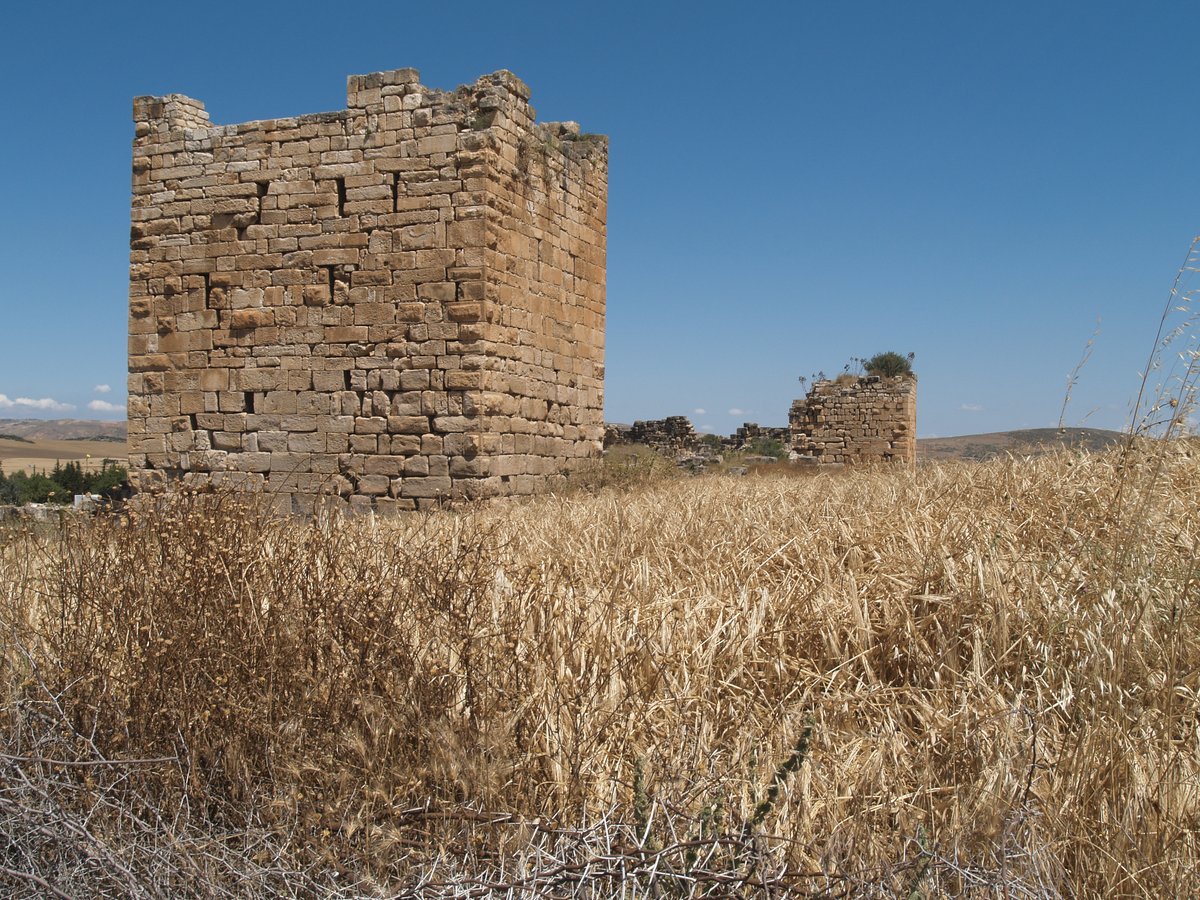
Thuburbo Majus does not have fully restored buildings, but remains of a forum, amphitheatre, temples, baths, and houses are still present. The Bishopric was founded during the Roman Empire and survived through the Arian Vandal and Orthodox Byzantine empires, only ceasing with the Muslim conquest of the Maghreb. The diocese was refounded in name at least in the 20th century.
Sources: Wikipedia, OpenStreetMap, Wikidata, Wikimedia Commons
Written by Mutabor
Discuss this with the author and others
No comments yet. Be the first to start the conversation.