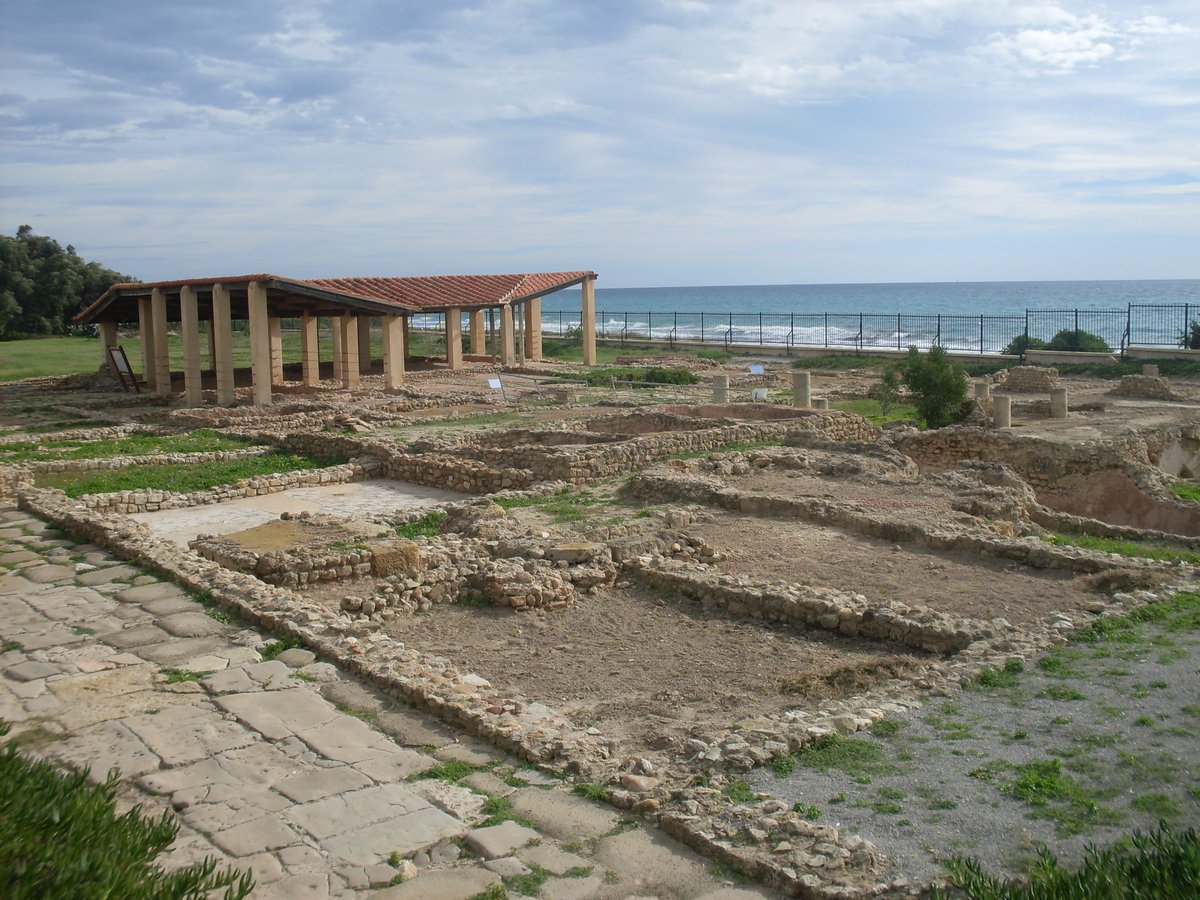

Néapolis is a Tunisian archaeological site located on the coast, two kilometers southwest of the center of the city of Nabeul. It is considered one of the rare cities in the Maghreb to bear a Greek name, and it is cited as early as the 5th century BC in the texts of Thucydides. It is also the oldest city cited after Carthage, and the same texts confirm its importance during the Punic period before its destruction by Lucius Calpurnius Piso in 148 BC.
The city was elevated to the status of a colony under Caesar or Augustus. Until the 5th century, some inscriptions still bear witness to its economic prosperity. This prosperity was based mainly on the production of a condiment highly appreciated by the Romans, made from fish, called garum. The city suffered significantly from the consequences of a major earthquake that caused a tsunami in July 365, submerging an entire part of the city. The remains, covering about twenty hectares, were discovered in 2017 by an Italian-Tunisian archaeological mission.
In the 12th century, Al Idrissi mentions the existence of an "ancient Nabeul" reduced to ruins a few kilometers from the new city. During his journey through the Regency of Tunis, Victor Guérin recorded several inscriptions on pedestals. The first excavations carried out in 1965 revealed an industrial complex from the Roman era for the manufacture of garum, as well as a residential quarter with paved houses featuring superb mosaics. A project to enhance the site was undertaken from 1996 to 2002 by the National Heritage Institute to restore the layout of the walls and the porticos of thebrine basins.
Sources: Wikipedia, OpenStreetMap, Wikidata, Wikimedia Commons
Written by Mutabor
Discuss this with the author and others
No comments yet. Be the first to start the conversation.