

In 1710, the distribution of land plots along the banks of the Fontanka River, then known as the Nameless Erik, began for the construction of country estates. On February 11, 1724, a list of persons granted plots was submitted to Emperor Peter the First by the city’s General Police Chief Anton Devier. Anton Devier, son-in-law of A. D. Menshikov, received a plot on which the Anichkov Palace was later located. One document described his estate as having a “wooden house on the shore, with servants’ quarters and barns in the yard, a pond built according to printed drawings in the city, and a simple vegetable garden.” In 1727, due to Devier’s arrest, the plot was confiscated.
Later, this plot belonged to the estate of timber merchant and merchant Dmitry Lukyanov, stretching about 200 sazhen along Nevsky Prospect and the Fontanka.
On August 20, 1739, the Commission on the Construction of Petersburg proposed to line Nevsky Prospect with stone houses for its improvement. This place could be built up by the merchant himself or given to those interested. Since this plot was located in a deserted part of the city and was unprofitable for Dmitry Lukyanov, he found a way out by selling the land to Elizabeth Petrovna, daughter of Peter the First.
It is said that the location for the Anichkov Palace was chosen deliberately. In 1741, the Preobrazhensky Regiment was stationed here; its soldiers helped Grand Duchess Elizabeth Petrovna seize the throne. On the eve of the coup, Elizabeth and the Orlov brothers visited the troops to ask if they would support the conspiracy. They promised the princess full support. The next day, Elizabeth led the Preobrazhensky soldiers in the assault on the Winter Palace.
Construction of the palace began in 1741. The project for the multi-story building in the shape of an elongated letter “H” was created by one of the first architects of the new capital, Mikhail Zemtsov. The construction was completed in the high Baroque style by Rastrelli.

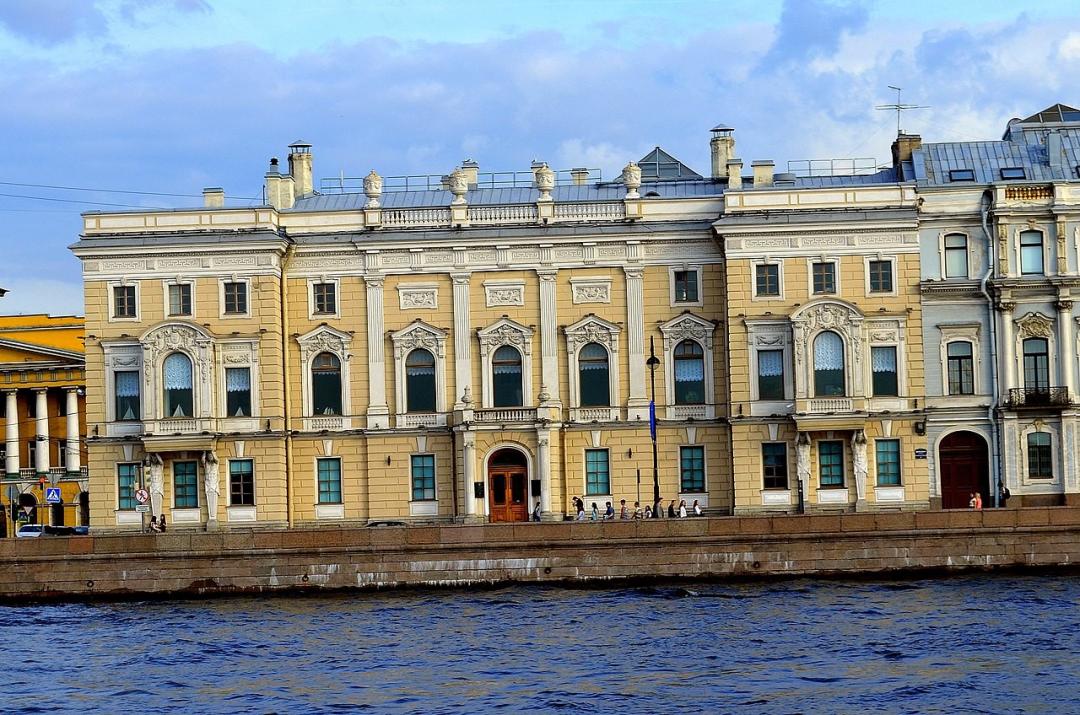
At that time, the Fontanka served as the city’s outskirts, and Nevsky Prospect was still a clearing. Thus, the palace was meant to adorn the entrance to the capital. A special canal was dug from the Fontanka to the palace, ending in a small harbor at the entrance. That is why the palace faces Nevsky Prospect not with its front facade, like most buildings, but with its side wall. In the 18th century, Nevsky “perspektiva” was not yet the main street of the city: rivers played a more important role, and house facades were oriented toward the embankments. The Anichkov Palace was built according to this principle, with its central entrance facing the Fontanka River.

Where does the name of the palace and the nearby bridge come from?
When Elizabeth signed the decree to build the palace, it was on the city’s outskirts, near a suburban settlement. Among those quartered there were soldiers of the Admiralty Battalion under the command of officer M. Anichkov.
They were entrusted with building the first wooden bridge, and the residents of this settlement began calling the bridge “Anichkov,” and later the name passed on to the settlement itself.
Later, when documents concerning the palace’s construction were drawn up, the papers referred to it as “…the palace by Anichkov Bridge.” By the time the palace was built, officer M. Anichkov was no longer alive, nor could he have visited the palace due to his social status, but his name remained forever in the history of our city.
The palace, reminiscent of Peterhof, with an adjacent garden, fountains, and flower beds, was gifted by Elizabeth to Razumovsky, her favorite and morganatic husband.
Subsequently, the palace was repeatedly given as a gift, usually for weddings. After Catherine the Great ascended the throne, she bought it from Razumovsky’s brother Kirill and deemed it most appropriate to gift it to her favorite, Count Grigory Potemkin.
The gift included 100,000 rubles for decorating the palace “to taste.” Grigory considered the canal old-fashioned and had it filled in. Architect Starov remodeled the palace, replacing the outdated Baroque with strict European Classicism, removing stucco from the building and leveling the number of floors. As a result, the palace became more austere but also monotonous.

Later, it continued to be passed as a gift: in the 18th century, empresses gave it to their favorites; from the early 19th century, it became the property of the Romanov family, and members of the royal family received it as a wedding gift.
In 1809, Alexander I gave the palace to his beloved sister as a dowry for the wedding of Grand Duchess Catherine Pavlovna to Prince George of Oldenburg. When the emperor’s sister remarried and left Russia in 1816, the palace returned to the treasury.
A year later, in 1817, Alexander I gave the palace as a wedding gift to his brother Nicholas Pavlovich, the future Nicholas I. Under him, architect Rossi redesigned some of the palace’s interiors. Emperor Nicholas I often held court balls within its walls. During the reconstruction of the Winter Palace after the fire of 1837, the imperial family moved to the Anichkov Palace and lived there for some time.
The son of Nicholas I, the future Alexander II, was raised in the palace. Later, in 1841, the Anichkov Palace was given to him as a wedding gift, and a quarter of a century later, it was re-gifted by Alexander II to his son, the future Alexander III. After Nicholas I’s death, the palace was renamed “Nikolaevsky” in his honor, but the new name did not catch on.
Alexander III considered the palace a safe place and chose it as his residence and protection from terrorists; it was then that a solid wall was built on the square side. After his death, the palace served as the residence of the Dowager Empress Maria Feodorovna.
The first mention of the White Lady ghost appears in A. Vasilchikov’s book “The Razumovsky Family.” The author briefly mentions a semi-transparent figure dressed in a white cloak. But the first to encounter the ghost was Nicholas I, who, it must be said, was not merely frightened but suffered a mild choking episode, which was rumored to be the first sign of the emperor’s serious illness. The emperor told his personal physician that a transparent female figure emerged from the wall and extended her hand, preventing a scream from escaping his lips. The White Lady tried to tell Nicholas something, but due to the shock, he could not understand. This incident sparked numerous rumors that soon spread throughout the city. It was said that the palace was haunted by the ghost of a Smolny Institute pupil who drowned in the Fontanka after Nicholas seduced and abandoned her. Whether this was true or not, from that moment the emperor became extremely devout. V. A. Zhukovsky, who was the tutor of young Alexander, son of Nicholas I, was so struck by this story that he wanted to write a poem about the White Lady, but the emperor was categorically against it.
There were witnesses who claimed to have seen the ghost rise to the sky with tongues of flame during the 1812 fire at the Anichkov Palace. However, this did not prevent the next Russian autocrat, Alexander II, from encountering the White Lady. The ghost told him that he would survive three assassination attempts.
In the famous diaries of Anna Vyroubova (recognized as a skillful historical forgery), there is an entry about Grand Duke Nicholas Alexandrovich’s meeting with the White Lady ghost. The mysterious transparent stranger told the prince the tragic news that he was destined to be the last Russian emperor. Nicholas allegedly did not understand her words or simply did not believe the bodiless entity. Then she disappeared forever. Since then, no one has ever seen the White Lady again.

Interestingly, this is an authentic 18th-century palace that barely suffered during the Great Patriotic War. On German maps, it was marked as No. 192, labeled “Palace of Young Bolsheviks,” and was slated for destruction. However, fate preserved it.
Sources:
https://www.spbmuzei.ru/anichkov.htm
https://www.spb.kp.ru/daily/25966/2904530/
http://www.peterburg.biz/legenda-o-prizrake-anichkova-dvortsa.html#ixzz6tM7vSsr4
https://ru.wikipedia.org/wiki/Аничков_дворец



Written by Jermaine
Discuss this with the author and others
No comments yet. Be the first to start the conversation.