


Architect Rastrelli, overseeing the construction of the Winter Palace for Empress Elizabeth Petrovna, lived in a house purchased by Baron S. G. Stroganov in 1742 at the corner of the Moika Embankment and Nevsky Prospect.
The first considerations about the construction time of the new house by architect Rastrelli were expressed by historian Kolmakov, who accepted the date 1752 as the start of construction and 1754 as the completion. In 1991, historian Yu. V. Trubinov did not suggest the idea of a six-week rapid construction. Later, this was found to be an error, and currently, the construction period of the Stroganov Palace is considered to be 1753–1754. Furthermore, it should be taken into account that Rastrelli did not work on a blank site but extensively used the structures inherited from an earlier period of the building's history. The author of the previous two-story house is considered to be M. G. Zemtsov. There are also grounds to believe that the one-story Stroganov house, located slightly south on the Moika river embankment, was incorporated into Rastrelli’s design. However, definitive answers are lacking.

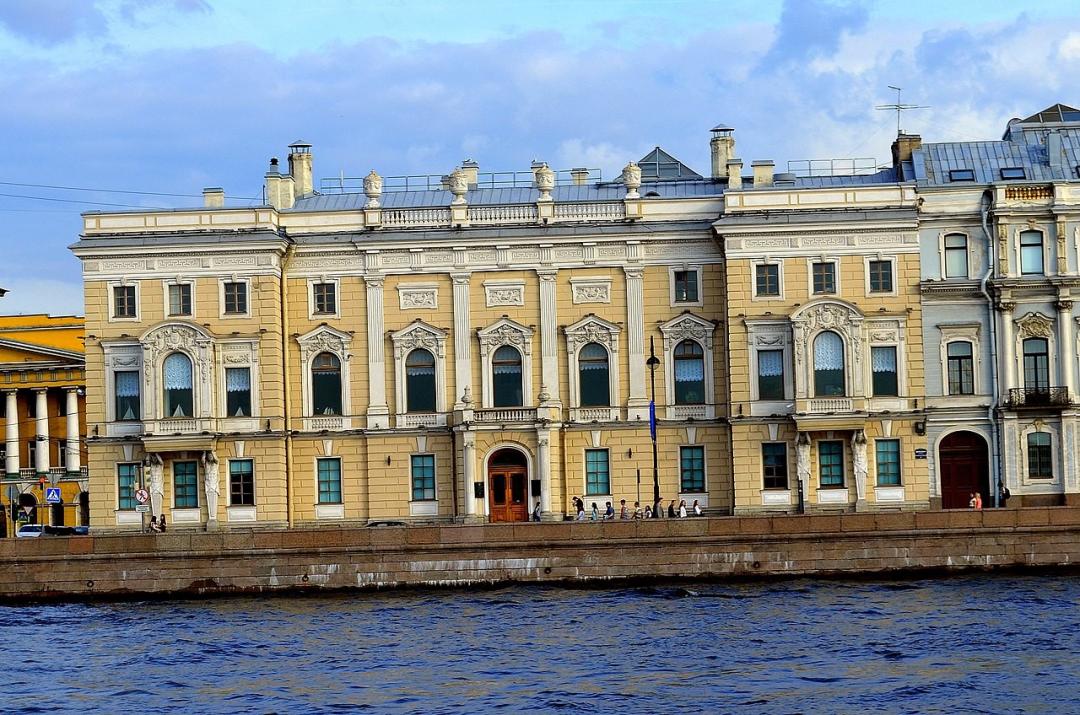
The palace built by Rastrelli consists of two wings with an inner courtyard; the facades, as the architect himself wrote, are “adorned with the most beautiful architecture in the Italian manner.” Initially, the facades were painted “with sand-colored paint with a yellowish tint,” like the walls of the Winter Palace located opposite across a vacant lot (Palace Square did not yet exist), then they were repainted pink with white. Some details (balcony railings) were gilded. Four statues representing the “Four Continents” and sculptures on the pediment of the main facade have not survived.

There is a suggestion that the profile of A. S. Stroganov is depicted in the relief medallions on the facade.
The composition of both palace facades follows a classicist three-part scheme; however, the main facade on Nevsky Prospect with a carriage archway into the inner courtyard looks more Baroque due to massive pilasters, three oval windows, grouped columns, and a broken segmental pediment, in the tympanum of which is placed the coat of arms of the Stroganov family.
The grand staircase, the Large Hall, the mirrored gallery — a total of fifty ceremonial rooms — were lavishly decorated in the “Rastrelli style.” Stucco rocaille decoration, mascarons on window casings, and paintings were executed by Italian masters. Researchers note that in this building, as in others, Rastrelli used his favorite composite method, combining heterogeneous elements in new, unusual combinations. Examples cited include classic Parisian hôtels particuliers (urban mansions): Hôtel Lambert, Hôtel de Lozen, Hôtel Lebrun, Hôtel Crozat. However, Rastrelli himself emphasized that he worked “in the Italian manner.” Therefore, “it can be concluded that the architect combined features of the classicist Italian palazzo and the French hôtel in the type of an urban noble mansion.”
Historian of St. Petersburg architecture V. Ya. Kurbatov, referring only to the facades of the Stroganov Palace, mentioned in 1913 as a possible prototype the Trautson Palace in Vienna, built by J. B. Fischer von Erlach the Elder in 1710–1712.
It is also significant that in the first design version, the inner courtyard of the Stroganov Palace had a semi-circular outline, which may indicate indirect influence of Italian Baroque introduced into Rastrelli’s style through the German-Austrian school of Fischer von Erlach (a similar semicircular courtyard exists in the Trautson Palace and in the Hôtel Bove in Paris by Antoine Lepautre).
From Rastrelli’s interiors in the Stroganov house, the Large Hall (partially altered by Voronikhin) and the Grand Vestibule have survived.
From 1756, the palace was owned by the baron’s son, Alexander Sergeyevich Stroganov. In 1787, he undertook significant renovations. In the early 19th century, the western part of the house (probably by Voronikhin) saw the refurbishment of the Small and Large Drawing Rooms. The Cabinet (museum) of Count A. S. Stroganov is fairly well preserved. Among the existing halls are the so-called Hubert Robert Hall, the Mineral Cabinet, the Picture Gallery — the most famous part, the Library, and the Physical Cabinet. Traditionally, most interiors were attributed to Voronikhin until the late 1980s, when N. V. Glinka defended a dissertation on the work of F. I. Demertsov. In it, as well as in several related articles and a 2002 book, it was suggested that F. I. Demertsov was the author of the Picture and Physical Cabinets, as well as two Dining Rooms (behind the Picture Cabinet and in the northwest corner of the building). Glinka considered the latter hall a joint work of Voronikhin and Demertsov.
A. N. Voronikhin created a magnificent vestibule, a staircase with massive “Pestum” Doric columns, the Mineral Cabinet (recreated in 2003) with a dome and an upper gallery. In the Mineral Cabinet, the count placed his mineralogical collection and a library on geology and mining.
The large ballroom, decorated by Rastrelli with a ceiling painting by Italian artist Giuseppe Valeriani, was delicately altered by Voronikhin, creating a unique blend of Rastrelli’s Baroque-rocaille style and Alexandrian classicism. “The architects consistently implemented a unified and constantly updated program, whose authors were the patrons — Alexander and Pavel Stroganov.”
Voronikhin worked on remodeling the interiors of the Stroganov Palace after returning from a trip abroad with the count’s son Pavel Alexandrovich in 1786–1790. On the site of the Buffet Room, Voronikhin created the Physical Cabinet (an alchemical laboratory) in the “Egyptian style.” The cabinet served the owner as a “Masonic temple.” Count Stroganov was a well-known Mason, a member of the famous lodge “Les Neuf Sœurs,” and held high positions in Masonic lodges in Prussia and France. He participated in the creation of the Masonic organization called the Grand Orient of France. In the famous portrait of A. S. Stroganov by A. G. Varnek from the collection of the State Russian Museum,

the count is depicted in his Egyptian cabinet by the window with a view of Kazan Cathedral (the artist’s fantasy does not correspond to the actual layout of the palace). Behind him is a bust of Zeus of Otricoli with the Latin inscription: “Art Aegiptiaca Petropoli Renata” (Egyptian Art, renewed in Petropolis). According to one version, this inscription was actually above the entrance to the Egyptian cabinet.
The prevailing notion of the Stroganov Palace as a building created exclusively by Rastrelli and Voronikhin is incorrect. M. G. Zemtsov played a significant role in its final appearance. Moreover, in 1818, some interiors in the southern and western wings were remodeled by architect I. F. Kolodin. In 1820, Carlo Rossi designed apartments for Prince V. S. Golitsyn and his wife A. P. Golitsyna, née Countess Stroganova. A small fragment has survived; most of the space is now occupied by the so-called Oak Fireplace Hall, probably related to the period of Count S. A. Stroganov. In 1842, P. S. Sadovnikov completed the formation of the southern wing. It was originally connected by a one-story gallery by Rastrelli, linking Baron S. G. Stroganov’s chambers with the kitchen. In the early 19th century, Voronikhin added a two-story annex to the western wing, housing Countess S. V. Stroganova’s cabinet. Between 1811 and 1814, he extended the building by one axis, so there were two cabinets — Large and Small. In 1842, Sadovnikov gave the southern wing its current appearance. An example of this architect’s interior work is the so-called State Bedroom in the southern wing (restored but not open to the public). The authorship of many works remains unestablished. In the northern part of the building are the Large and Small Cabinets of Count S. G. Stroganov and the so-called Arabesque Gallery adjoining the first. All were created in the mid-19th century, as was the now-known decoration of the Large Drawing Room in the western wing.
The Stroganov Palace forms a quadrangle in plan, with a patio (inner courtyard) in the center. Possibly, a garden existed on the patio grounds as early as 1793, laid out by A. N. Voronikhin. On plans of the Stroganov house from the first half of the 19th century, there is no garden. In 1908, it was replanned to accommodate sculptures and the “Tomb of Homer,” previously located at the Stroganov dacha. It was open to visitors and left a nostalgic impression on many townspeople about their youth. It existed until 2003, when it was cut down and replaced by a summer restaurant under canopies; the restaurant has since been removed.
The main part of the painting collection belonged to Count A. S. Stroganov. On the second floor of the building, in an enfilade of rooms along the facade facing the Moika Embankment, architect Demertsov arranged a picture gallery. The building was completed by Voronikhin. The gallery with coffered vaults and columns at the beginning and end is depicted in the watercolor “View of the Picture Gallery of Count A. S. Stroganov,” painted by Voronikhin himself in 1793 (Hermitage). The Picture Gallery hosted classes for students of the Academy of Arts. On the eve of his death, Count A. S. Stroganov requested to be moved to the gallery to die among the works of art he had collected.

The Stroganov collection included masterpieces of world art: “Portrait of a Young Man as St. Sebastian” by Giovanni Boltraffio (at the time, the painting was attributed to Leonardo da Vinci; since 1922 in the Hermitage collection, since 1930 in the Pushkin Museum of Fine Arts in Moscow), “Saint Dominic” by Botticelli (now in the Hermitage), works by Rembrandt, Rubens, Watteau, Fragonard, Boucher, Chardin, Robert, Van Dyck, Poussin. The Stroganov Palace Picture Gallery housed Watteau’s “The Capricious Girl” (since 1923 in the Hermitage collection).
The painting collection was expanded by Count S. G. Stroganov. Sergey Grigorievich also owned a numismatic collection and increased the unique Stroganov collection of Sasanian silver items. The great-grandson and namesake of the most famous of the counts — Alexander Sergeyevich Stroganov — significantly enlarged the collection with silver items, ancient coins, gems, and Etruscan bronzes.
Count Sergey Grigorievich Stroganov, an archaeologist, philanthropist, collector, and founder in 1825 of the first “School of Drawing in Relation to Arts and Crafts” in Russia — the future Stroganov School of Technical Drawing (now the Moscow State Stroganov Academy of Industrial and Applied Arts) — had his own cabinet with a coin collection in the palace.

Sergey Grigorievich’s son, Count Pavel Sergeyevich Stroganov (1823–1911), continued the family tradition of collecting paintings. Having inherited a house in St. Petersburg near the Summer Garden on Sergievskaya Street, 11 (now Chaikovsky Street), he turned it into a museum. He formed the main part of the collection of Italian Early Renaissance paintings in Italy. Some paintings entered the Hermitage in 1912.
Pavel Sergeyevich’s younger brother, Grigory Sergeyevich Stroganov (1829–1910), a collector and honorary member of the Academy of Arts, spent the second half of his life in Italy, in Rome, where he assembled an outstanding painting collection. He took part of the inherited paintings to Italy. In his house on Via Sistina in Rome, he housed his rich collection of artworks and books. The building was named “Palazzo Stroganoff.” Among the paintings in this unique collection were Duccio’s “Madonna” (now in the Metropolitan Museum, New York), Fra Angelico’s reliquary, and Simone Martini’s “Annunciation Madonna.” Other works included paintings by Pinturicchio, Daddi, Matteo di Pacino, two landscapes by Fragonard, a portrait of Erasmus of Rotterdam by Quentin Massys, and much more. The count also collected medals, Egyptian and ancient antiquities. The library contained more than 30,000 volumes. After his death, the collection was auctioned off in Paris. Part of his Roman collection was bequeathed to the St. Petersburg Hermitage, which was fulfilled by his heirs in 1911.
After the revolution in 1918, the Stroganov Palace was nationalized. In 1919, a museum was opened in its ceremonial halls. In 1925, the museum became a branch of the State Hermitage but was closed in 1929. The family collection was dispersed among various museums. Many priceless items were sold or stolen.
In May 1931, at an auction in Berlin, the USSR authorities sold masterpieces taken from the palace, including 108 paintings. In 2000, scattered exhibits of the former outstanding art collection were gathered for an exhibition in the USA, which was later repeated in France, the Netherlands, and Russia.
On October 4, 1912, a theft of valuable papers and cash belonging to the palace owner was committed in the palace. The gang was arrested by October 15. The gang’s informant was former State Duma deputy Alexey Kuznetsov, who obtained the palace entry plan from the palace parquet maker Chugunov — his fellow countryman.
In the first half of the 1920s, some interiors were restored. In 1935, the facade was repainted, which remained green and white until 2003. Later, the Institute of Plant Breeding of the Academy of Sciences was housed here. Since 1937, the building was transferred to the military department. The interiors suffered significant damage.
On April 4, 1988, the Leningrad City Executive Committee decided to transfer the former Stroganov Palace premises to the Russian Museum. It was first opened for viewing in 1995. The official opening took place in 2003. Since then, an exhibition has existed, beginning in the New Front Hall and constantly improving. Many legends and stories are associated with the palace; more information is here: https://reveal.world/story/legendy-doma-stroganovyh

At the entrance to the building in the inner courtyard are two small sphinxes carved from pink granite. These mythical figures first appeared in St. Petersburg at the end of the 18th century at the Stroganov dacha and are depicted in a 1797 painting by A. N. Voronikhin. In the early 20th century, the sculptures were placed at the Stroganov Palace. In 1959–1960, they served as models for the manufacture of the lost four sphinxes on the pier at the Bezborodko dacha, which were made of gray granite.
Sources:
https://ru.wikipedia.org/wiki/Stroganov_Palace
https://www.citywalls.ru/house1113.html



Written by Jermaine
Discuss this with the author and others
No comments yet. Be the first to start the conversation.