

The lands between the Fontanka River and the modern Sadovaya Street gradually began to be built up from the 1720s. By 1740, estates designed by Domenico Trezzini were located there, including those of Peter I's cabinet secretary Alexei Makarov and Alexei Volkov, secretary to Prince Alexander Menshikov.
A relative of Elizabeth Petrovna (the wife of Vorontsov, Anna Skavronskaya, was the empress’s cousin) and a participant in the palace coup of November 25, 1741 (he persuaded the Preobrazhensky Life Guards Regiment to side with Elizabeth Petrovna) decided to build an extensive urban estate.
Documentary sources provide different dates for the construction of the palace complex. In the work of academician Igor Grabar, "History of Russian Art," the years 1744–1745 are indicated, while in the notes on Russian architecture by Jakob Stählin, the period is from 1746 to 1759. The most reliable year for the completion of construction is considered to be 1758. The project development was entrusted to F.-B. Rastrelli. In the newspaper "Saint Petersburg Gazette," issue number 95 of 1758, a housewarming on November 23 at Count Mikhail Vorontsov’s residence is mentioned, attended personally by Elizabeth Petrovna. The empress gifted the count a "decree for 40,000 rubles" and bestowed upon him the title of chancellor. After this, the palace received its second name — the "Chancellor’s House."

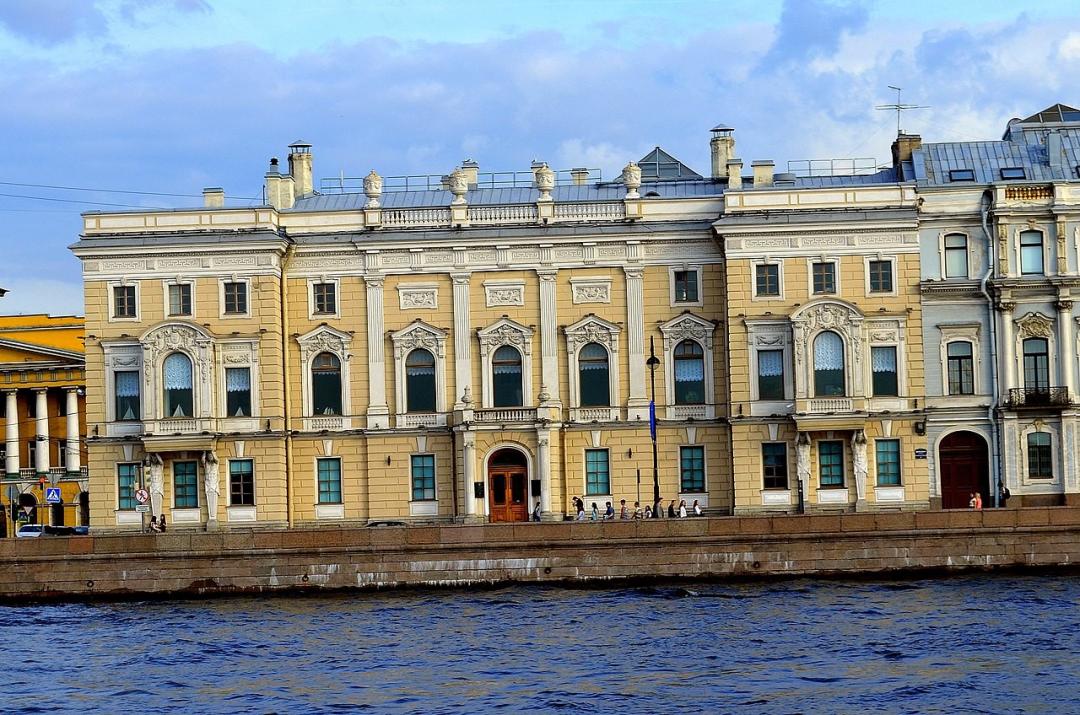
The Vorontsov Palace became a vivid example of a mid-18th-century urban estate. On a plot shaped like an irregular rectangle stood the main building with two side wings, one of which adjoined a U-shaped two-story building, forming an enclosed inner courtyard. In the main cour d’honneur, a formal garden was laid out, symmetrically planned along the palace’s main axis. An oval-shaped pond was dug in the garden, from which alleys radiated in different directions; a little further away was a pool connected to the Fontanka River. On the side of the large courtyard, the 109-meter-long facade was designed in Rastrelli’s characteristic style — the central risalit was flanked by two side ones, less ornate and lower in height. The facades were executed in the Baroque style, with imaginative window frames, abundant gilded stucco, and patterned grilles. The estate was surrounded by a fence cast according to Rastrelli’s sketches. The central gates with wrought iron grilles were supported by two attached columns, originally topped with sculptures.
The palace interiors were luxuriously decorated, with over 50 ceremonial halls and rooms. Behind the central entrance opened a spacious vestibule with a grand staircase adorned with sculptures and mirrors. The staircase led to the second-floor halls intended for receptions and celebrations. The main ceremonial room was a two-story hall in the bel étage. It featured especially rich decor, with ceilings decorated with plafonds painted with scenes from ancient myths. The wall paintings were done by the Bolognese artist Angelo Carboni.
The construction costs were so high that they ruined Vorontsov. In letters to his friend Ivan Shuvalov, he often complained that he had become "completely bankrupt because of his unfortunate palace." In 1763, due to colossal debts, he was forced to sell the palace to the treasury. The estate was valued at 217,000 rubles. The palace stood empty for seven years until it began to be provided to foreign guests — in 1770, Prince Henry of Prussia lived there, followed by Prince Nassau-Siegen, then Vice-Chancellor I. A. Osterman.
At the end of the 1790s, Emperor Paul I transferred the palace to the capital of the Maltese Order. Some rooms were rebuilt for its needs, and the main staircase and vestibule were altered. Between 1798 and 1800, according to the project of architect Giacomo Quarenghi, the Church of the Nativity of St. John the Baptist was built in the palace, and from the garden side, the Maltese Chapel was attached to the main building, designed in the style of high classicism. Under the guidance of master David Elteser, the walls were decorated with artificial marble, and stucco master Bern created decorative reliefs. The chapel housed a luxurious marble altar and a 15-register organ, as well as the order’s treasures and the chair of the Grand Master. According to city legend, a 3.5-kilometer underground tunnel was laid from Paul I’s bedroom in the Mikhailovsky Castle, leading to the chapel’s basement.
In 1810, by decree of Emperor Alexander I, the palace was transferred to the Page Corps. Since the palace’s layout and decoration were unsuitable for the needs of a military educational institution, it was decided to rebuild the palace. Architect Alexander Staubert was invited to lead the project.

The facade decoration was left unchanged, but the original interiors were almost completely lost: almost all internal rooms were redesigned for the needs of the educational institution. During this period, ceiling and wall reliefs, parquet floors, and paintings were removed, and the grand staircase was moved closer to the church. Only a few vaulted galleries and corridors of the original interior were preserved. The rooms on the first floors of the wings were rented out as shops. One of the tenants was Ivan Lisenkov’s bookstore, which poet Alexander Pushkin often visited. The palace was maintained with the funds raised from rental payments.

Subsequently, the palace complex was completed and expanded according to the needs of the Page Corps. The palace garden was gradually filled with utility buildings. Between 1832 and 1834, under the direction of architect Albert Cavos, service buildings along Chernyshyov Lane were rebuilt. Between 1853 and 1856, the Maltese Chapel was expanded.
The next stage of palace renovations took place in 1883–1884. Several new service buildings were erected on the territory, wings were added to the northern part of the main building and the chapel, and the southwestern wing of the main palace was raised by one floor. The new volume was planned to accommodate rooms for the third company.

The Page Corps was housed in the palace from 1810 until the revolution.
After the revolution, the palace was occupied by the Petrograd organization of the Left Socialist Revolutionaries and their combat detachment. Here is what is written about this: "On the same day, July 7, 1919, information was received about military preparations in the building of the former Page Corps on Sadovaya Street, where the Petrograd organization of the Left Socialist Revolutionaries and their combat detachment were housed. Around 8 p.m., Red Army units surrounded the Left SR headquarters. Upon the demand to surrender weapons, they refused. Artillery was then brought up. The rebels were offered to immediately cease resistance, but they responded with a volley of small arms fire. A fierce shootout ensued, lasting about 40 minutes. By 10 p.m., white flags appeared in the windows of the Page Corps, and 260 people surrendered. The losses were as follows: the rebels had two killed and two wounded, the Red Army units lost 10 killed and 45 wounded. A large amount of weapons was seized."
Then the building was occupied by the First Petrograd Infantry School of the Red Army. Between 1927 and 1933, the complex was restored under the direction of architect N. P. Nikitin. During World War II, the building served as a hospital. From 1950, the palace housed the Leningrad Infantry School named after Kirov, and from 1958 to 2017, the Suvorov Military School. During this period, a series of restoration and repair works were carried out, during which the facades of the main building and wings, the vestibule, and the dining room were restored, and the floor beams were replaced. Under the guidance of artist Nikolai Pertsev, the paintings in the church and chapel were restored.
In 2017–2018, junior course cadets of the Naval Military School studied in the building due to the major renovation of the Naval Military School building on the Petrograd Embankment. In 2019, the Vorontsov Palace was transferred to the Third Cassation Court of General Jurisdiction.
Sources:
https://ru.wikipedia.org/wiki/Vorontsov_Palace_(Saint_Petersburg)
https://www.citywalls.ru/house2568.html
Leningrad Soviet during the years of the Civil War and Socialist Construction. - L., 1986. - p. 43.



Written by Jermaine
Discuss this with the author and others
No comments yet. Be the first to start the conversation.