

Rundāle Palace, built in the 16th century, was located on the northern side of the pond. On Francesco Bartolomeo Rastrelli's plan, it is depicted as a small square field with towers at the corners. The Rundāle mansion was created already at the end of the 15th century. From 1505 to 1681, it belonged to the Grothus family, and in the list of Livonian castles, the palace is mentioned in 1555. Elements of facade decoration were found on the palace grounds — cast fragments and fragments of coats of arms carved in stone, dated to the mid-17th century. In 1735, Ernst Johann von Biron bought the Rundāle mansion for 42,000 thalers.
The old palace was completely demolished, and the stones, bricks, and even mortar were used in the construction of the new palace.
In August of the same year, the architect of the Russian court, Francesco Bartolomeo Rastrelli, arrived in Courland. He not only created the project for his first stone palace and garden but also personally signed contracts with carpenters, masons, potters, and material suppliers. It was decided to build the building from brick, for which 12 kilns were created for firing.

In spring 1736, the construction project was approved by the client; it included a situational plan, plans of two floors, drawings of four facades, and the altar of the church. It is known that Rastrelli, in his later years, offered the originals of his projects to the Prussian King Frederick II, but he did not buy them. Rastrelli's legacy was scattered; however, eight sheets from this project are kept in the Albertina graphic archive in Vienna.
The first stone for the palace construction was laid on May 24, 1736, and by July 6, the foundation work was completed. Masons began work — Rastrelli requested 500 workers but received 268. After the winter break, work resumed on April 12, 1737, and by May 28, the central building was finished. On June 18, the construction of the ceilings of the side wings began. By October, one side wing was roofed, and the second was covered with a temporary structure. For the first time in Courland, tinned sheet metal was used to cover the roof, which sparkled in the sun like silver. Nevertheless, it was said that this expensive roof cost as much as one of Biron's diamond-studded buttons on his doublet.
On October 1, 1737, the building was completely plastered, but the client's circumstances changed: Biron was elected Duke of Courland, and he had to build his main residence in the capital Mitau. Therefore, he ordered the building in Ruental to be simplified and part of the finishing materials, made by masters of the St. Petersburg Imperial Construction Office and woodcarver A. Kamaev, potter I. Ushakov from the Nevsky Brick Factory with his team, and painters I. Mizinov, I. Pilugin, and I. Evdokimov, to be transported to Mitau. On June 14, 1738, the construction of the winter palace in Mitau began, also designed by Rastrelli.
Due to this, work in Ruental slowed down; the finishing of all rooms was completed only by 1740, but not all wall panels and stoves were installed, and many materials were stored in warehouses. After Biron's arrest on November 9, 1740, work stopped, and the delivered finishing materials and construction details were sent to St. Petersburg. The already installed parts — doors, wall panels, and parquet — were dismantled and transported there as well.
After many years of exile, Biron was restored to his rights and property only twenty years later by Peter III and Catherine II. He returned to Courland with his family only in 1763, and in 1764, the construction of the palaces in Ruental and Mitau resumed. The Baroque style was out of fashion, so the work was entrusted to the German architect Johann Gottfried Seidel. The old duke found work for Rastrelli, who no longer had work in St. Petersburg. In August 1764, he was appointed chief intendant of the ducal buildings: he prepared construction documentation and supervised the construction overall. In 1766, the court architect became the Dane Severin Jensen. He made minor changes to the palace interiors: he combined five small rooms into a ceremonial dining room — the Great Gallery, and instead of the palace church, created the White Hall for dancing, decorated with white stucco molding. The fashion for this elegant molding and artificial marble was brought by the Berlin sculptor Johann Michael Graff with his brother Joseph and assistants Bauman and Lanz. They worked in the palace in 1767–1768 (the engraving with the date "1767" is visible above the door in the Golden Hall) and completed decorative finishes in 27 rooms, and in two — panels of artificial marble. From Rastrelli's interiors, both ceremonial staircases, the small gallery, galleries, and the vestibule of the first floor have been preserved.
The ceiling paintings were done by Italian painters from St. Petersburg, Francesco Martini and Carlo Zucchi, who painted ceilings in eight rooms and walls in two. Their departure from St. Petersburg is reported in 1763, and Francesco Martini received his last salary in March 1769.
The client first came to Ruental to reside in April 1767, stayed in the palace until December, and then arrived with his court in 1768, when the palace was officially opened, although some finishing works continued until 1770, when I. M. Graff's assistant installed mirrors in the White Hall.
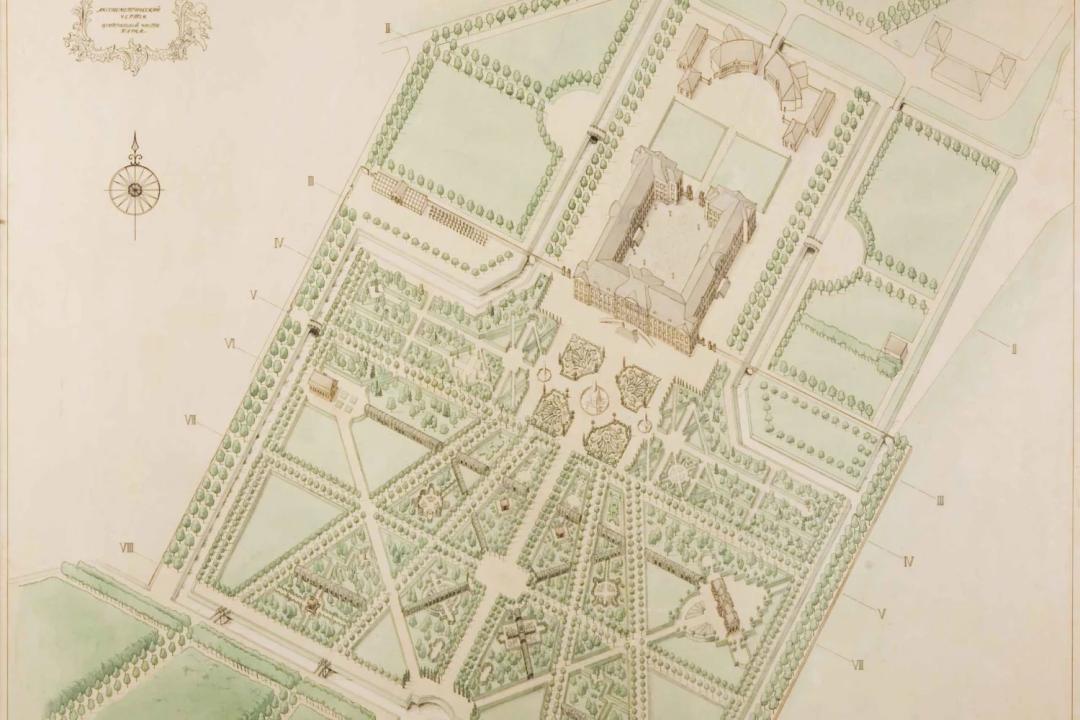
Today, the palace ensemble consists of the palace building itself with stables and other utility buildings, to which the "French Garden" of 10 hectares adjoins from the south, enclosed on all sides by a canal, and beyond it stretches a hunting park (34 hectares).
On two floors, the palace has 138 rooms arranged enfilade. The southern side of the central building houses the duke's ceremonial apartments, and on the northern side are his private living rooms. The eastern wing contains the ceremonial halls — the Golden (formerly Throne) and White (formerly Dance) Halls, connected by the Great Gallery. Notably, Rastrelli used unusually large bricks produced at a nearby factory in the palace's brickwork. Some of these bricks were transported to St. Petersburg and used in the construction of the Strelna Palace.
The decorative sculpture master Graff brought the Prussian variant of the Rococo style to Latvia. Italian artists F. Martini and C. Zucchi, who worked with Rastrelli on the construction of the Winter Palace in St. Petersburg, were followers of the Venetian school.
Duke Ernst Johann died in 1772, and the palace was inherited by his widow, Duchess Benigna Gottlieb; under her, fruit gardens were laid out around the palace. Duke Peter rarely visited Rundāle, mostly residing in the smaller palace Vircava near Jelgava.
After Courland's annexation to the Russian Empire in 1795, the palace, like all the Birons' property bought from them by Empress Catherine II, passed into the treasury. Soon the Ruental estate was granted to the hero of the Russo-Turkish and Russo-Polish wars, participant in suppressing the Tadeusz Kościuszko uprising in Poland, Valerian Zubov, brother of the empress's favorite Platon Zubov. In autumn 1794, while crossing the Western Bug, Valerian Zubov was wounded by a cannonball in his left leg, which was later amputated.
After Paul I ascended the throne, Valerian Zubov retired from St. Petersburg to his Courland estates, as all his other properties were seized to pay debts incurred during the unsuccessful military campaign in Persia, which he led. Although General-in-Chief Valerian Alexandrovich was opposed to the conspiracy against the emperor, he was forced to participate in it. Paul I was killed, but the new emperor Alexander I soon ceased favoring the conspirators. They were soon removed from court, and Valerian Zubov began visiting his Courland estates and organizing grand balls there. Considering himself responsible for the Persian campaign, he helped war veterans and received them at the Rundāle estate. On October 10, 1802, he held a harvest festival there, attended by 1,200 guests.

After his brother's death in 1804, the estate was inherited by Platon Zubov. He proved to be a good owner: he earned large incomes from grain trade and breeding Prussian horses.
The palace suffered during Russia's war with Napoleon in 1812. Expensive silk wallpapers were torn from the walls, mirrors were broken, but most of all, Platon Alexandrovich mourned the library gifted by Catherine II, which Napoleon's soldiers tore to shreds. In 1813, he began restoring the palace and then often lived in Ruental rather than in his main estate in Janishki, Shavelsky district.

In 1820, Platon Zubov married the daughter of a poor Vilnius nobleman, Tekla (Fyokla Ignatievna) Valentinovich. Zubov took his young wife to Ruental, where he died on April 7, 1822, at the age of 54. Three weeks after his death, the widow gave birth to a girl, the most serene princess Alexandra Platonovna, but the girl lived only until February 24, 1824. On November 12, 1824, Tekla Ignatievna married Count Andrei Petrovich Shuvalov. The owners rarely visited the estate, except for the period from 1864 to 1866, when Count Pyotr Andreyevich Shuvalov was governor-general of Livonia, Courland, and Estonia and used Ruental as his official summer residence.
In the 1880s, the palace interiors were renovated, but by the end of the century, some interior items and art collections were taken to St. Petersburg.

The palace remained the property of the Shuvalov family until 1920, when, as a result of land reform in the Republic of Latvia, they lost their rights to the Rundāle estate.
From 1915 to 1918, the palace housed the commandant's office and a hospital of the German army. In 1919, it was ransacked by soldiers of the Bermondt-Avalov army.
After partial repairs in 1923, the palace housed the primary school of the Rundāle parish. In 1924, the palace was transferred to the Latvian Union of War Invalids, then taken over by the Monument Administration, which began repairs and partial restoration of the premises. The western wing was rebuilt for school needs. In 1938, the palace was taken over by the State Historical Museum, which wanted to establish a museum of church art there. The palace rooms were open to visitors even during World War II. In 1945, grain was stored in the palace halls.
In 1963, part of the palace premises was transferred to the Bauska Local History Museum, and in 1972, Rundāle Palace received the status of an independent museum. Restoration work began in 1972. The first restored rooms were opened for viewing in 1981, and the last ones in 2014.

The palace and the adjacent garden are open to visitors as a museum. The palace is also used for receiving high-ranking foreign guests by the President of Latvia.
In 2007, Rundāle Palace was included in the List of European Cultural Heritage.
Sources:
https://www.russkije.lv/ru/lib/read/rundale-palace.html


Written by Jermaine
Discuss this with the author and others
No comments yet. Be the first to start the conversation.