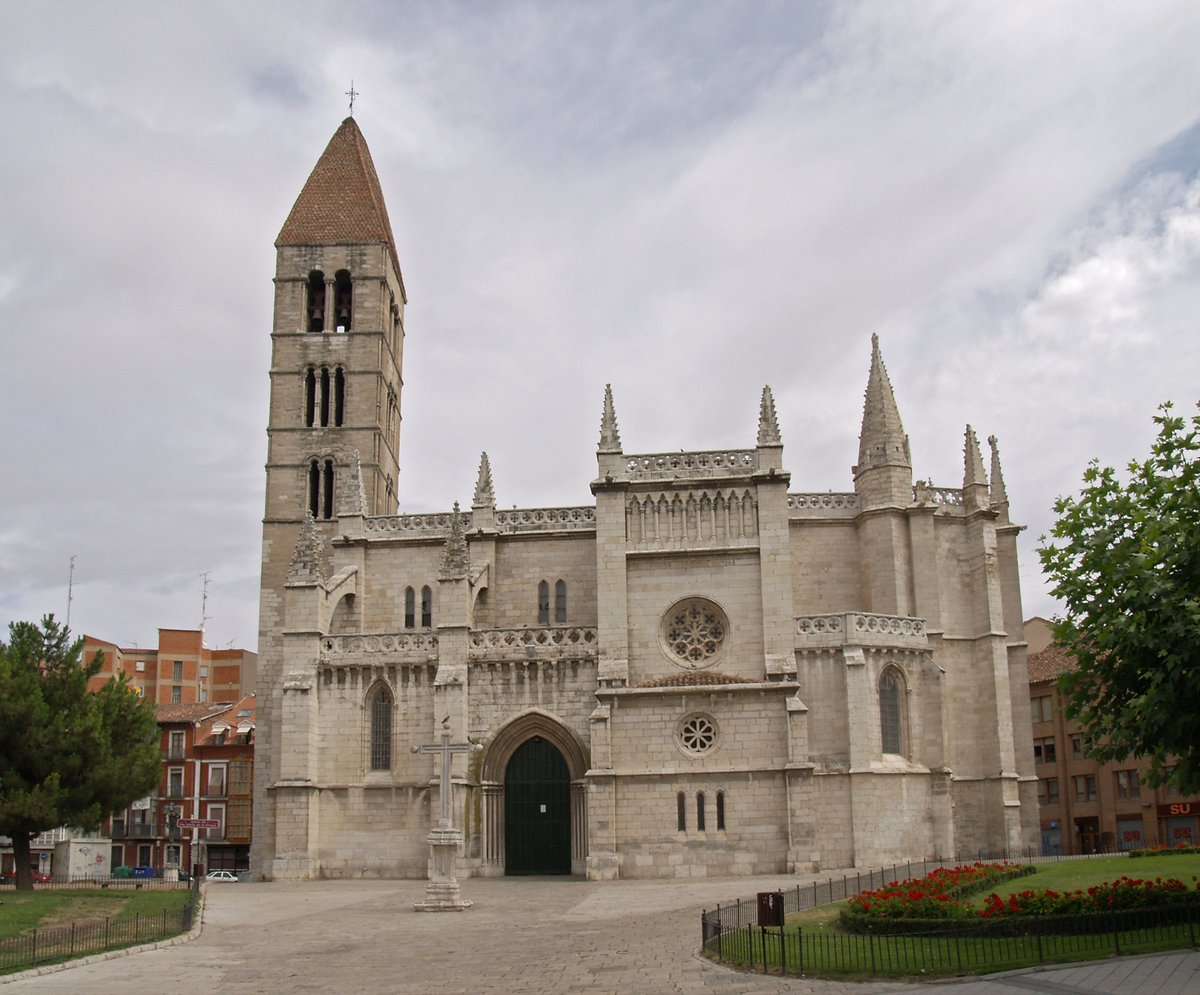

The Church of Santa María La Antigua in Valladolid, Spain, is a 12th-century church, but it wasn't always that way. Beneath the current structure, remains of foundations have been discovered dating back to a Roman hypocaust. The church was likely founded by Count Pedro Ansúrez in 1095, but this original structure no longer ever existed. The oldest parts of the current temple date back to the late 13th century. The gallery on the northern side of the building and the tower were built in Romanesque style in the late 12th century.
The naves and sanctuary were rebuilt in Gothic style in the 13th century, following the style of Burgos Cathedral. The church has three aisles, with three polygonal apses and a transept. The nave and the aisles are rib-vaulted. In the mid-16th century, the building underwent extensive repairs under the direction of architect Rodrigo Gil de Hontañón. He added buttresses and several gauges to restore the collapsing building. The high altar retablo, by Juan de Juni, was created during this period and now resides in the Valladolid Cathedral.
Several Baroque altarpieces were executed for the church's interior during the 17th and 18th centuries, hiding the original Gothic appearance. In the early 20th century, the building was extensively restored and rebuilt to show its original Romanesque-Gothic appearance, following the doctrines of the French architect Eugène Emmanuel Viollet-le-Duc.
Sources: Wikipedia, OpenStreetMap, Wikidata, Wikimedia Commons
Written by Nicolo Ciampini
Discuss this with the author and others
No comments yet. Be the first to start the conversation.