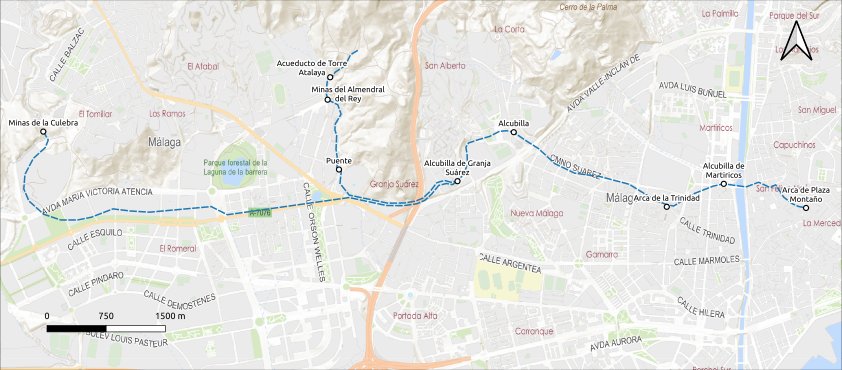

Aguas de la Trinidad were a historic water supply system for Málaga, functioning from mid-16th century to early 20th century. They were the main water source for the city for two and a half centuries, until the construction of the San Telmo aqueduct in the late 18th century. The water system originated from the mines of Almendral del Rey, the runoff from the Teatinos river, and a spring located in Torre Atalaya. The system included various aqueduct sections: the Almendral del Rey aqueduct, the Culebra aqueduct, and the Torre Atalaya (or Dos Ojos) aqueduct.
The Almendral del Rey aqueduct conveyed water from the mines of the same name along the right bank of the Teatinos river until its confluence with the Culebra aqueduct, near a now-disappeared alcubilla in Granja Suárez. The Culebra aqueduct originated from the mines located on the right bank of the Culebra river until it ran parallel to the Almendral del Rey aqueduct, where they confluenced near the Granja Suárez alcubilla. The Torre Atalaya aqueduct, also known as the Dos Ojos aqueduct, was constructed to convey water from the spring of Torre Atalaya to its confluence with the Almendral del Rey aqueduct, requiring the construction of a bridge over the Teatinos river, which still survives.
The Trinidad aqueduct started at the confluence of the Almendral del Rey and Culebra aqueducts, continued alongside the Cuarto river and ended at an arch adjacent to the Trinidad Convent, which gave name to these waters. This arch functioned as the main point of urban distribution. Water was distributed to private houses and public fountains via conduits that crossed the Guadalmedina river using a siphon at the Martiricos alcubilla and the streets Parras and Guerrero.
The Aguas de la Trinidad project was first conceived in 1532. The water system was abandoned and eventually extinguished by the early 20th century.
Sources: Wikipedia, OpenStreetMap, Wikidata, Wikimedia Commons
Written by Nicolo Ciampini
Discuss this with the author and others
No comments yet. Be the first to start the conversation.