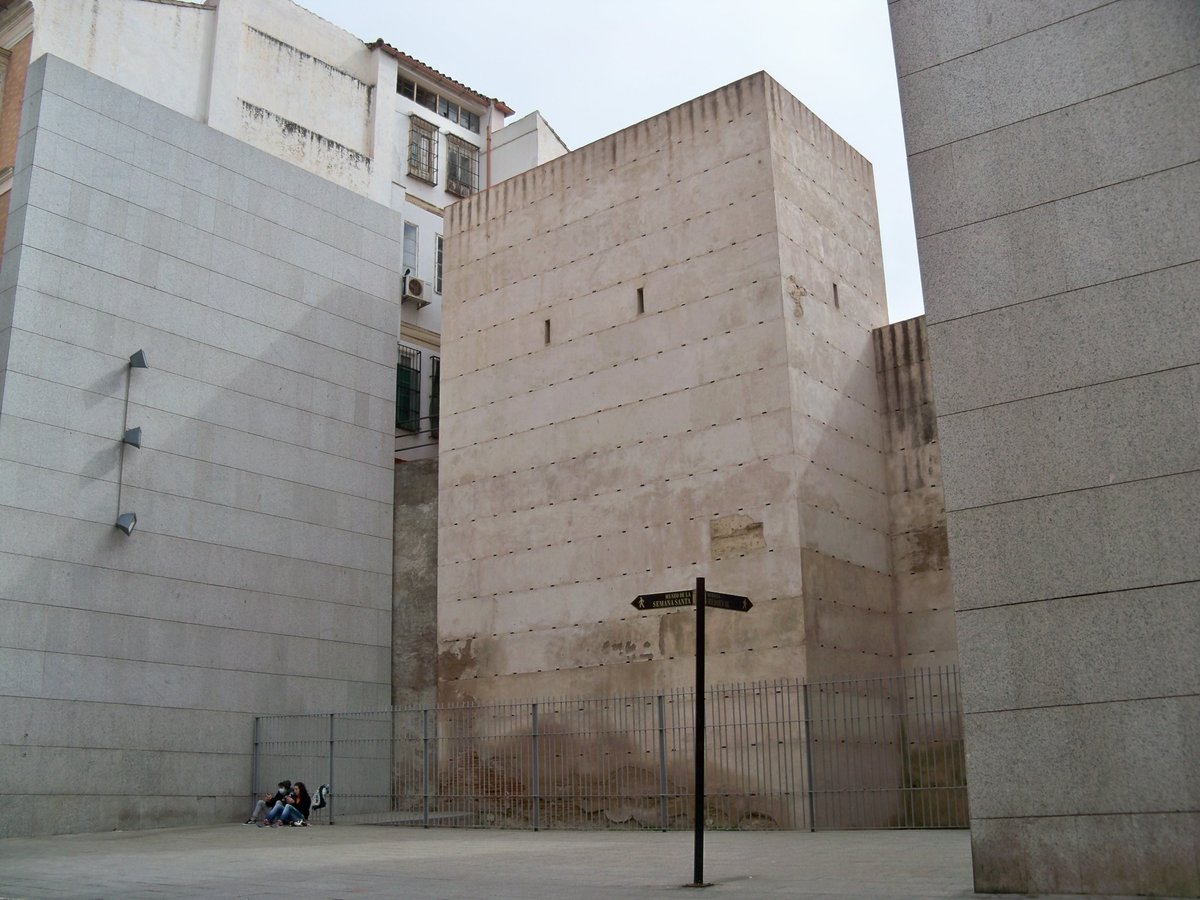

The medieval city wall of Málaga was a defensive structure built in the 11th century around the old medina. Its construction coincided with the city's urban expansion during that century. While the infrastructure underwent various phases of renovation in later periods, such as in the 13th century under Abd Zannun and the 14th century, its original layout remained largely unchanged.
The wall retained its defensive function after the conquest of Málaga. It served as a frontier against the Nasrid Kingdom of Granada and later as a border port, military base, and hub for operations in North Africa and Italy. The structure consisted of two wall lines with a walkway between them, an exterior barbacana of lesser height, and several defensive towers. A ditch was excavated in its northern and western perimeters.
Today, several sections of the wall are preserved. The Muro de Santa Ana runs from the northern tower of the Alcazaba to the Granada gate, while fragments are integrated into a bookstore on Puerta de Buenaventura. At Carretería 62-64, a 12th-century section is visible at street level, featuring a mix of brick and masonry that appears to reflect 18th-century housing restorations rather than repairs to the wall itself. Other remains are integrated into basements, and the wall's path is marked on the pavement in several streets using red travertine marble tiles.
Sources: Wikipedia, OpenStreetMap, Wikidata, Wikimedia Commons



Written by Nik Frost
Discuss this with the author and others
No comments yet. Be the first to start the conversation.