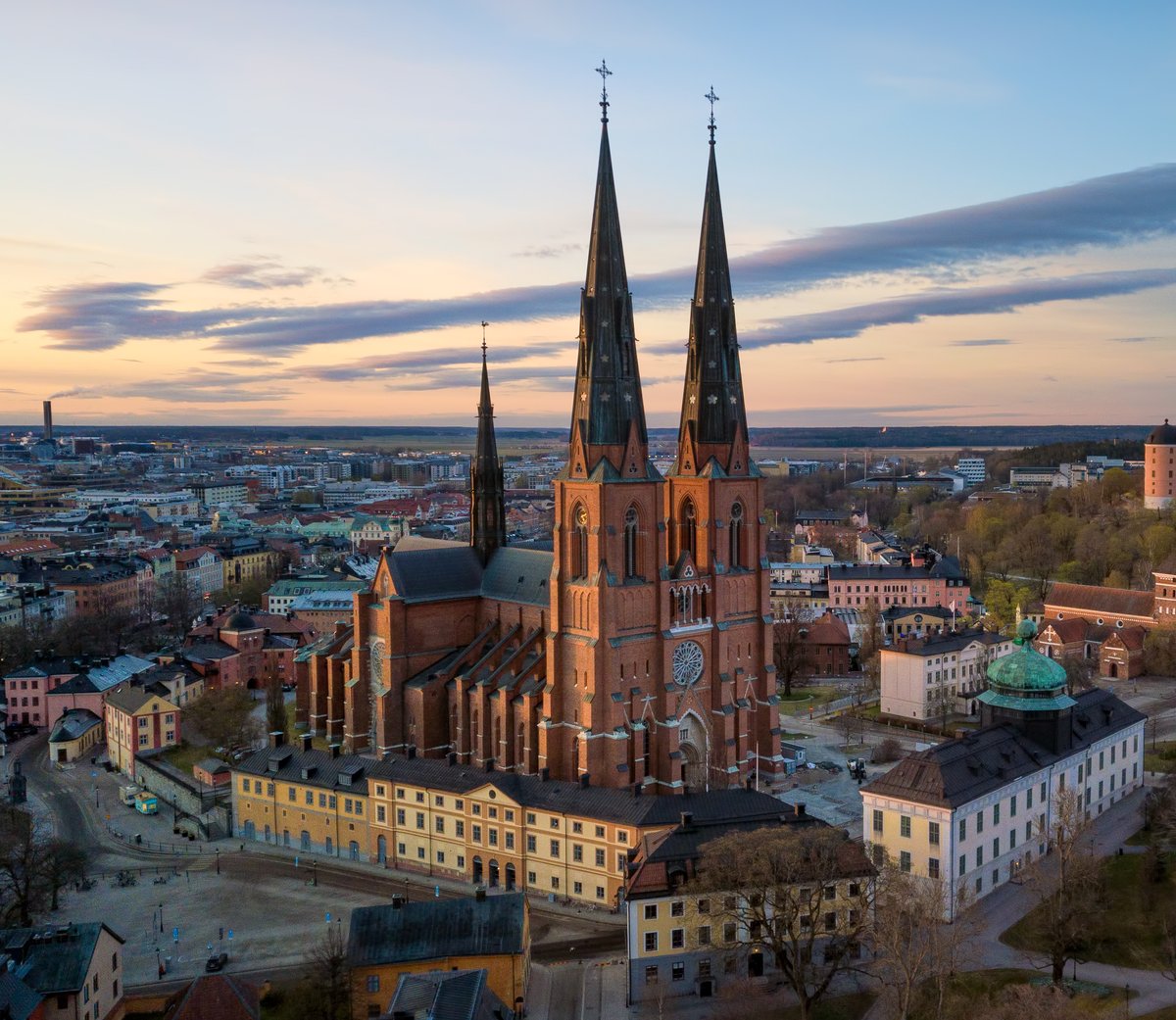

Uppsala Cathedral is a symbol of the Uppland region's rich history, dating back to the late 13th century. It is the seat of the Archbishop of Uppsala and the burial site of King Eric IX (c. 1120–1160, reigned 1156–1160, buried 1160), who was murdered in 1160 and later became the patron saint of Sweden. The cathedral was originally built under Roman Catholicism, but after the Protestant Reformation, it continued to be the traditional location for the coronation of new Kings of Sweden until 1719, when Stockholm's Storkyrka took over this role.
Martin Modéus is currently the archbishop and Karin Johannesson is the bishop. The church was designed by French architects, including Étienne de Bonneuil, and is built in the French Gothic style. It is in the form of a cross formed by the nave and transept, and its principal construction material is brick, with many details made of Gotland limestone. The church was completed only in the 15th century, after construction had commenced around 1272.
Étienne de Bonneuil, a French master builder, worked on the east and south chapels, the transepts, and possibly the south portal of the cathedral in the late 13th century. Construction work was slow due to the cold climate, the plague, and financial difficulties. The cathedral was consecrated in 1435 but was still incomplete. The cathedral was damaged by fire on several occasions, including in 1702 during the great fire that seriously damaged the city, but not the church.
Extensive renovation work was carried out in the 18th and 19th centuries, including by Helgo Zetterwall, who uncovered and restored many medieval frescoes that had been whitewashed over after the Reformation. Uppsala Cathedral is the tallest church in the Nordic countries, standing at 118.7 meters (389 feet) tall.
Sources: Wikipedia, OpenStreetMap, Wikidata, Wikimedia Commons
Written by Nik Frost
Discuss this with the author and others
No comments yet. Be the first to start the conversation.