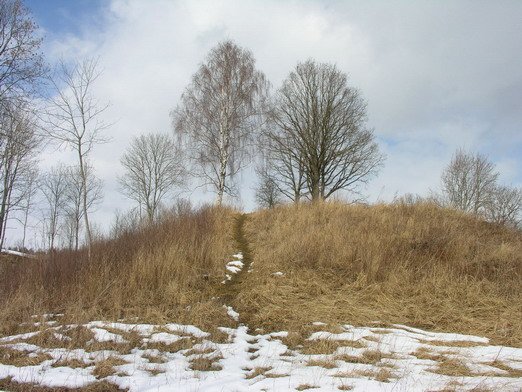
Jautakių piliakalnis, a hill in Pilalė, Pilies Hill, Pilies Region, is part of Mažeikiai–Skuodas municipality. Discovered in 170, the site sits at the foot of Pilies Hill. The hill, termed as aikštelė in the archaeological community, is oriented towards the Ventos wind. The aikštelė, remnants of Rantų užtvaros – liekanų are found in its rytinio pakraštyje, is 45 meters long and 8-15 meters wide, and has a height of 1.5 meters (originally 3 meters high).
The aikštelė has a width of 17 meters. A 1.5 meter high pylimas is found behind the aikštelė, and a 1.5 meter high and 4 meter wide griovys is also found behind the aikštelė. A 3 meter high stalai are found on the aikštelė. Jautakių piliakalnis dates from the 1st Millennium to the 13th Century. In the 1st millennium and the first half of the 13th century, Jautakių piliakalnis was probably a dwelling place for its inhabitants. Archeological excavations of Jautakių piliakalnis were conducted in 1966 by the History Institute, in 1970 by the archaeologists of the Mokslinės metodinės kultūros paminklų apsaugos tarybos, and in 1975-1976 by archeologists from the History Institute, Jonas Stankus and Algimantas Merkevičius.
Excavations at the site uncovered cultural objects with stylized stylus, stone tools, millstones, clay, bones, tusoktė, and pottery, as well as remnants of Rantų užtvaros – liekanų. The pylimas was made of stone and clay, and the griovys also found behind the aikštelė was made of the same materials. The site covers 2.5 hectares and has an archaeological settlement from 1775-1777 and 1993. There are 21 open hearths at the site, ranging from 0.6 x 0.9 m to 1.0 x 1.2 m in size.
Findings from the 150 cm deep layer date back to the Iron Age and Roman period. Stone steps, human skeletons, artifacts like a chisel, a capstone, a cylindrical spindle whorl, a grenade fragment, a pottery fragment, bricks, lime plaster, Karolis stone, tiles, and pottery, bones of animals, and iron loops were found. The archaeological site is protected by Lithuania’s national museum.
Sources: Wikipedia, OpenStreetMap, Wikidata, Wikimedia Commons
Written by Nicolo Ciampini
Discuss this with the author and others
No comments yet. Be the first to start the conversation.