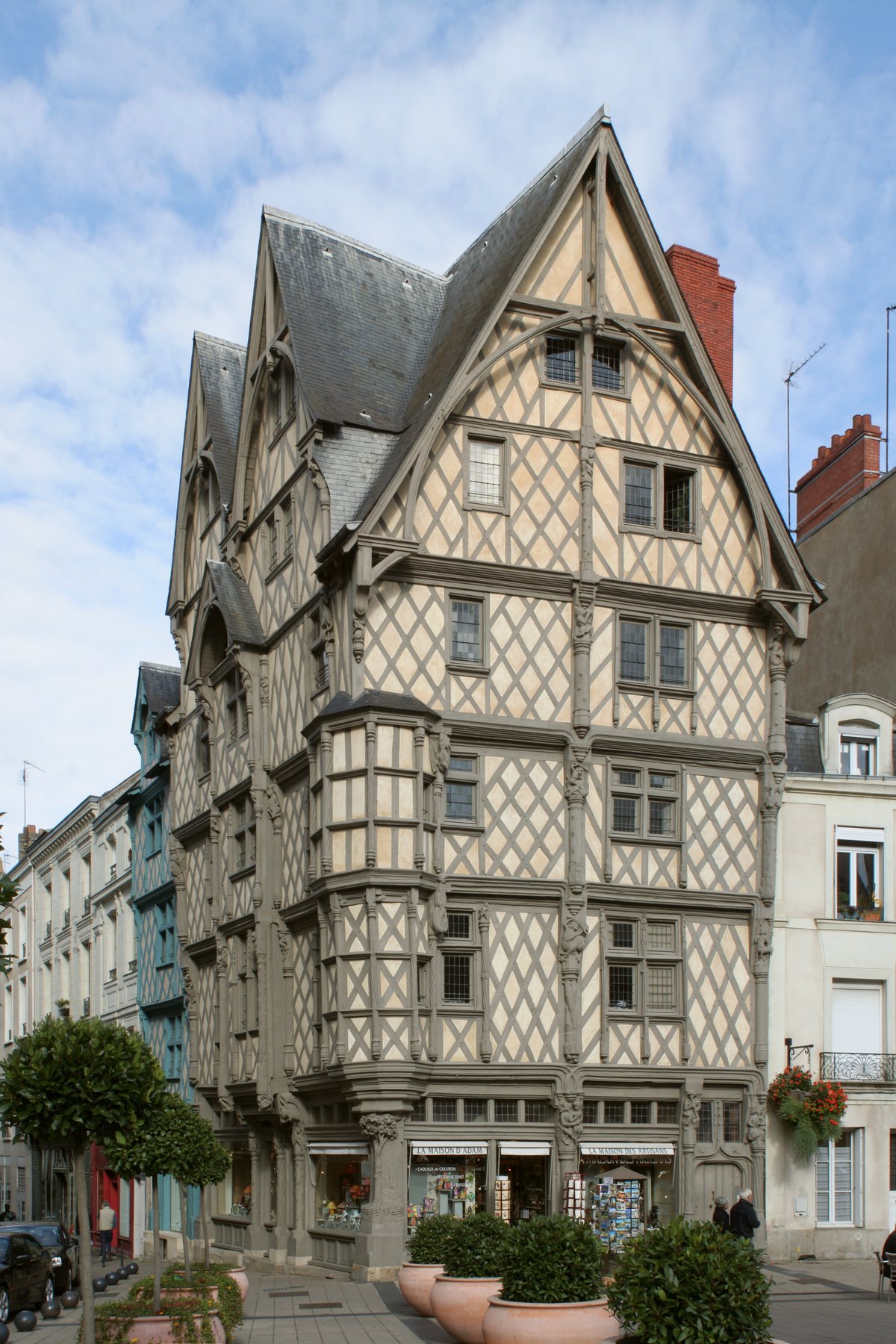

Known as Maison d'Adam, this timber-framed house stands at the heart of Angers, France, at the crossroads of Rue Montault and Place Sainte-Croix, just behind the cathedral. Constructed around the late 15th century, it's one of the few surviving medieval buildings currently housing the Maison des artisans d'Angers on the ground floor and apartments above. For centuries, this land was the property of the Lefèvre family. It's believed that Jean Lefèvre or Jean Lebreton commissioned the construction of the house.
The house was owned by several individuals, including Renée Lefèvre, Jean Jolivet, a merchant of woolen cloth, and Michel Adam, the grandson of Jean Jolivet, a merchant of silk. During the revolution, the revolutionaries destroyed the statues of Adam and Eve, leaving only the apple tree. In archaeology, it was determined that the house was built around 1491. The façades and the building were classified as historical monuments by decree of September 28, 1922.
Renovations were active until 1951, with the first restoration work starting in 1990. Today, the building houses the Maison des artisans d'Angers. The Maison d'Adam was restored around 1994 and 2022. This latest restoration, led by the Soclova (one of the Anjou housing companies), cost around 3 million euros. The Maison d'Adam has six levels: a ground floor, three floors, two levels of attic, and a vaulted basement. On the main façade, Place Sainte-Croix, it features a large gable. The timber-framed façade is decorated with numerous sculptures, and the 'Tree of Life' sculpture can be found among them.
Surprisingly, it is unknown where the 'Tree of Life' sculpture came from or its historical significance. This aspect requires further research for a more complete understanding of this medieval masterpiece.
Sources: Wikipedia, OpenStreetMap, Wikidata, Wikimedia Commons
Written by Nicolo Ciampini
Discuss this with the author and others
No comments yet. Be the first to start the conversation.