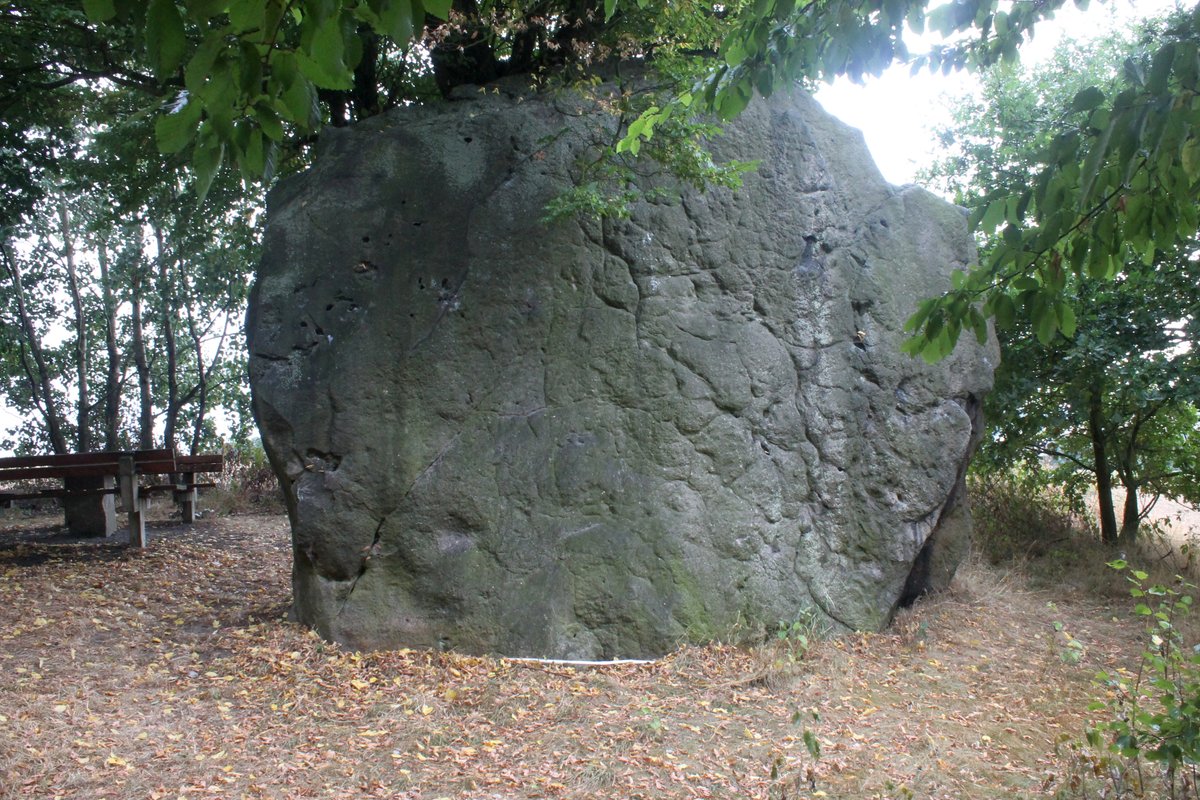
A massive block of quartzite rises from the woodland floor near Wolfershausen. It is an oblate rectangular cuboid, a heavy, silent presence standing 4.7 metres tall and 4.6 metres wide. It rests in the south-eastern corner of a small woodland, just over a kilometre north of the village.
The stone is a product of deep time, formed between 23 million and 8 million years ago. In a tropical climate, silica-saturated groundwater moved through local sandstones, leaching out minerals and leaving behind a rock made almost entirely of quartz. This quartzite is dense, nearly void of porosity, and weighs approximately 37 metric tons. For comparison, the sarsen stones of Stonehenge weigh only about 7 metric tons each. Because the bedding planes of this quartzite are now vertical, we know the stone is not in its natural resting place; it was moved here by hands long since turned to dust.
Humans have been drawn to this weight for millennia. Archaeological digs at the base of the megalith uncovered Neolithic human remains, proving the site was in use around 3000 B.C. It was a place of activity and intent long before the first records of the region. By 1615, it was simply known in documents as the "Großer Stein," a large stone, but the local imagination preferred something more dramatic. The name Riesenstein, or giant's stone, grew from the shadows of the Lotterberg hill.
One legend speaks of a malicious giant who watched the construction of the Breitenau Monastery. He supposedly ripped this massive rock from the earth and hurled it at the building to reduce it to rubble. He missed his mark, and the stone fell before it passed the Ellenberg hill, landing where it sits today. Another story weaves a tale of a kidnapping. A giant named Kunibert stole a giantess named Nagathe from her home with the giant Lothar. In a fit of rage, Lothar threw a stone at Kunibert, but the projectile struck the soft ground instead. The stone became a permanent monument to his missed aim.
Today, the Riesenstein is a protected German natural monument. It sits in the floodplain of the Eder River, roughly 180 metres from the eastern bank. Visitors can reach it from a tarmacked road north of the railway bridge. It remains a heavy, geological ghost in the trees, a piece of ancient tropical sediment repurposed as a Neolithic altar and a giant's weapon.
Sources: Wikipedia, OpenStreetMap, Wikidata, Wikimedia Commons
Written by Aurora
Discuss this with the author and others
No comments yet. Be the first to start the conversation.