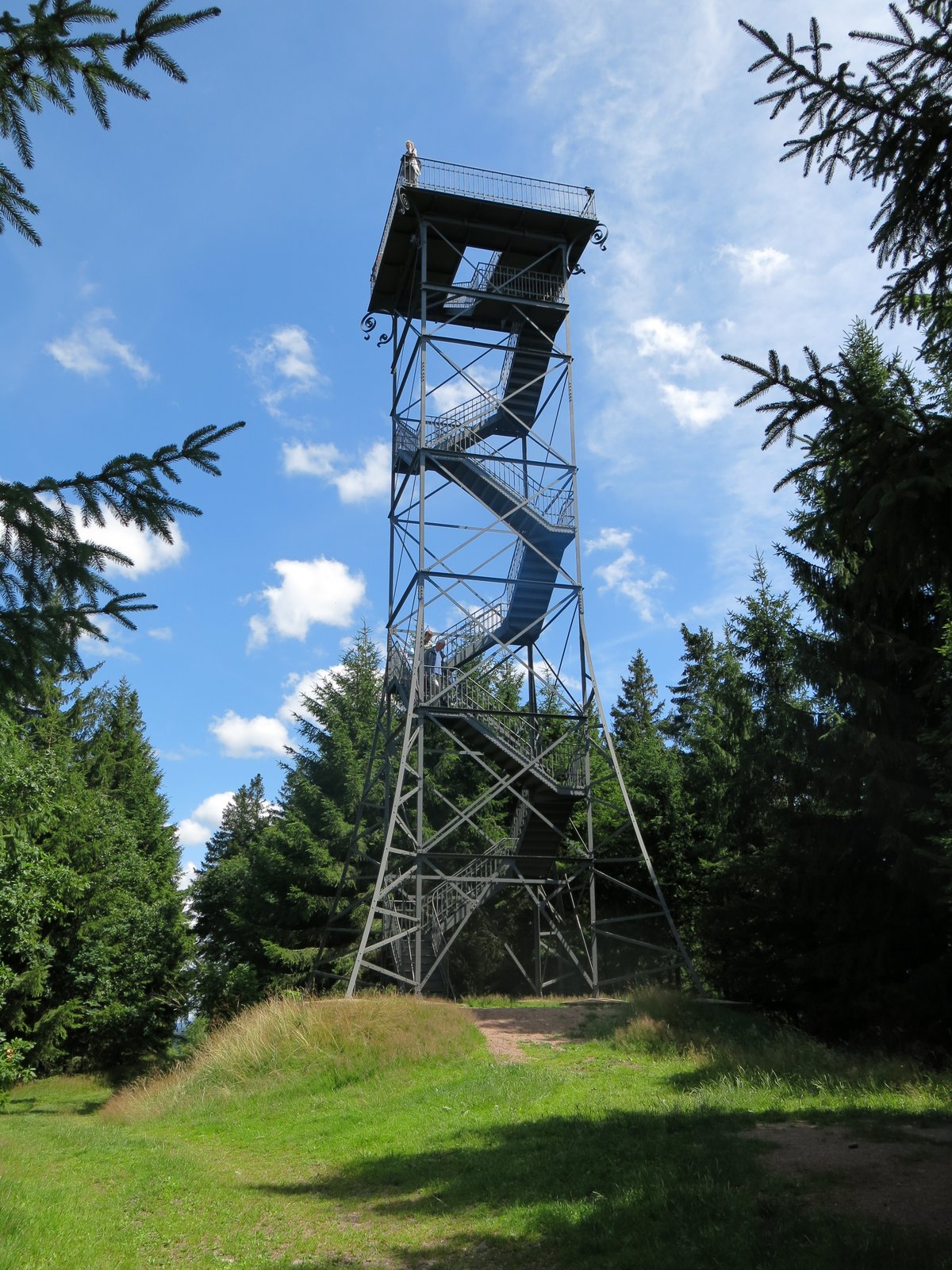
A wooden tower once stood here on the Ringberg until a storm tore it down in August 1896. What remains today is its iron successor, the Carl-Alexander-Turm. It is the only preserved historical observation tower in the western Thuringian Forest, situated on the Ringberg mountain at an elevation of 638.9 m.
Before the iron arrived, the peak was a place of architectural evolution. In 1825, an observation pulpit was raised to honor the 50th anniversary of Grand Duke Carl-August's reign. This structure sat on the mountain for decades before Alexander Ziegler commissioned a more substantial wooden tower in 1867. He named it for Grand Duke Carl Alexander and even installed a mailbox for visitors to deposit postcards with their addresses. A general post director was so moved by the structure during a hike that he composed a verse about it.
In 1897, the firm Wilk of Eisenach stepped in to provide a more permanent solution. They erected the current 21-meter iron tower, a structure of 111 steps leading toward the clouds. The inauguration occurred on August 15, 1897, and the tower began its long life of public service. It became a community project early on, with a dedicated association formed in 1889. The Thüringerwald-Verein took up the mantle of preservation in 1932, and the local population eventually chipped in to provide a fresh coat of paint in 1952, moving the tower from a mere landmark to a shared piece of local heritage.
The mid-century years saw the city of Ruhla take official ownership in 1956. Repairs followed in quick succession, often fueled by the generosity of the people. In 1959, a general renovation cost over 8,000 Marks, and a construction hut from the 1940s was kept around as a shelter. By 1989, the work became more intensive, involving the replacement of all steps and platforms to ensure the stairs remained safe for those seeking the view. Panoramic signs were added in 1992 to help orient the eyes toward the distant peaks.
Today, the tower stands as a vantage point where the horizon stretches out in every direction. From here, the Thuringian Forest unfolds toward the Inselsberg, and the city of Ruhla sits at the base. On clear days, the eyes can travel far enough to catch the Brocken in the Harz mountains. After a closure in 2012 due to safety concerns, public donations once again saved the structure, leading to its reopening in August 2014.
Sources: Wikipedia, OpenStreetMap, Wikidata, Wikimedia Commons
Written by Aurora
Discuss this with the author and others
No comments yet. Be the first to start the conversation.