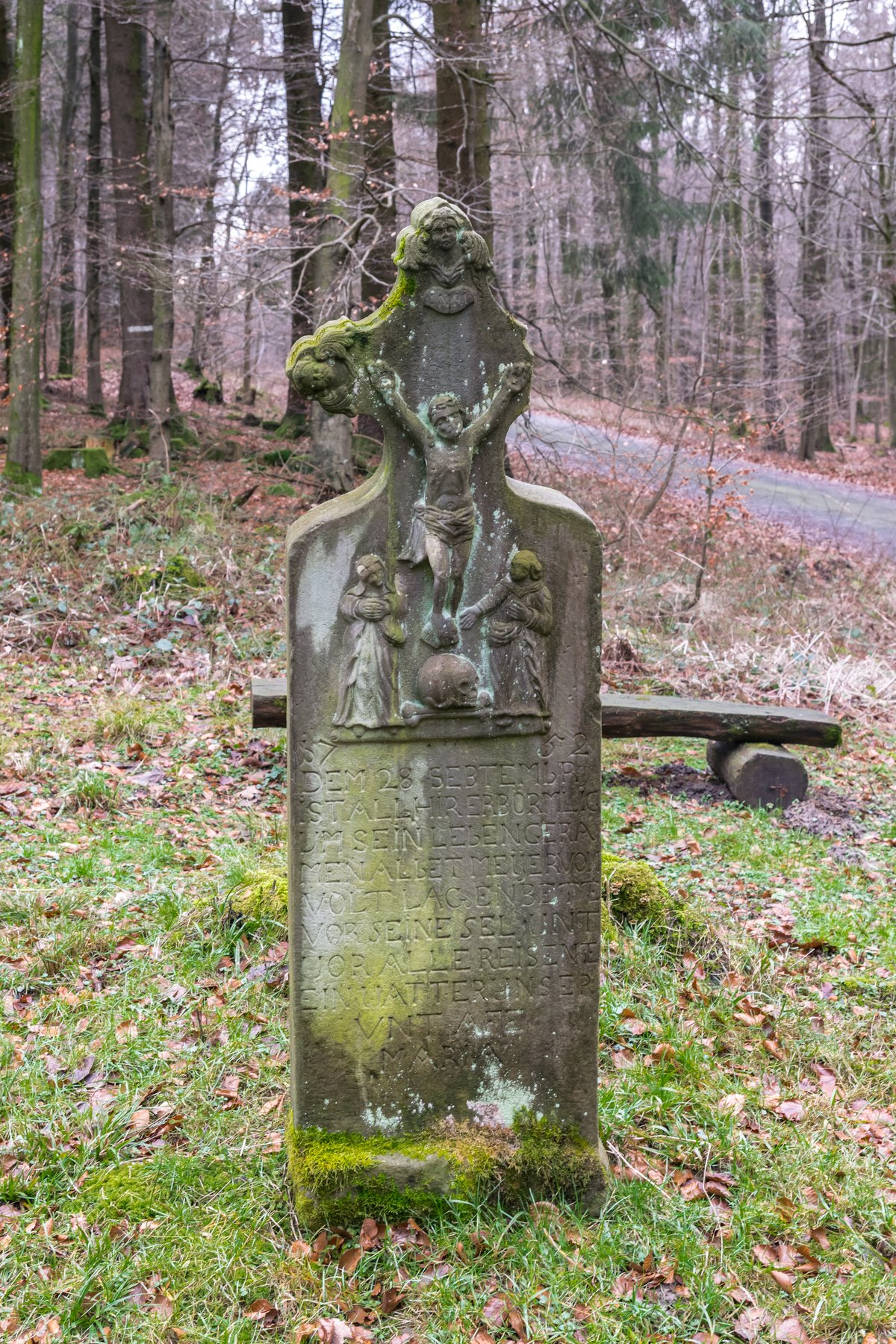
A stone cross stands on the Spellerberg plateau, marking a triple border between Horn-Bad Meinberg, Bad Lippspringe, and Altenbeken. It is a modest monument of sandstone, rising about 1.90 metres from the grass. It is a Töddendenkmal - a specific type of memorial for a traveling merchant. These markers are rare, yet they speak to the high status of the merchants who moved through these remote landscapes, traveling with goods and stories that built the commerce of the region.
In 1752, a merchant named Albert Meijer traveled this path. It was a busy crossroads for the time, where trade routes from southern Münsterland over the Weser mountains met the roads toward Bad Lippspringe and the Zollstock branch leading toward Detmold. At an elevation of roughly 400 metres, the landscape was a workspace for men like Meijer. He was a wanderhändler, a traveling merchant whose life was defined by the movement of goods and the endurance of the road.
Local legend captures a scene of sudden, violent irony. While traveling from Horn to Paderborn, Meijer stopped to rest and began the craft of making tin spoons. He built a fire to melt the metal and set up a plate iron as a barricade against the wild animals of the woods. As he worked, sleep overcame him. A dark figure approached his camp and poured molten tin from a pan into the sleeping man's open mouth. Meijer choked to death instantly. The assailant then moved to the luggage to plunder the contents, but in his haste, he stepped into the plate iron and fell into the flames, burning to death alongside the man he had just murdered.
This cross is a physical remnant of a specific, brutal moment in the history of the Weser mountains. It serves as a reminder of the risks faced by those who moved the region's economy by hand and foot. The merchant families who eventually built the great brands of Westphalia - names like Brenninkmeyer, Hettlage, Boecker, and Peek & Cloppenburg - often trace their lineage back to these very types of travelers. They were the wanderhändler, the mobile commerce of the old world.
Today, the site remains a quiet junction. You can still see the crucifixion group and the skull carved into the sandstone. It sits at the meeting point of three municipalities, a permanent sentinel over a crime scene that has been smoothed over by centuries of growth. It is a piece of history that is both a tragedy and a tribute to the importance of the road.
Sources: Wikipedia, OpenStreetMap, Wikidata, Wikimedia Commons
Written by Aurora
Discuss this with the author and others
No comments yet. Be the first to start the conversation.