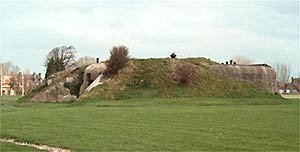

The Merville Gun Battery is a decommissioned coastal fortification in Normandy, France, built as part of the Germans' Atlantic Wall to defend continental Europe from Allied invasion. It was a particularly heavily fortified position and one of the first places to be attacked by Allied forces during the Normandy Landings. A British force under the command of Lieutenant Colonel Terence Otway succeeded in capturing this position, suffering heavy casualties.
The Merville Battery is composed of four 6-foot-thick steel-reinforced concrete gun casemates, built by the Todt Organisation. Each was designed to protect First World War-vintage Czech-made leFH 14/19(t) 100 mm mountain howitzers with a range of 8,400 m. Other buildings on the site include a command bunker, a building to accommodate the men, and ammunition magazines. During a visit on 6 March 1944, Field Marshal Erwin Rommel ordered the builders to work faster, and by May 1944, the last two casemates were completed.
The battery was defended by a 20 mm anti-aircraft gun and multiple machine guns in fifteen gun positions, all enclosed in an area 700 by 500 yards. This area was surrounded by two barbed wire obstacles 15 feet deep by 5 feet high, which also acted as the exterior border for a 100-yard-deep minefield. Another obstacle was an anti-tank ditch covering any approach from the nearby coast.
Sources: Wikipedia, OpenStreetMap, Wikidata, Wikimedia Commons

Written by Nicolo Ciampini
Discuss this with the author and others
No comments yet. Be the first to start the conversation.