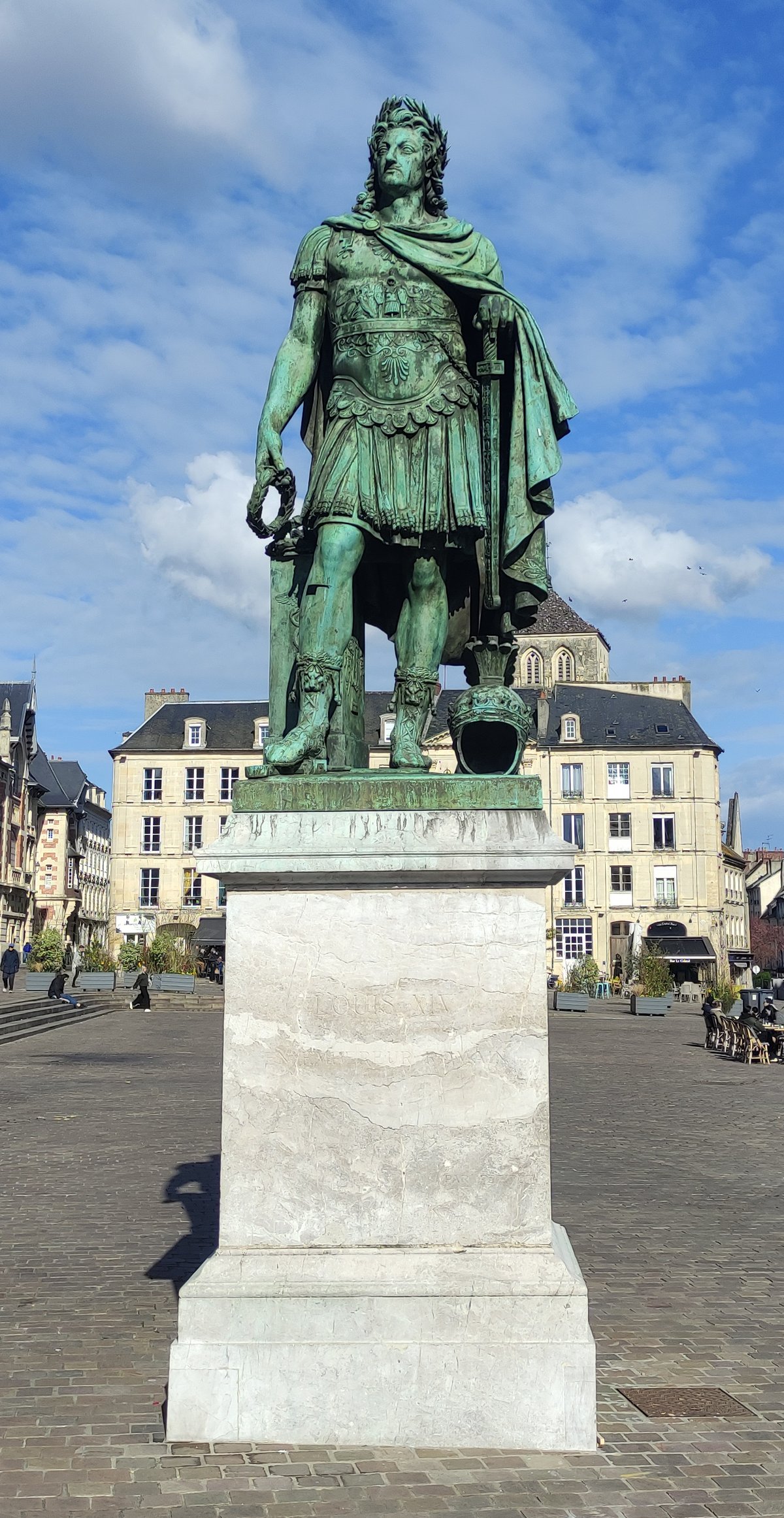

The bronze statue of Louis XIV in Caen is a neo-classical work by the sculptor Louis Petitot. Installed in 1828, it was erected to show the city's loyalty to the new regime. It replaced a previous statue of the same subject, which had been erected in the 17th century on the Place Royale and destroyed during a period of unrest.
In the 1630s, the municipality of Caen launched an urban planning operation to develop a large square. On November 4 and 9, 1684, the municipality decided to build a statue of Louis XIV in the center of this new square, called Place Royale. The original statue was eventually overturned in the night of 3 to 4, 1791. The destructors, probably the club des Jacobins, had made a first attempt on the night of July 2 to 3, 1791, but the guard was alerted and only the inscriptions on the pedestal were destroyed.
The current bronze statue was commissioned after a project for a statue of François de Malherbe was abandoned. The municipality chose to create a new statue of Louis XIV to show its fidelity to the new regime in the context of the Restoration. Louis Petitot took inspiration from the Auguste de Prima Porta for the work. The statue was cast in bronze in 1827. The official inauguration of the ensemble took place on the 14th anniversary of the return of Louis XVIII to France.
Since its installation, the statue has moved several times. From 1828 to 1884, it stood on the Place de la République. Between 1884 and 1961, it was located in front of the wall of the lycée Malherbe in the former abbaye aux Hommes. Since 1961, it has been situated on the Place Saint-Sauveur in the old town center of Caen.
Sources: Wikipedia, OpenStreetMap, Wikidata, Wikimedia Commons
Written by Nicolo Ciampini
Discuss this with the author and others
No comments yet. Be the first to start the conversation.