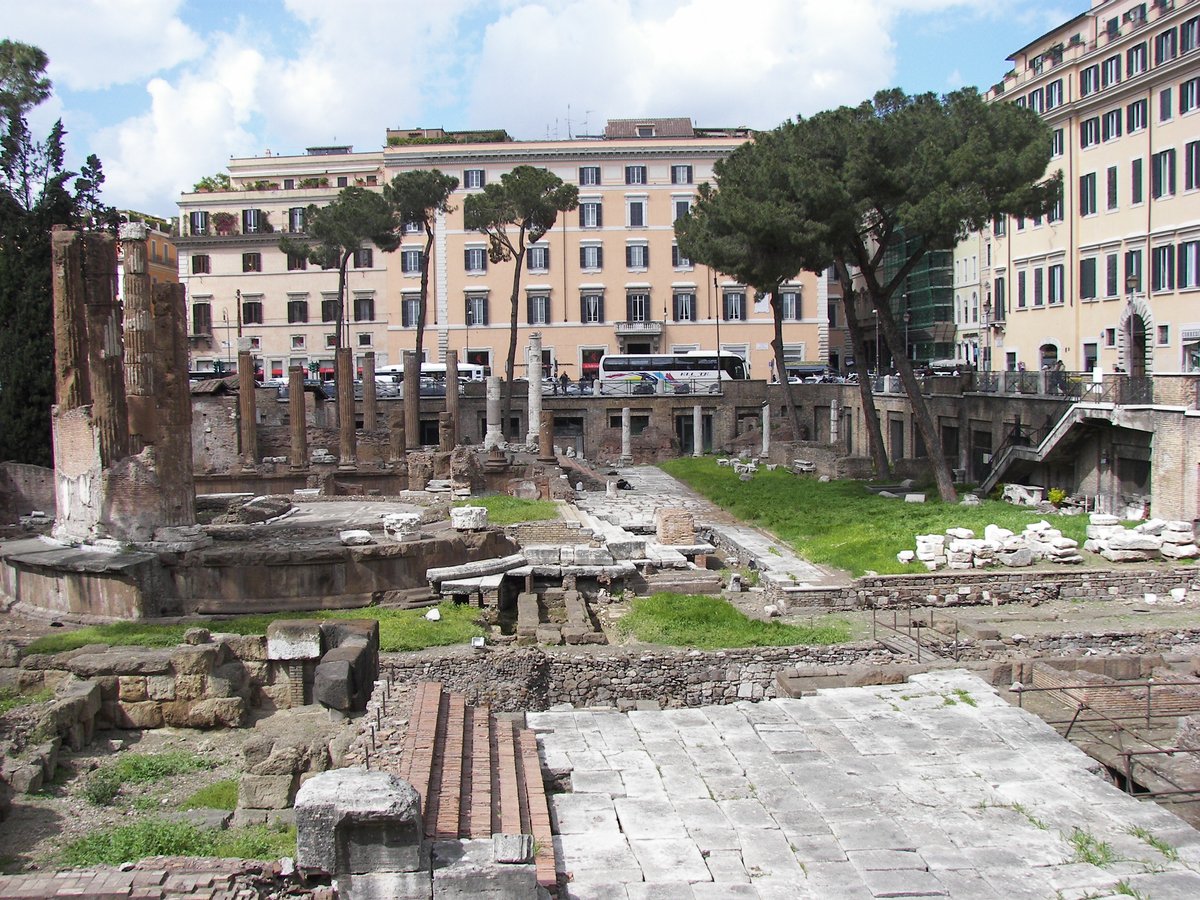

You can stand exactly where Julius Caesar met his end in the Largo di Torre Argentina. This area in the ancient Campus Martius served as one of the places where the ancient "Argentario" - the bankers - used to conduct their trade. The square takes its name from the Torre Argentina, a tower named after the city of Strasbourg.
In 1927, during demolition work to reconstruct part of Rome, workers discovered the colossal head and arms of a marble statue. This discovery brought to light a holy area dating to the Republican era, containing four temples and part of Pompey's Theatre. Temple A was likely the Temple of Juturna, built by Gaius Lutatius Catulus after his victory against the Carthaginians in 241 BC. The long area behind it was used as a public latrina without dividers or cubicles.
Temple B is a circular tholos with six columns remaining. Built by Quintus Lutatius Catulus in 101 BC, it was devoted to Fortuna Huiusce Diei, the fortune of this day. Temple C is the most ancient of the four, featuring terracotta decoration dating back to the 290s/280s BC and likely dedicated to the goddess Feronia.
Since 2019, the public can tour these ruins via new walkways. The site also houses the 18th-century Teatro Argentina, where many notable operas by Rossini and Verdi premiered. Located in Temple D is the Torre Argentina Cat Sanctuary, founded in 1993. It houses about 350 cats and operates as a no-kill shelter, despite protests from archaeologists to dismantle the shelter to protect the excavation.
Sources: Wikipedia, OpenStreetMap, Wikidata, Wikimedia Commons


Written by Nicolo Ciampini
Discuss this with the author and others
No comments yet. Be the first to start the conversation.