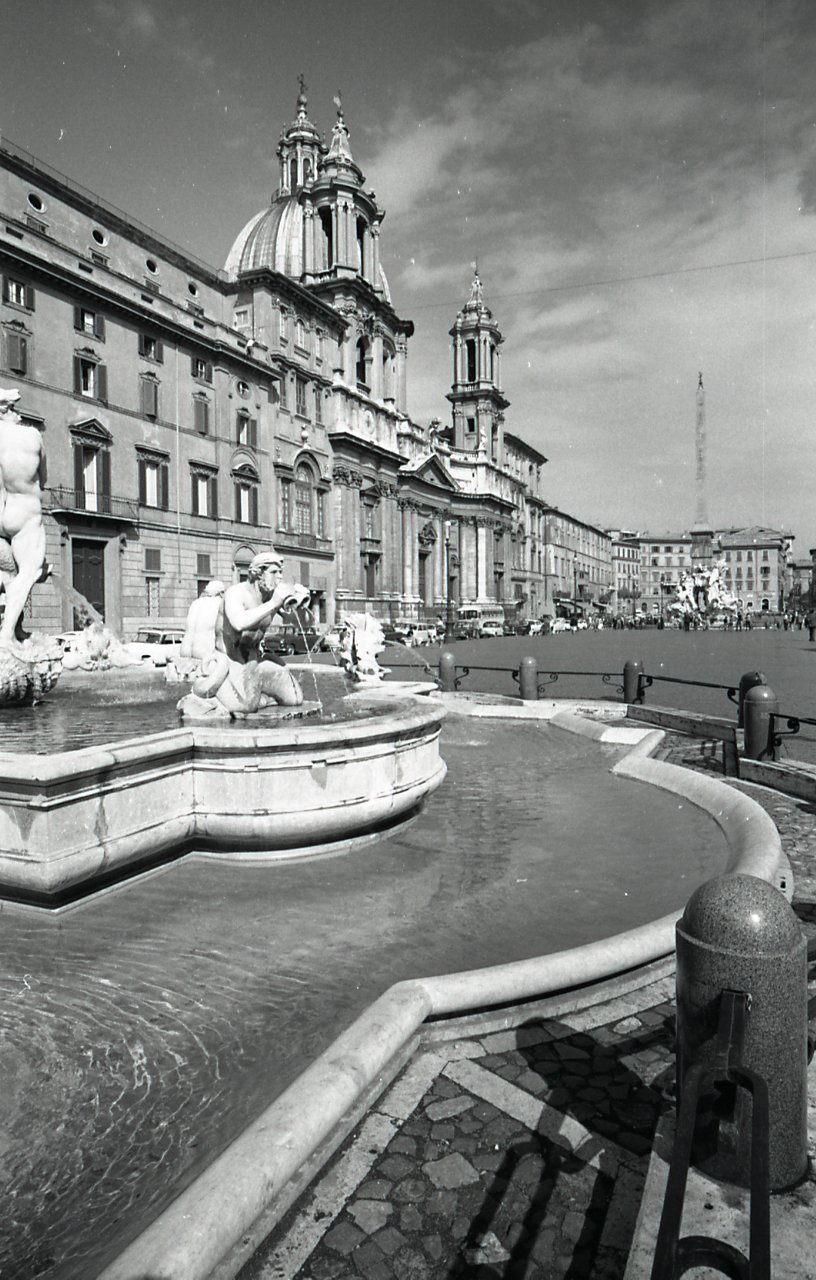

Piazza Navona has a peculiar, elongated shape because it was built on the site of the Stadium of Domitian, constructed by Emperor Titus Flavius Domitianus starting in 80 AD. Ancient Romans flocked here to watch the agones, or games, and the space follows the form of that ancient stadium. Most of the original stone was eventually scavenged for other buildings, but the curve of the arena remains today.
In the 17th century, the space underwent a dramatic makeover and became a showcase for Baroque design during the pontificate of Innocent X, whose family lived in the nearby Palazzo Pamphili. In 1651, Gian Lorenzo Bernini installed the Fontana dei Quattro Fiumi, which sits in front of the Church of Sant'Agnese in Agone. This masterpiece of water and stone is topped by an obelisk that was brought in pieces from the old Circus of Maxentius.
There is something surreal about the historical festivities here. From 1652 until 1866, the area was flooded every weekend in August in elaborate celebrations of the Pamphili family. Today, a Christmas market is held in the square each year from the first week of December until the first week of January, while the regular city market moved to the nearby Campo de' Fiori in 1869.
The square still feels like a stage, even if the ancient games are over. Visitors should note the fountains; for example, the Fontana del Moro suffered vandalism in 2011 when a man used a large rock to damage some of the figures. It is a reminder that even the most beautiful monuments remain vulnerable to unrefined behavior.
Sources: Wikipedia, OpenStreetMap, Wikidata, Wikimedia Commons



Written by Nicolo Ciampini
Discuss this with the author and others
No comments yet. Be the first to start the conversation.