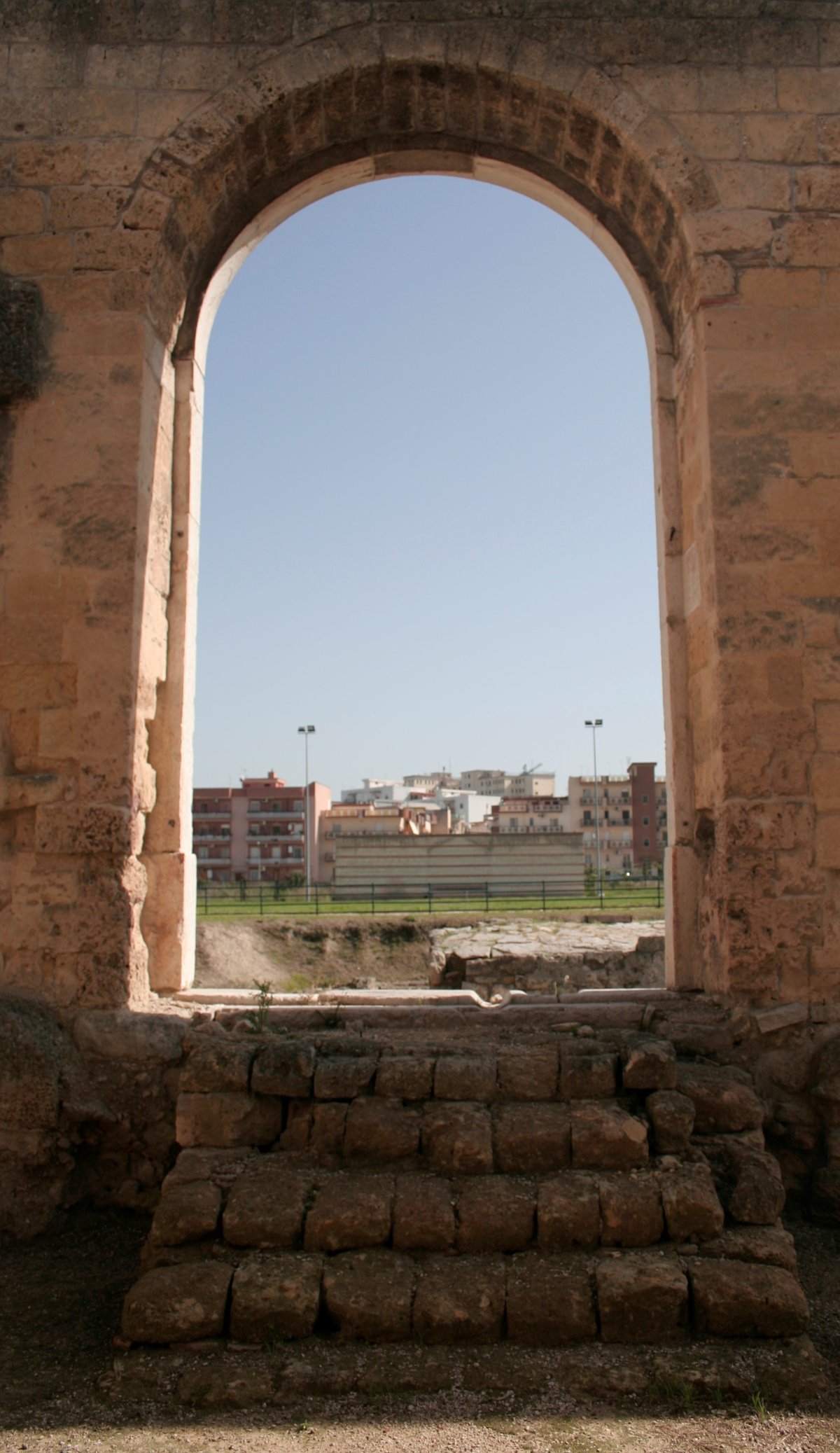

For a long time, scholars believed the original cathedral of Canosa di Puglia was located on the hill of San Pietro. This belief was based on an anonymous 9th-century biography of the bishop Sabino. However, recent archaeological research has identified San Pietro not as the episcopal seat, but as a large cemetery complex. Sabino intended to realize his own burial there, which later became an object of worship and pilgrimage.
The actual episcopal seat was located in a more central area near the church of Santa Maria. The sources attribute the construction of the baptistery of San Giovanni and a second church to Sabino. Archaeological findings, including the use of bricks stamped with his monogram, confirm his involvement in these structures. The complex includes a large three-aisled church preceded by a wide atrium and flanked by residential and funerary structures.
Further investigation into the area of Piano di San Giovanni revealed an intricate hydraulic system in the atrium. It is likely that a fountain or cistern was originally located here to collect rainwater, possibly for use in baptismal rites. During the Sabinian period, a significant renovation occurred, including a new mosaic floor and a staircase to bridge a one-meter height difference between the church of Santa Maria and the monumental baptistery.
In 2006, researchers identified a portion of the cathedral south of the atrium. This section includes the narthex and the central and southern aisles of a three-aisled church oriented to the west. While the earliest phase dates between the 4th and 5th centuries, the most notable additions belong to the Sabinian era. The atrium served as a connection between the existing ecclesial nucleus and the newly built baptistery.
Sources: Wikipedia, OpenStreetMap, Wikidata, Wikimedia Commons
Written by Nicolo Ciampini
Discuss this with the author and others
No comments yet. Be the first to start the conversation.