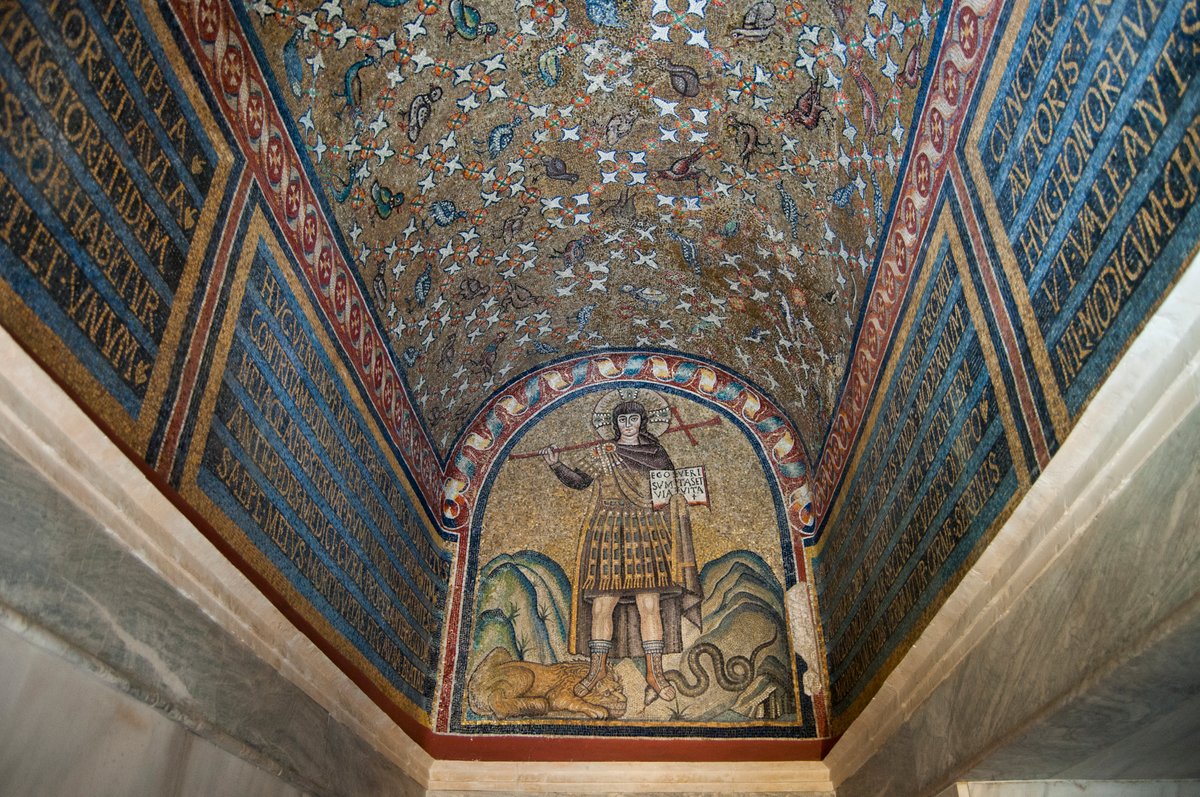

The Archbishop's Chapel, or Cappella Arcivescovile, is a chapel located on the first floor of the bishops' palace in Ravenna, Italy. It is the smallest of the city's famous mosaic sites and served as a private oratory of Trinitarian bishops dating from the turn of the 6th century. Although it is commonly attributed to St. Peter Chrysologus, the chapel was actually built by Peter II shortly after he became archbishop in 495. The mosaics date from the original construction or soon after.
The tiny cruciform chapel is currently dedicated to Saint Andrew, though the original dedication was to the Saviour. This is evidenced by a lunette over the vestibule door representing a beardless Christ treading on the beasts, dressed as a general or victorious Emperor. The lower parts of the walls are lined with marble slabs, while the rest of the interior used to be covered with rich, tapestry-like mosaics. Some parts of these survive, while others were substituted with tempera paintings by Luca Longhi in the 16th century.
The significance of this property lies in the fact that it is the only Early Christian private oratory that has survived to the present day. Its iconography is also important by virtue of its strongly anti-Arian symbolism. The vault still holds some of its original mosaics, while the lower walls remain covered in marble slabs. Today, it stands as a testament to the era's religious art and the architectural history of the bishops' palace.
Sources: Wikipedia, OpenStreetMap, Wikidata, Wikimedia Commons
Written by Nicolo Ciampini
Discuss this with the author and others
No comments yet. Be the first to start the conversation.