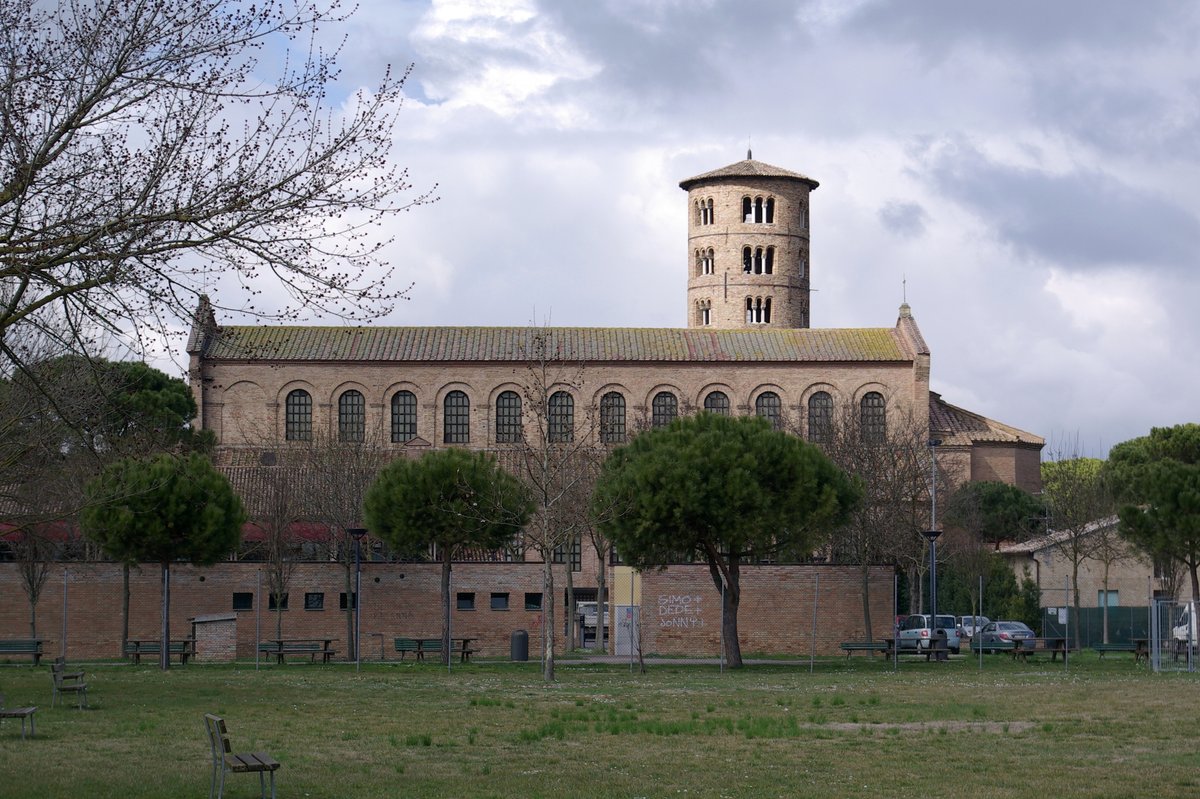

Work on the Basilica di Sant'Apollinare in Classe began in the early 6th century by order of Bishop Ursicinus. At that time, Classe was the ancient home port of the Roman fleet, located directly on the shore. Due to the accumulation of silt over centuries, the coastline has since moved 9 kilometres to the east, leaving the imposing brick structure inland. The church was consecrated on 9 May 549 by Bishop Maximian and dedicated to Saint Apollinaris, the first bishop of Ravenna and Classe.
The interior features a central nave with 24 columns of Greek marble. The carved capitals of these columns depict acanthus leaves that appear twisted as if being buffeted by the wind. While the lateral walls were once covered with gorgeous mosaics - likely demolished by the Venetians in 1449 - the mosaic decoration in the apse and on the triumphal arch remains. These 6th-century scenes depict Saint Apollinaris praying to God for grace, a subject closely linked to the fight against Arianism by restating the divine and human nature of Christ.
The basilica also contains faded 18th-century frescos depicting archbishops of Ravenna and various panels from the 7th century. One panel portrays Emperor Constantine IV granting privileges, while another shows Abraham, Abel, and Melchisedek at an altar. The walls are lined with numerous sarcophagi from the 5th to the 8th centuries, showing a transition from Roman human figures to Byzantine symbolism and increasing abstraction.
Sources: Wikipedia, OpenStreetMap, Wikidata, Wikimedia Commons
Written by Nicolo Ciampini
Discuss this with the author and others
No comments yet. Be the first to start the conversation.