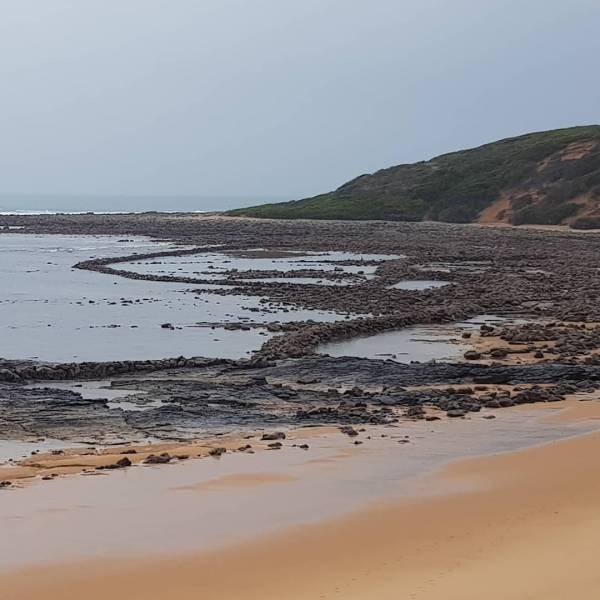

The Stilbaai Tidal Fish Traps, also known as the Noordkapperpunt Stone-Walled Fish Traps, are ancient intertidal stonewall fish traps located along the Western Cape coast of South Africa. Found in various spots from Gansbaai to Mosselbaai, there are several concentrations on the Hessequa coast between Gouritsmond and Witsand. These traps are located on the edge of the Skulpiesbaai Nature Reserve and the Stilbaai Marine Protected Area. In 2018, they were officially declared a National Heritage Site.
Constructed by ancient peoples possibly more than 2,000 years ago, the traps are designed to form pools in the intertidal zone. They operate on the principle of spring tides during a new moon, where fish swim over the walls to feed. As the water recedes, the fish are trapped in the enclosures, making it easy to remove them from the nearly dry traps. While some traps date back as far as 3,000 years ago, many of the existing structures were built during the last 300 years, with some as recent as the late 20th century.
The evolution of fishing in the region may date back to the Middle Stone Age, approximately 250,000 to 25,000 years ago. These man-made pools are built from boulders and pebbles across gullies. To be efficient, the walls must be packed solidly with a horizontal top to withstand the waves. Today, the traps remain functional relics of the past. Local farmers and interested people still use the traps to catch fish and perform the necessary repacking of the walls after each spring tide.
Sources: Wikipedia, OpenStreetMap, Wikidata, Wikimedia Commons
Written by Mutabor
Discuss this with the author and others
No comments yet. Be the first to start the conversation.