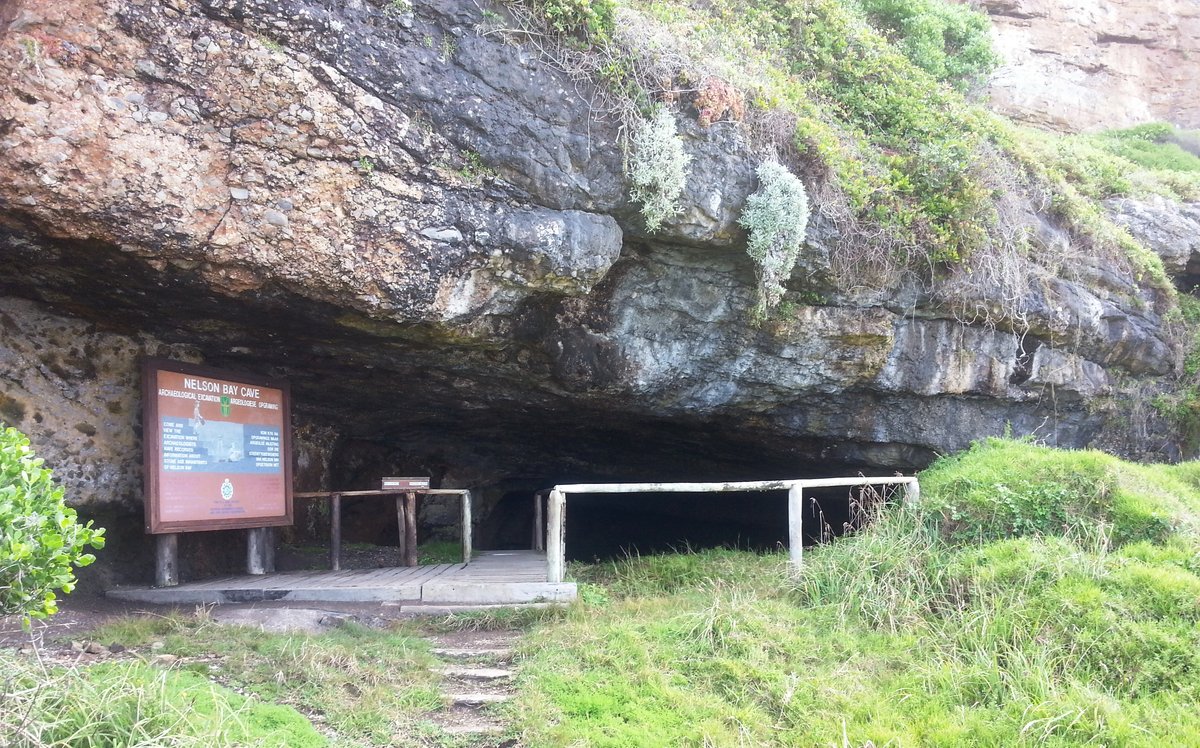

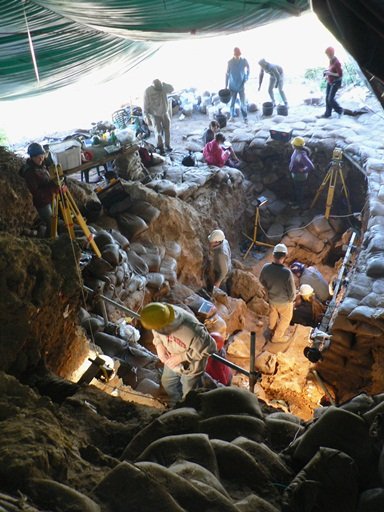
Nelson Bay Cave, previously known as Wagenaar's Cave, is a coastal archaeological site in the Robberg Nature Reserve on the Robberg Peninsula in Plettenberg Bay, South Africa. The cave is 18 meters wide and 35 meters deep, with a cave opening 21 meters above mean sea level. It was one of the first sites excavated in the southern Cape aimed at recording changes in terrestrial fauna caused by changes in climate and sea levels. As a type-site of the Robberg Later Stone Age Industry, the cave contains Stone Age artifacts that show the transition from Middle Stone Age (MSA) to Later Stone Age (LSA) technologies. The cave is geologically composed of sandstones and quartzites of the Cape Supergroup, and its geological conditions have allowed for the preservation of archaeological material.
The cave's location on the south-facing slope, in contact breccia between Silurian Table Mountain Group quartzite and Cretaceous Robberg Formation of the Uitenhage Group quartzitic sandstone, provides a record of environmental change. The stories hidden within its depths begin with the lower bed, which contains MSA deposits that occur in sterile gray loam and iron-rich sediments. Above the sterile layer is a layer that mainly contains materials from the Robberg Industry. The upper unit contains LSA artifacts, including marine mammals and shell middens dated to the Holocene.
The basal unit in the cave's stratigraphy consists of natural sediments including the basal loam (BL), pale brown loam (PBL), black loam I (BL I), black loam II (BL II), black loam III (BL III), rubble horizon, gray loam I (GL I), gray loam II (GL II), yellow stony loam (YSL), and brown stony loam (BSL). Following these natural sediments are sedimentary units mainly consisting of cultural material. These include the gray-brown shelly loam (GSL), crushed shell midden (CS), brown soil below midden Jake (BSJB), midden Jake (J), midden rice A and B (Ra and Rb), brown soil below middens Glen and Helgren (BSBH/G), midden Helgren and Glen (H/G), brown soil below middens Ivan and Betsy (BSBB/I), middens Ivan and Betsy (B/I), and grey ash above mitten Ivan (GAI). On top of GAI lies the pit fill, which has a mixture of debris and cultural material mixed with loamy sand.
Sources: Wikipedia, OpenStreetMap, Wikidata, Wikimedia Commons
Written by Mutabor
Discuss this with the author and others
No comments yet. Be the first to start the conversation.