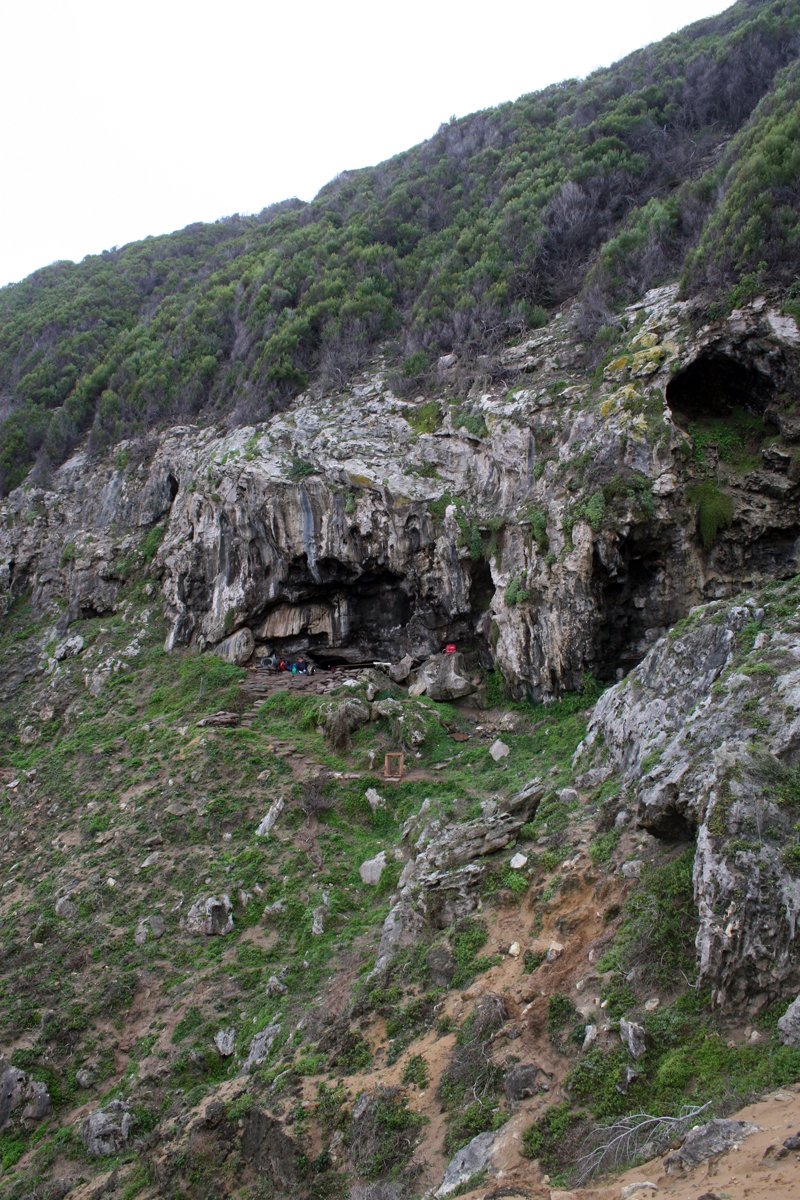

Blombos Cave is an archaeological site in the Blombos Private Nature Reserve, about 300 km east of Cape Town. The cave contains Middle Stone Age (MSA) deposits dated between 100,000 and 70,000 years Before Present (BP) and a Late Stone Age sequence dated between 2,000 and 300 years BP. The archaeological record from this site is central to the ongoing debate on the cognitive and cultural origins of early humans and the understanding of when and where key behavioural innovations emerged among Homo sapiens in southern Africa during the Late Pleistocene.
Material recovered from the MSA phase, such as engraved ochre, engraved bone ochre processing kits, marine shell beads, and refined bone and stone tools, represents greater ecological niche adaptation. These findings indicate a more diverse set of subsistence and procurement strategies, the adoption of multi-step technology, the manufacture of composite tools, stylistic elaboration, and increased economic and social organisation. The results have led to a paradigm shift in the understanding of the timing and location of the development of modern human behaviour.
One of the most significant findings is cross-hatching done in ochre on a stone fragment, which is believed to be the earliest known drawing done by a human in the world. The cave is situated in a south-facing cliff face 34.5 meters above sea level, approximately 100 meters from the present-day shoreline. The geological setting indicates that the cave was formed by wave action sometime during the Plio-Pleistocene.
Sources: Wikipedia, OpenStreetMap, Wikidata, Wikimedia Commons
Written by Mutabor
Discuss this with the author and others
No comments yet. Be the first to start the conversation.