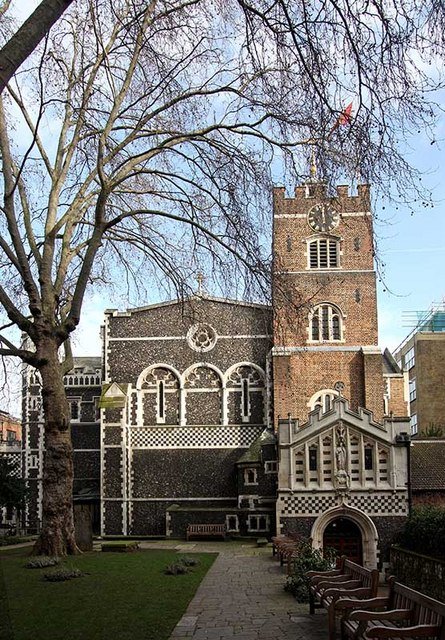

In 1123, Rahere had a vision that a winged beast came and transported him to a high place, relaying a message from the High Trinity and the court of Heaven that he was to erect a church in London's Smithfield. King Henry I gave him the land - which was technically royal property - and Rahere got to work using servants and child labourers to haul stones from across the city.
The church gained a reputation for curative powers, with many sick people filling its aisles, notably on 24 August (St Bartholomew's Day). Many miracles were attributed to occur within and without the walls of the building, including a light sent from heaven from its first foundation, and especially miraculous healings. The church also touches the history of the Peasants' Revolt; in 1381, accounts differ as to whether rebels dragged Wat Tyler's body into the church or to the nearby hospital after he was struck down by the Mayor of London.
It hasn't always been a place of quiet prayer. The north transept was used as a blacksmith's forge, and squatters even moved into the building during the 18th century. Even the American polymath Benjamin Franklin spent a year as a journeyman printer in the lady chapel in the early 1720s.
Today, it serves as an active Anglican parish. You can still see the Tudor gatehouse on West Smithfield, a late 16th-century addition built over a 13th-century stone archway. The church escaped the Great Fire of 1666, though it lost half of its nave to the demolition of the monasteries in 1543.
Sources: Wikipedia, OpenStreetMap, Wikidata, Wikimedia Commons


Written by Nicolo Ciampini
Discuss this with the author and others
No comments yet. Be the first to start the conversation.