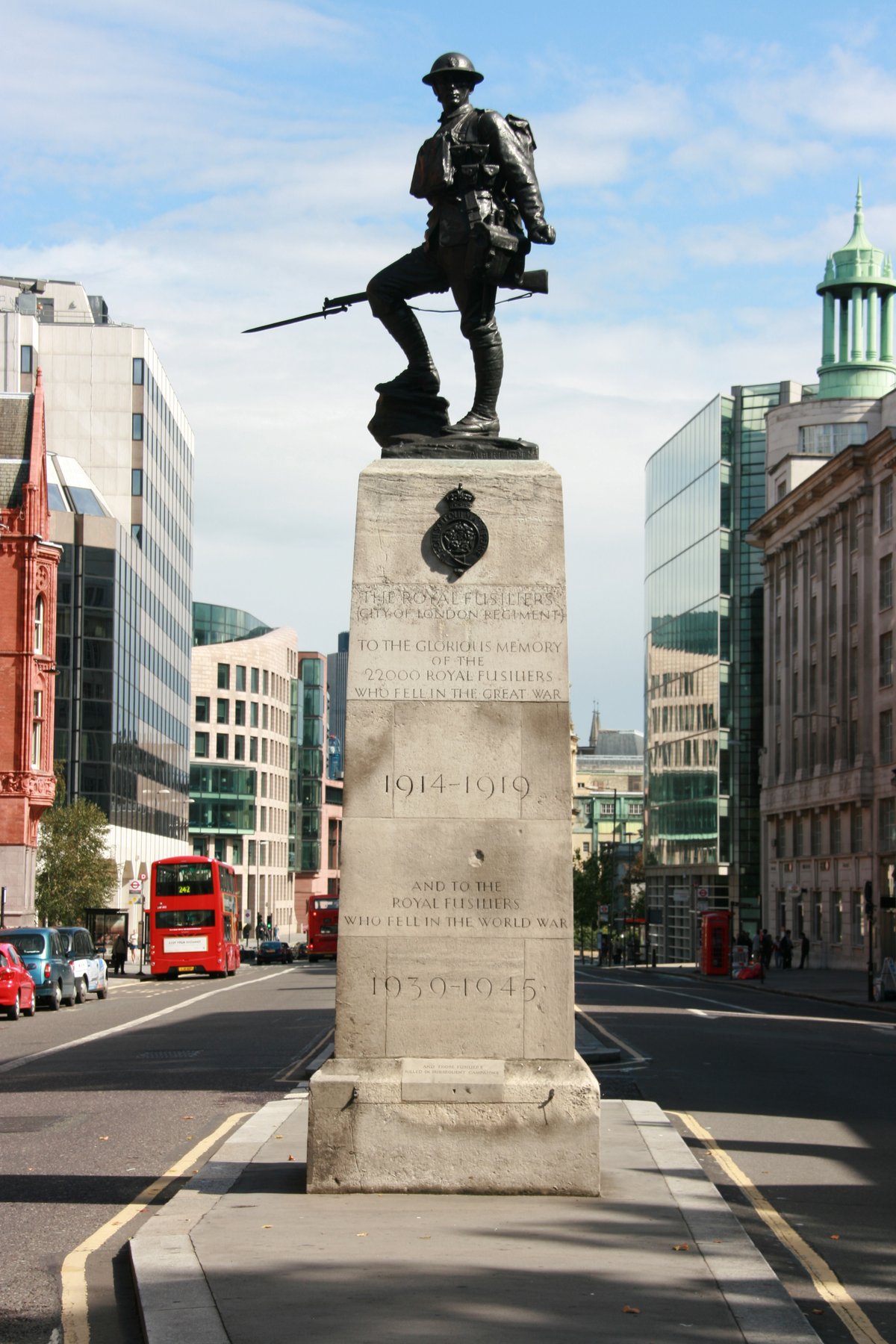

Why does this bronze soldier look so familiar? He stands on a 16.5-foot Portland stone pedestal, facing west to guard the historic entrance to the City of London. He is a private in service dress, rifle and fixed bayonet in hand, standing guard on the boundary with the London Borough of Camden.
It is the Royal Fusiliers War Memorial, unveiled in 1922. It was supposed to go in a Royal Park, then a barracks, before finally landing here at Holborn Bar. They raised the money via a subscription list in 1919, and the monument was unveiled by the Lord Mayor of London on November 4, 1922.
Look closely at the details. The statue was modeled on a real man, Sergeant Cox, who served through the entire First World War. But here is the bit that tickles: this exact same bronze figure was also unveiled in 1932 as part of a different memorial in Flers. It stood near the site where tanks were first used in battle in 1916.
Today, the memorial is Grade II* listed. It serves as a tally of the 22,000 men who fell in the Great War and the Russian Civil War. If you turn around to the east side, you can see a bronze plaque listing 47 regular, Territorial, service, reserve, special reserve, extra, garrison and labour battalions of the Royal Fusiliers.
Sources: Wikipedia, OpenStreetMap, Wikidata, Wikimedia Commons

Written by Nicolo Ciampini
Discuss this with the author and others
No comments yet. Be the first to start the conversation.