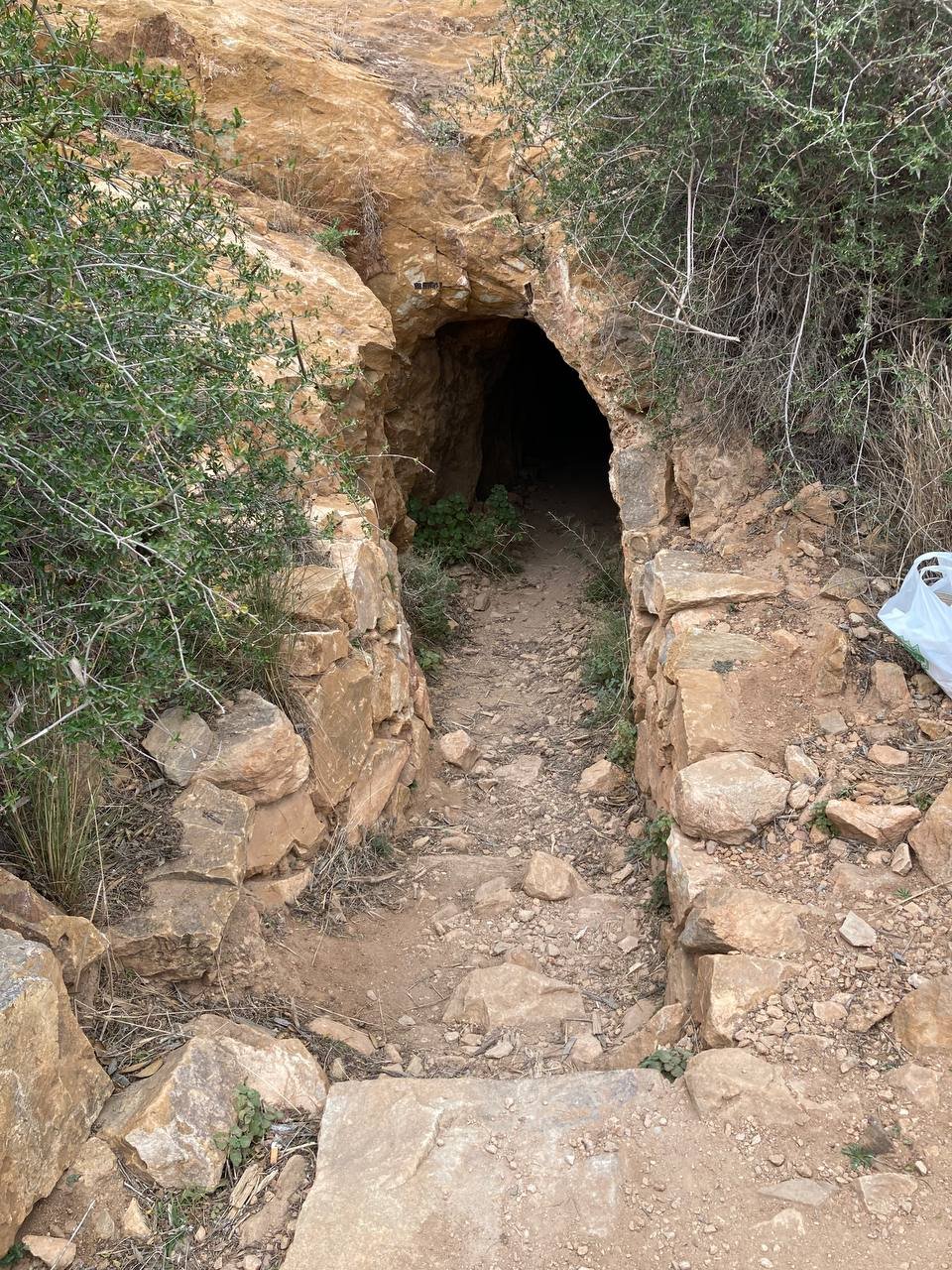

The Sima de las Palomas, or ‘Rock-Dove hole’, is a vertical shaft in a karst hill in the southeastern Spain’s Murcia region. It was inhabited for tens of thousands of years, but its most notable resident, a young Neanderthal woman, was buried there only a few thousand years ago. Cave excavations in the 1990s uncovered Neanderthal remains scattered throughout the hill, but it wasn't until 2006 that the shaft was opened and examined. Inside, archeologists found the remains of a Neanderthal woman, Palomas 96, and her child, Palomas 97.
The bodies were in a burial position, suggesting intentional interment, and Palomas 96’s body had elbows bent and hands touching her forehead. The bodies were in this position before rigor mortis had set in. Archeological investigation started in the 1990s when remains of an individual now called Palomas 1 were found in the rubble; someone had abseiled into the shaft and found a fossil in the sediment a few meters down. It turned out to be the jaws of a Neanderthal, still together, and an important enough find to warrant scientific investigation.
The researchers soon discovered that much of the shaft had been dug out and the remains dumped on the hillside. Excavation necessitated the building of scaffolding from the bottom of the shaft. Overhanging rock provides shelter and access to the Sima de las Palomas, which is located 123 meters above sea level. The cave overlooks Mar Menor, a saltwater lagoon in the Mediterranean. The shaft has a depth of 18 meters. The presence of nesting rock doves at the time of the investigation gave the shaft its name.
Excavations in the shaft in 2006-2007 found a skeleton of a young Neanderthal woman, possibly buried with her child. Between 1992 and 1999, rubble from the mine was investigated, and after 1994 the shaft itself was investigated. Excavations continue today, under the auspices of the Murcian Association for the Study of Palaeoanthropology and the Quaternary.
Sources: Wikipedia, OpenStreetMap, Wikidata, Wikimedia Commons
Written by Nik Frost
Discuss this with the author and others
No comments yet. Be the first to start the conversation.