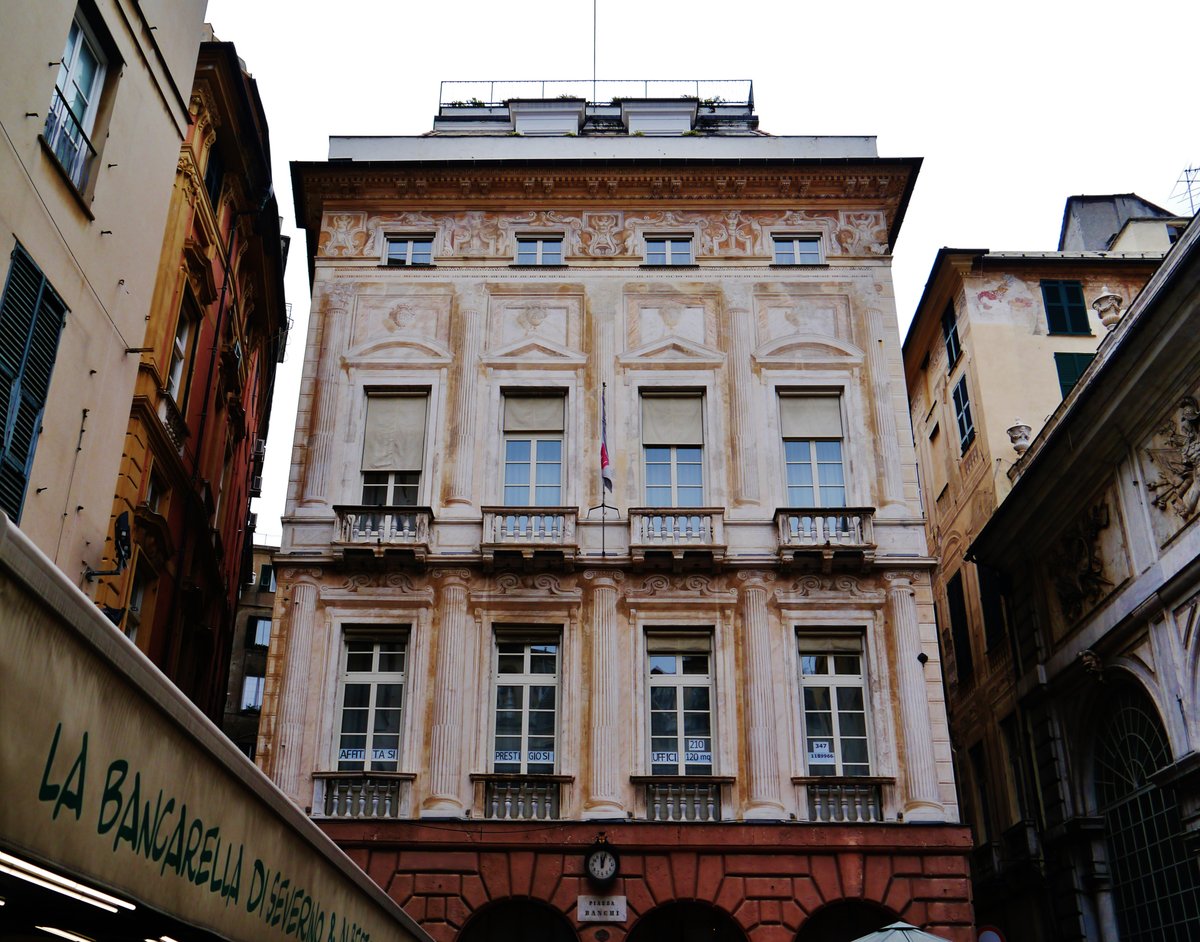

The Palazzo Ambrogio di Negro, located at Via San Luca 2 in the heart of Genoa, Italy, is a 16th-century Mannerist palace built by Ambrogio di Negro, a banker to the Spanish Crown. It was once the seat of the Edoardo Garrone Foundation and is now home to the organization's headquarters. The palace's façade on Via San Luca serves as the main entrance. The Loggia dei Mercanti and the Church of San Pietro in Banchi are also visible outside the palace.
Ambrogio di Negro, a member of the Accademia degli Addormentati, was a cultured man who loved art and design, and this is evident in the palace's interior, which preserves an important Mannerist painting cycle. The palace has two main facades, one on Piazza Banchi and the other on Via San Luca, where the entrance is. The most impressive feature of the palace is its vaulted staircase, which rises to the second floor, offering a glimpse into the inner courtyard with its loggia.
The portals in the great hall on the primo piano nobile, made from both white marble and black stone, are noteworthy. The main floor hosts the decorative cycle dating back to the late 16th century, with the large fresco of 'The Rape of Helen' in the main room surrounded by panels with episodes from the life of Paris. The two smaller rooms feature the cycles of Danae and her son Perseus, with Andra Semino's workshop believed to have created the frescoes.
Sources: Wikipedia, OpenStreetMap, Wikidata, Wikimedia Commons
Written by Nicolo Ciampini
Discuss this with the author and others
No comments yet. Be the first to start the conversation.