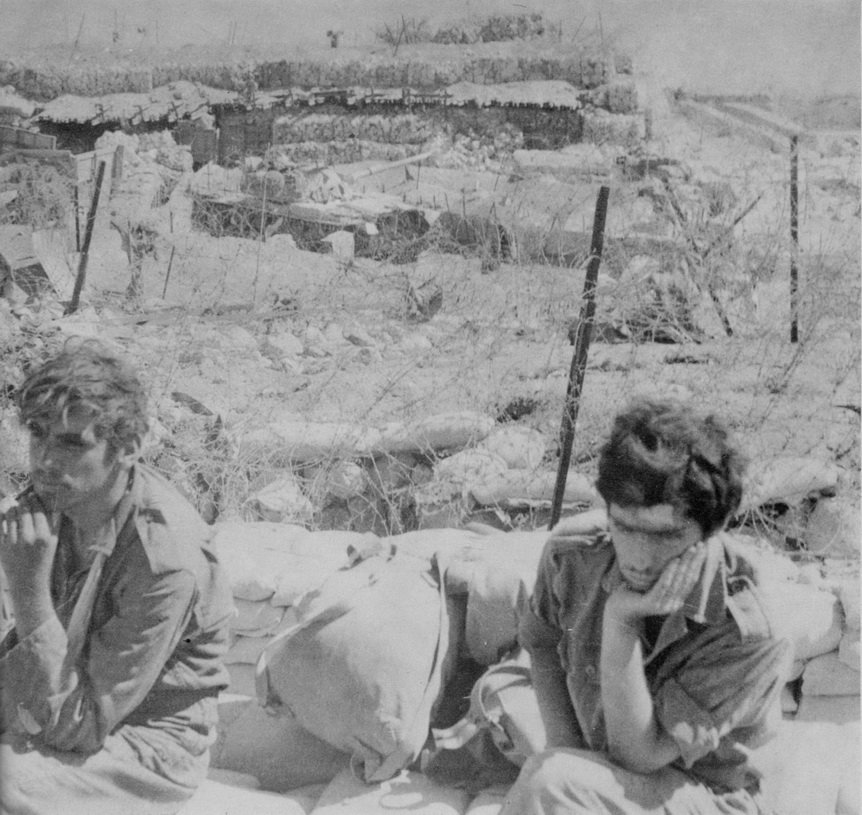

The Bar-Lev Line was a chain of fortifications built by Israel along the eastern bank of the Suez Canal shortly after the 1967 Arab–Israeli War. Designed to defend against major Egyptian assaults, the elaborate system of sand and concrete was expected to function as a graveyard for Egyptian troops. Costing around $300 million in 1973, the line was named after Israeli Chief of Staff Haim Bar-Lev. It was built at the Suez Canal, a unique water barrier that Moshe Dayan described as one of the best anti-tank ditches in the world.
The line incorporated a massive, continuous sand wall lining the entire canal, supported by a concrete wall. The sand wall varied in height from 20–25 metres (66–82 ft) and was inclined at an angle of 45–65 degrees. This structure prevented any armored or amphibious units from landing on the east bank of the Suez Canal without prior engineering preparations. Israeli planners estimated it would take at least 24 hours, and probably a full 48 hours, for the Egyptians to breach the sand wall and establish a bridge across the canal.
Despite these preparations, the line was overrun in less than two hours in 1973 during Egypt's Operation Badr. The Egyptian army used water cannons fashioned from dredging pumps to blast through the massive earthen ramparts, creating 81 breaches and removing three million cubic metres of packed dirt on the first day of the war.
Sources: Wikipedia, OpenStreetMap, Wikidata, Wikimedia Commons
Written by Mutabor
Discuss this with the author and others
No comments yet. Be the first to start the conversation.