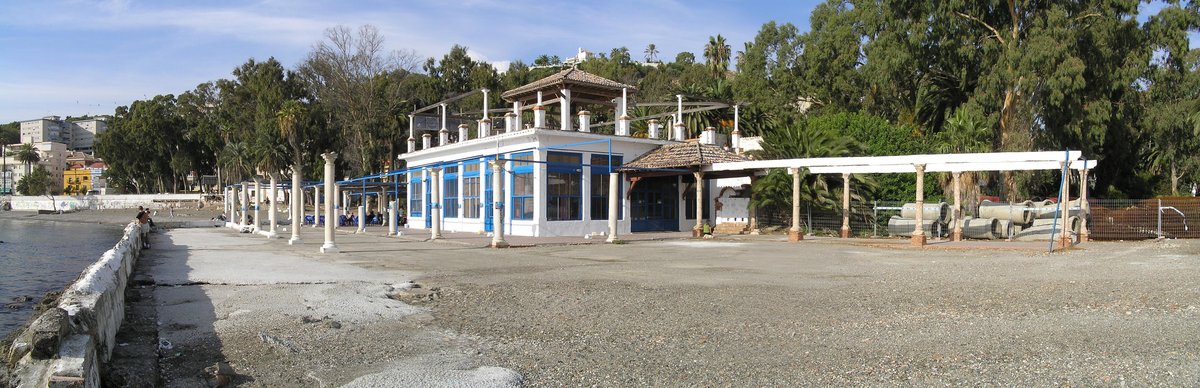

For the wealthy elite of early 1900s Málaga, the Baños del Carmen served as a premier leisure destination. When it opened in 1918, it broke local customs by allowing men and women to bathe together without the barriers used in other public baths. The site was built on the remains of Monte San Telmo, a location where a small port called Puerto de la Cantera once existed.
During the 19th century, Málaga experienced industrial and commercial growth, including infrastructure projects like the railway and port expansion. These works utilized stones from the San Telmo quarry. By the 1920s, the Baños del Carmen had expanded to include a restaurant, a movie screen, and a dance floor of over 2,000 square meters for concerts and classical ballet. It also hosted Málaga's first tennis tournament and its first soccer pitch, which was eventually flooded and replaced by La Rosaleda in 1941.
The balneario is considered a symbol of the city of Málaga. While a restoration plan by the Ministry of Environment and the Coastal Demarcation remains pending, the area continues to be a point of interest. Today, the site features a beach that is a meeting place for alternative movements, a terrace bar, two active tennis courts, and a restaurant where flamenco groups occasionally perform.
Sources: Wikipedia, OpenStreetMap, Wikidata, Wikimedia Commons

Written by Nicolo Ciampini
Discuss this with the author and others
No comments yet. Be the first to start the conversation.