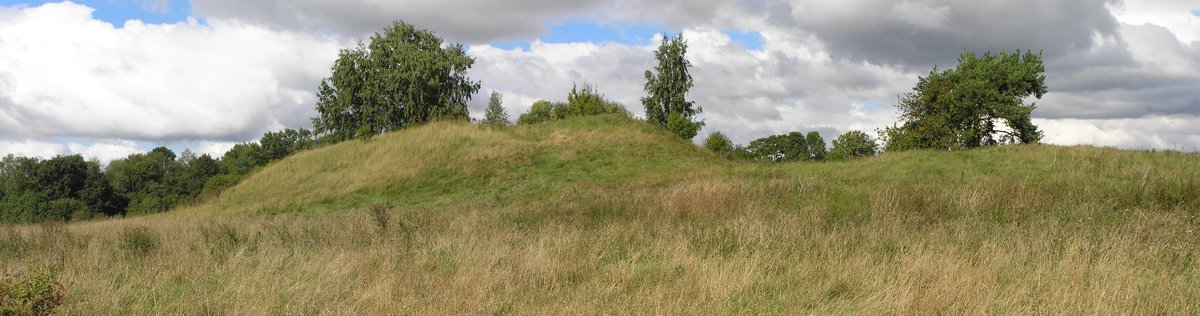

The Kereliai hillfort, situated between Kereli village and Kupis river's left bank, dates back to the Iron Age, between the 1st century BC and the 2nd century AD. This quadrilateral archaeological site, marked by a ditch on the north-western side, spans 30x19 meters. On the Northern slope, a 1.2-hectare plateau yields excavated remains, hosting broken pottery, two burials. In 1955, a wooden structure was found in the hill, while Vytautas Daugudis unearthed a 4x1 square meter surface in 1984, revealing a cultural layer 45–70 cm deep.
From 1984 to 1985, Elena Grigalaviciene excavated the entire hillfort surface – a total of 568 square meters, reaching 2 meters cultural layer. This excavation unveiled three layers. The upper layer, paved with 2 meter thick slabs and 0.5 meter high walls, bore a 30 cm high stone column, which was likely part of a wooden structure. On the site, fragments of flint, slag, charcoal, bones, arrowheads, spearheads, knives, pyrites, pottery, animal bones, and other artifacts were found.
Sources: Wikipedia, OpenStreetMap, Wikidata, Wikimedia Commons
Written by Nicolo Ciampini
Discuss this with the author and others
No comments yet. Be the first to start the conversation.